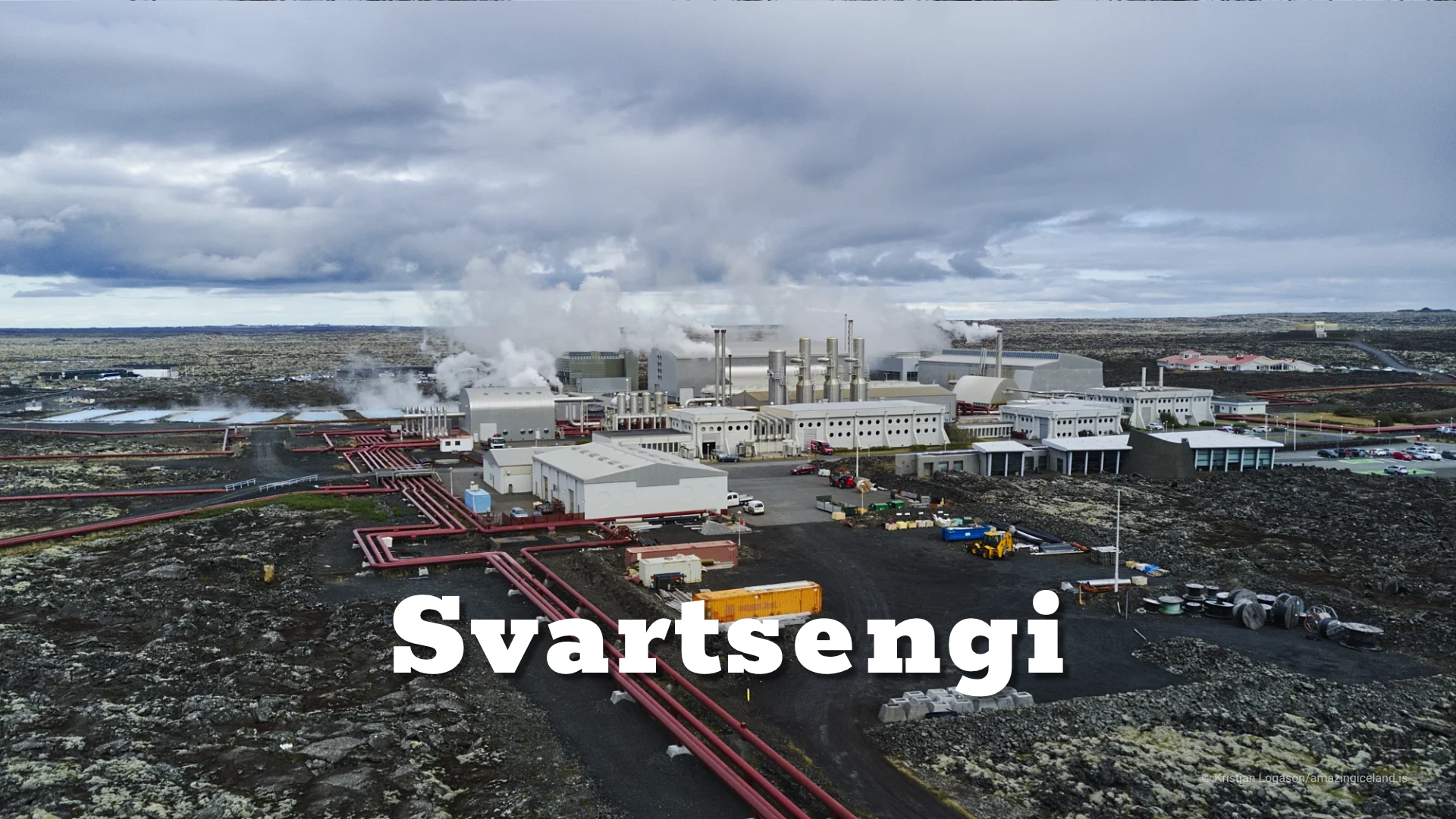
Svartsengi geothermal power plant in Reykjanes
Svartsengi is one of the most important geothermal power stations in Iceland and one of the clearest places to understand how the country uses geothermal energy on an industrial scale. The plant lies about four kilometres north of Grindavík, within the Svartsengi geothermal field beneath and beside Mount Þorbjörn.
Drilling began here in the early 1970s. Hot-water production started in **1976**, supplying district heating to nearby communities, and electricity generation followed in **1978**. Svartsengi became Iceland’s first geothermal power station to combine electricity generation with large-scale production of hot water for domestic heating.
Its development also produced one of the most unexpected consequences in Icelandic tourism. Geothermal water discharged onto the surrounding lava gradually formed the reservoir that became the **Blue Lagoon**.
Since **December 2023**, Svartsengi has entered another chapter. The power station now operates beside the active Sundhnúkur volcanic system, protected by defensive embankments and managed through repeated periods of seismic unrest and volcanic activity. A place originally built to extract energy from Iceland’s geology is now also being defended from it.
The location of Svartsengi geothermal power plant in Reykjanes
Latitude
63.8860
Longitude
-22.4154
Svartsengi geothermal power plant in Reykjanes
Iceland’s first combined geothermal plant
Exploration of the Svartsengi geothermal field began in 1971, when drilling started to determine whether the high-temperature system could be used for district heating and electricity generation.
The first major step came in 1976, when geothermal heat from Svartsengi began supplying hot water to nearby communities. Houses in Grindavík received district heating from the field that November, marking the beginning of a system that would become increasingly important across the Reykjanes region.
Electricity generation followed in 1978, initially on a much smaller scale than today. Svartsengi was then expanded gradually rather than constructed as one complete power station from the beginning.
Additional production units were added over several decades as demand increased and geothermal technology improved. Expansion continued through the 1980s, 1990s and 2000s, with major additions in 1999 and 2008.
The latest major development is Power Plant 7, formally commissioned in 2025 as part of a broader modernisation of the Svartsengi system. It replaced older production units and increased both the efficiency and reliability of electricity and hot-water generation.
Today Svartsengi remains one of the central energy facilities serving the Reykjanes region.
How Svartsengi uses geothermal energy
The geothermal system beneath Svartsengi contains extremely hot water and steam circulating through fractured volcanic rock. Production wells bring that geothermal fluid to the surface, where its energy can be separated and used.
Steam is used to generate electricity, while heat from the geothermal fluid is transferred through heat exchangers to fresh water. That heated fresh water can then be distributed through the district-heating network.
This distinction matters because the water circulating deep underground is not normally pumped directly into people’s homes. Its heat is transferred to cleaner water that becomes part of the public heating system.
Svartsengi therefore produces two useful forms of energy from the same geothermal resource: electricity and hot water for heating. That combined production was one of the reasons the plant became so important in the development of geothermal energy in Iceland.
The modern station uses a much larger system of production wells and technical infrastructure than the original plant. What began as an experimental geothermal project in the 1970s has developed into a critical part of the energy system of the Reykjanes Peninsula.

The accidental creation of the Blue Lagoon
One of the most famous consequences of Svartsengi was never part of the original plan. After geothermal fluid had passed through the power-production process, silica-rich water was discharged onto the surrounding lava field.
The assumption was that the water would simply disappear through the porous volcanic rock. Instead, something unexpected happened.
As the geothermal water cooled, silica precipitated from it and gradually sealed pores and cracks in the lava. The ground became less permeable, and water that had originally been expected to drain away began collecting on the surface.
A pale blue lagoon slowly formed beside the power station. This was the beginning of the Blue Lagoon.
The distinctive water contains silica, minerals and algae, while suspended silica is largely responsible for its milky blue appearance. What later became one of Iceland’s best-known visitor attractions therefore began as an unintended by-product of geothermal energy production.
The power station and the Blue Lagoon are not two unrelated places sitting beside one another. They are parts of the same geothermal story, and the existence of one directly explains the origin of the other.
Svartsengi and the new volcanic era
Since December 2023, Svartsengi has become closely associated with the renewed volcanic activity on the Reykjanes Peninsula. Magma intrusions and eruptions along the Sundhnúkur crater row have repeatedly affected the area between Svartsengi and Grindavík.
The power station is critical infrastructure, supplying hot water and electricity to communities across Reykjanes. Protecting it therefore became an important part of the response to the eruptions.
Protective earth embankments were constructed around parts of the Svartsengi area to help divert possible lava flows away from essential infrastructure. During periods of intense volcanic activity, staff have at times evacuated the site and operated parts of the system remotely from Reykjanesvirkjun.
Despite repeated eruptions nearby, Svartsengi has continued operating. That has changed the meaning of the place considerably.
Svartsengi is no longer only an example of Icelandic geothermal engineering. It is also a working demonstration of how critical infrastructure can be maintained inside an actively changing volcanic landscape.
The power station, defensive barriers, fresh lava and Mount Þorbjörn now form a landscape very different from the one that existed here only a few years ago.
Visiting Svartsengi
Svartsengi lies about four kilometres north of Grindavík and can be approached through the public road system when access to the area is open.
This is an operating industrial facility rather than a conventional visitor attraction. A visit is therefore mainly about seeing the power station within its landscape rather than touring the machinery itself.
The relationship between industry and geology is what makes the site interesting. Steam rises from the plant against Mount Þorbjörn, while lava fields, defensive barriers and recent volcanic activity surround infrastructure that has been operating here for almost half a century.
Because conditions on Reykjanes can change, access to roads around Svartsengi may sometimes be affected. During periods of renewed seismic or volcanic activity, current road information and Civil Protection instructions should take priority over any fixed description of access.
Mount Þorbjörn remains the dominant landmark beside the plant. Together with the steam, lava and industrial structures, it gives Svartsengi a character unlike any other geothermal power station in Iceland.
Interesting facts:
- Exploration drilling at Svartsengi began in 1971.
- Hot-water production started in 1976.
- Electricity generation began in 1978.
- Svartsengi became Iceland’s first geothermal plant to combine electricity generation with large-scale district heating.
- Power Plant 7 was commissioned in 2025.
- The original Blue Lagoon formed when silica-rich geothermal water from the plant accumulated on the surrounding lava.
- Silica gradually sealed the porous lava and prevented the water from draining away.
- Svartsengi is operated by HS Orka.
- Since December 2023, the plant has operated beside the active Sundhnúkur volcanic system.
- Protective embankments have been built around the area to help defend important infrastructure from lava flows.
Image Gallery


Photography tips:
- Use wide compositions to show the relationship between the power station, Mount Þorbjörn, surrounding lava and industrial steam. The site works best when industry and geology are allowed to share the frame.
- Steam is one of the strongest visual elements, particularly in cold weather or low light when it becomes more clearly defined against the landscape.
- Dusk can work particularly well because artificial lighting begins to appear while enough detail remains in the lava fields and surrounding slopes.
- Include defensive embankments and newer lava where possible. These features now explain Svartsengi far better than older photographs showing only the original power station.
- Longer focal lengths can compress the relationship between the plant and Mount Þorbjörn, while wider lenses are better for showing how much volcanic landscape surrounds the infrastructure.
- Overcast weather often suits the site because steam remains visible without harsh contrast, while darker skies can emphasise the industrial character of the scene.
- New photography is especially important at Svartsengi because the landscape has changed significantly since the recent volcanic activity began.
- The strongest photographic idea is now the contrast between essential infrastructure and an actively changing volcanic landscape.
Destinations nearby