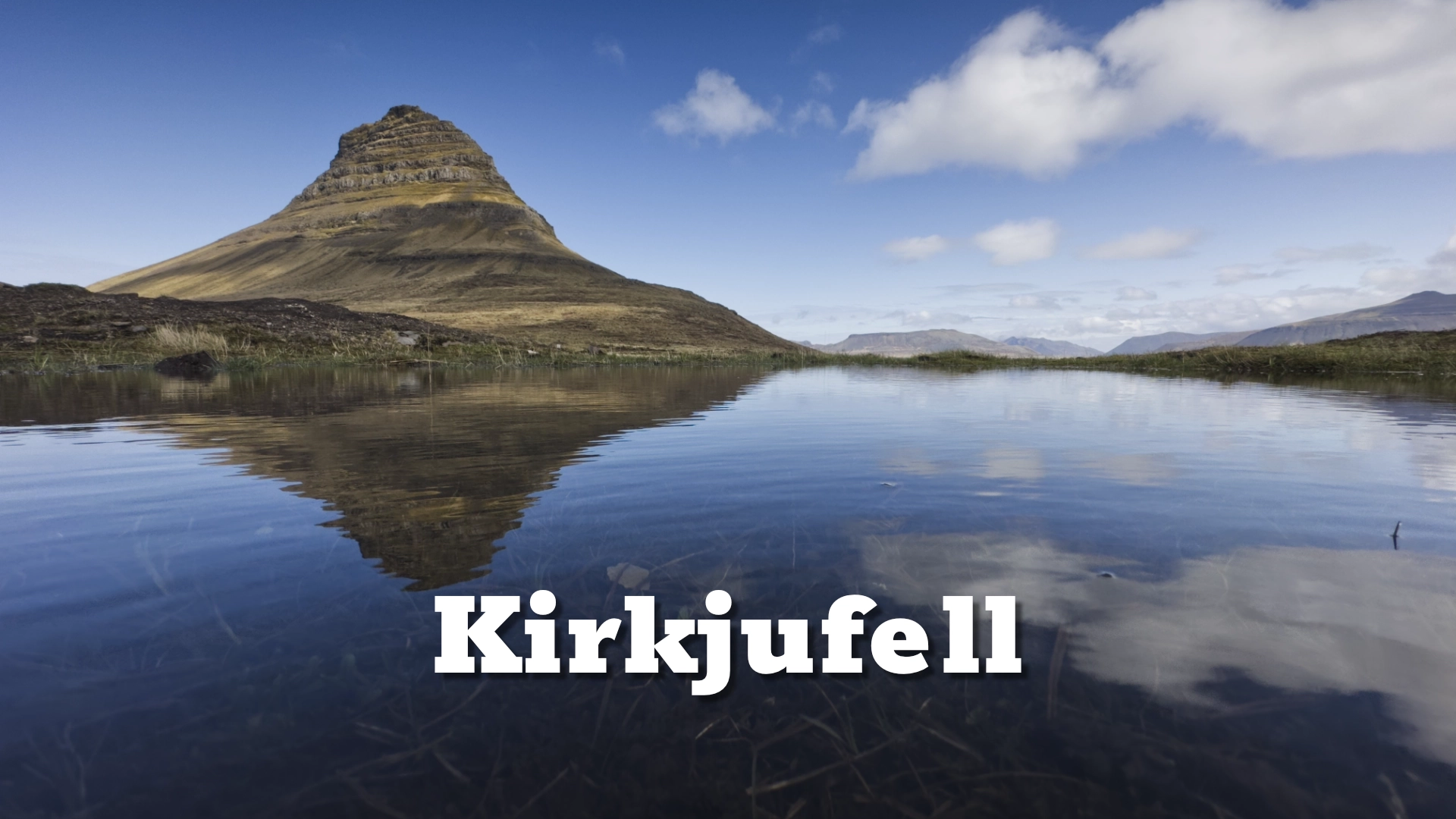
Kirkjufell or Arrowhead mountain in Snæfellsnes peninsula
Kirkjufell rises beside **Grundarfjörður** on the north coast of the Snæfellsnes Peninsula. At **463 metres**, it is not especially high by Icelandic standards, but height is not what gives the mountain its importance.
Its distinctive form comes from the way glaciers reshaped the landscape around it. Ice moved through the valleys on either side and gradually removed surrounding rock, leaving Kirkjufell standing as an isolated, steep-sided mountain.
Its appearance changes dramatically with viewpoint. From some directions it looks almost conical, while from others it stretches into a longer ridge. Together with nearby **Kirkjufellsfoss**, it has become one of the most recognisable and photographed landscapes in Iceland.
The location of Kirkjufell or Arrowhead mountain in Snæfellsnes peninsula
Latitude
64.9419
Longitude
-23.3069
Kirkjufell or Arrowhead mountain in Snæfellsnes peninsula
A mountain shaped by glaciers
Kirkjufell is one of the clearest examples around Grundarfjörður of how glaciers transformed the landscape during the Ice Age. Large glaciers moved through the valleys on either side of the mountain and gradually eroded the surrounding rock.
Kirkjufell remained standing between them. That process isolated the mountain and produced much of the steep profile seen today.
The shape therefore comes primarily from large-scale glacial erosion rather than from any single volcanic event or unusual internal rock structure. Some explanations repeated online have suggested that contracting basalt columns or drifting icebergs somehow carved the mountain into its present form, but those descriptions do not fit the actual geomorphology.
The more straightforward explanation is also the more interesting one. Kirkjufell is the remnant of a landscape that glaciers removed around it.
Kirkjufell, Firðafjall, Sugarloaf and Arrowhead
The mountain has carried several names, each belonging to a different period or way of seeing it. Today it is known as Kirkjufell, meaning “Church Mountain.”
Older Icelandic sources also used the name Firðafjall. Danish sailors called it Sukkertoppen, or “Sugarloaf,” a reference to the steep conical blocks in which refined sugar was once sold.
A much newer name came through television. In Game of Thrones, Kirkjufell became “Arrowhead Mountain.”
That name was never part of the traditional Icelandic naming of the mountain. It entered popular use after the series and belongs to Kirkjufell’s modern international identity rather than to its older local history.
The different names are useful because they show how the same mountain has repeatedly been reinterpreted: first as part of the local geography, then as a maritime landmark, and later as a globally recognisable television location.

Kirkjufellsfoss and the classic view
For most visitors, Kirkjufell and Kirkjufellsfoss function as one destination. The waterfall is small, but its position in front of the mountain creates the composition that made Kirkjufell internationally recognisable.
Parking is charged at the site, and the area around the waterfall has been improved in recent years with better paths, stairs and three viewing platforms. These changes help manage the large number of visitors and provide safer places from which to see and photograph the falls.
Crowding varies considerably with the time of day. At the busiest times, the classic viewpoints can be full, while at quieter hours the same place can feel completely different.
There is no need to pretend Kirkjufell is an undiscovered location. Its popularity is now part of the destination, and the challenge is not to avoid the famous view entirely but to understand why it works and then decide whether to photograph it in the familiar way or find another interpretation.
The summit
A route leads to the top of Kirkjufell, but this is not a normal mountain walk. The terrain is steep, rocky and frequently slippery, with difficult rock bands and serious exposure.
There have been several severe accidents and fatalities on the mountain. Current guidance describes the route as very demanding and dangerous and recommends it only for experienced mountain hikers with appropriate safety equipment and local guidance.
Climbing Kirkjufell is prohibited during winter.
For anyone visiting simply to see or photograph the mountain, there is no need to climb it. The strongest and most recognisable views are all from the surrounding low ground, where the full form of Kirkjufell can actually be understood much better.
Kirkjufell on screen
Kirkjufell reached a much larger international audience through Game of Thrones, where it appeared as “Arrowhead Mountain” north of the Wall. The series transformed an already distinctive local landmark into one of the most recognisable Icelandic landscapes associated with television.
The mountain also appears in The Secret Life of Walter Mitty. When Walter arrives by boat at Grundarfjörður, Kirkjufell can be seen in the background.
An older claim that Kirkjufell appeared in the James Bond film Die Another Day was incorrect. Those Icelandic scenes were filmed elsewhere, in the east of the country.
The screen history adds another layer to a mountain that was already visually distinctive long before it became internationally famous.
Interesting facts:
- Kirkjufell rises 463 metres above the Grundarfjörður area.
- Its shape was created mainly by glacial erosion during the Ice Age.
- Older Icelandic sources also called it Firðafjall.
- Danish sailors used the name Sukkertoppen, or “Sugarloaf.”
- “Arrowhead Mountain” came from Game of Thrones.
- Kirkjufellsfoss and Kirkjufell are best understood as one visitor stop.
- The waterfall area now includes improved paths, stairs and three viewing platforms.
- Parking is charged at Kirkjufellsfoss.
- The summit route is steep, rocky and slippery.
- Winter climbing is prohibited.
- Kirkjufell appears in both Game of Thrones and The Secret Life of Walter Mitty.
Image Gallery


Photography tips:
- The classic composition uses Kirkjufellsfoss as foreground with the mountain behind it. It is famous for a reason and is still worth making.
- The new viewing platforms define where many visitors now stand, so be prepared to work around both people and infrastructure at busy times.
- Do not reduce Kirkjufell to one viewpoint. The mountain changes shape dramatically as you move around Grundarfjörður and the surrounding coast.
- Reflections in pools, shoreline views, wider compositions across the fjord and roadside perspectives can all produce very different interpretations of the same mountain.
- Summer evenings can work especially well from the Grundarfjörður side when low-angle light reaches the mountain and reveals more structure in the slopes.
- For northern lights, Kirkjufell is useful during the dark nights from August through April, when the mountain provides a recognisable foreground beneath a northern sky.
- The mountain has no special auroral property; the photographic strength comes from combining a distinctive foreground with a clear view of the sky.
- Longer focal lengths can simplify the mountain and compress background relationships, while wider lenses are more useful when working with Kirkjufellsfoss or shoreline foregrounds.
- If the classic waterfall viewpoint is crowded, moving away from it often produces a more individual photograph and a better understanding of the mountain itself.
Destinations nearby