Svalþúfa and Þúfubjarg in Snæfellsnes peninsula
At the tip of Snæfellsnes, just east of Lóndrangar, **Svalþúfa and Þúfubjarg** form two parts of the same móberg headland. Svalþúfa is the high ground above the sea, while Þúfubjarg is the steep cliff face dropping from it towards the Atlantic.
A parking area and marked path lead to a viewing platform with a barrier, where the cliff, seabird colonies and Lóndrangar can all be seen within the same landscape. The site works equally well as a short viewpoint stop or as the beginning of a coastal walk towards Lóndrangar and Malarrif.
The geology and birdlife would be enough to make Svalþúfa worthwhile, but the headland also carries one of the best-known stories from western Snæfellsnes. According to tradition, this is where **Kolbeinn Jöklaskáld** met **Kölski, the Devil**, and defeated him not with strength or weapons, but with verse.
The location of Svalþúfa and Þúfubjarg in Snæfellsnes peninsula
Latitude
64.735116
Longitude
-23.774461
Svalþúfa and Þúfubjarg in Snæfellsnes peninsula
Svalþúfa above, Þúfubjarg below
Svalþúfa and Þúfubjarg form a large móberg headland on the exposed coast of Snæfellsjökull National Park. The distinction between the two names is straightforward: Svalþúfa is the high ground above the sea, while Þúfubjarg is the cliff face below it.
From the viewing platform, the coast opens directly towards the North Atlantic and the dark towers of Lóndrangar rise nearby. This is one of the best places to understand the sea stacks in relation to the surrounding headland rather than seeing them only as isolated volcanic formations.
The shape of the coast is important here. Grassy upper ground gives way abruptly to dark cliffs, offshore rock and open sea, creating a strong contrast between the relatively gentle surface of Svalþúfa and the much more severe landscape below.
The marked trail continues from the viewpoint towards Lóndrangar and farther on to Malarrif, so the headland also works as an introduction to a longer section of the protected coastline.
A bird cliff
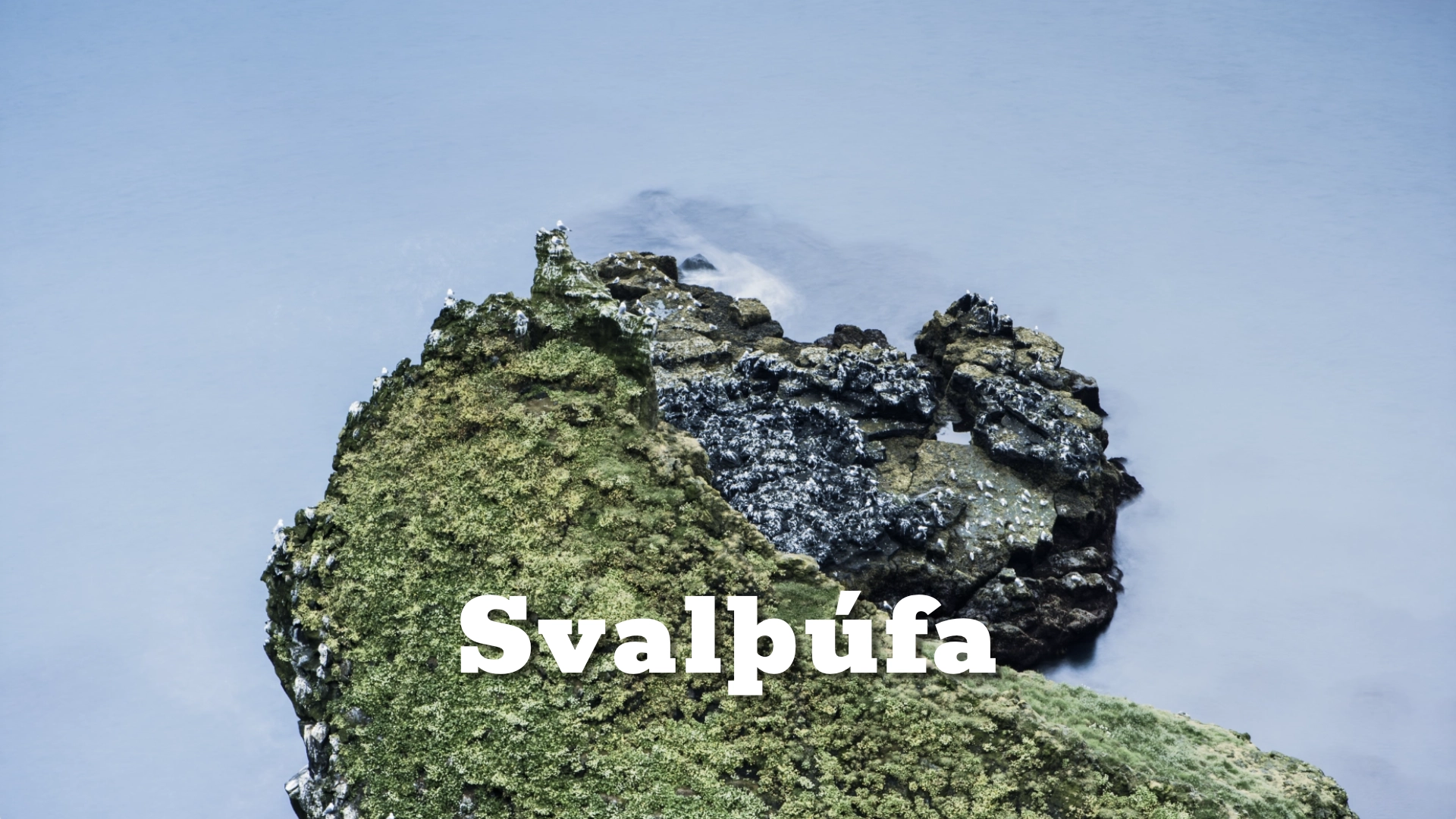
Þúfubjarg is an important seabird cliff, and during the breeding season the ledges below the viewpoint become crowded with birds. Puffins, guillemots and kittiwakes are among the species associated with this coast, together with other seabirds using the cliffs and surrounding waters.
The number and activity of birds change considerably with the season. During spring and summer the cliff can be filled with movement and sound, while outside the breeding period the same rock face may appear much quieter.
The best way to experience the birdlife is from the established viewing area. A long lens or binoculars makes it possible to watch activity on the cliff without approaching the nesting ledges or leaving the path.
The bird colony also changes the character of Svalþúfa as a destination. In summer, the headland is not simply a geological viewpoint; it becomes part of an active coastal ecosystem stretching from the cliffs to the sea below.

Kolbeinn Jöklaskáld and the Devil
Local tradition places one of the best-known supernatural contests on Snæfellsnes here at Svalþúfa. The poet was Kolbeinn Jöklaskáld, Kolbeinn the Glacier Poet, and his opponent was Kölski, one of the Icelandic names for the Devil.
According to the story, Kolbeinn was tending sheep near Svalþúfa when the Devil approached him. Knowing Kolbeinn’s reputation as a poet, Kölski challenged him to a contest in verse, with Kolbeinn’s soul at stake if he lost.
The two began exchanging verses, each expected to answer the other with equal or greater skill. The Devil tried to overwhelm Kolbeinn with increasingly difficult constructions, dark imagery and wordplay, but Kolbeinn continued to answer him.
The contest went on until Kölski produced what he believed would be the verse Kolbeinn could not match. Kolbeinn answered again, and this time the Devil could find no reply.
Kolbeinn had beaten him at his own challenge and kept his soul.
The story survives because it belongs so naturally to this landscape. A visitor can stand on the same headland where tradition places the contest and look across the same cliffs, sea and open ground that became part of the tale.
Why the verses are not translated
The rhyme duel survives in Icelandic tradition, but the verses themselves do not transfer cleanly into English. Their effect depends on rhyme, sound, word choice and Icelandic wordplay, all of which are difficult to preserve together.
A literal translation would keep the meaning of the words but lose much of the contest. Rewriting the verses to rhyme in English would preserve something of the form, but the result would no longer be the same poetry.
For that reason, the story can be told in English while the verses themselves are better left in Icelandic. That is not a gap that needs to be filled with invented or overworked translation.
The limitation is part of the nature of oral and poetic tradition. Some stories can travel easily between languages, while others depend so strongly on sound and linguistic structure that part of them necessarily remains tied to the original.
Walking from Svalþúfa
Svalþúfa is also the natural starting point for walking towards Lóndrangar. From the parking area, a marked trail leads from the viewpoint down through the coastal landscape towards the sea stacks.
The out-and-back section towards Lóndrangar is roughly 1 kilometre, making it easy to combine with a short visit to the viewpoint.
Continuing farther, the marked route from Svalþúfa past Lóndrangar to Malarrif is about 2.6 kilometres and is considered an easy walk in normal conditions.
The strength of the route is not simply that it connects several named destinations. It allows the character of the coastline to unfold gradually, with bird cliffs, móberg formations, lava, sea stacks and open Atlantic views changing as the path continues.
Svalþúfa can therefore be visited quickly, but it becomes more rewarding when treated as the beginning of a larger coastal landscape rather than an isolated viewpoint.
Interesting facts:
- Svalþúfa is the high ground; Þúfubjarg is the sea-facing cliff below it.
- Both form part of one large móberg headland.
- Lóndrangar can be seen clearly from the viewing platform.
- Thousands of seabirds nest in Þúfubjarg during spring.
- Local tradition places a rhyme duel between Kolbeinn Jöklaskáld and Kölski, the Devil, at Svalþúfa.
- The Icelandic verses from the tradition are not translated here because their rhyme and wordplay do not survive properly in English.
- A marked trail leads from Svalþúfa towards Lóndrangar and on to Malarrif.
- The full Svalþúfa–Lóndrangar–Malarrif route is about 2.6 km.
Image Gallery


Photography tips:
- A longer focal length can compress the distance between the viewpoint, cliff and Lóndrangar, while wider lenses work better when the intention is to show the scale of the coastline.
- For the bird cliff, use a long lens and work from the established viewing area. This gives access to nesting activity without approaching the ledges or disturbing the birds.
- The contrast between grassy upper ground, dark móberg cliffs and the Atlantic works particularly well in directional or broken light.
- Overcast weather can also suit the site, especially when the aim is to hold detail in both the cliffs and the sea without excessive contrast.
- Strong wind is common on the exposed headland, so camera stability matters. Keep equipment simple and secure rather than carrying unnecessary gear onto the viewpoint.
- If walking towards Lóndrangar, look back as well as forward. Some of the strongest compositions come from the changing relationship between the headland, trail and coast behind you.
Destinations nearby