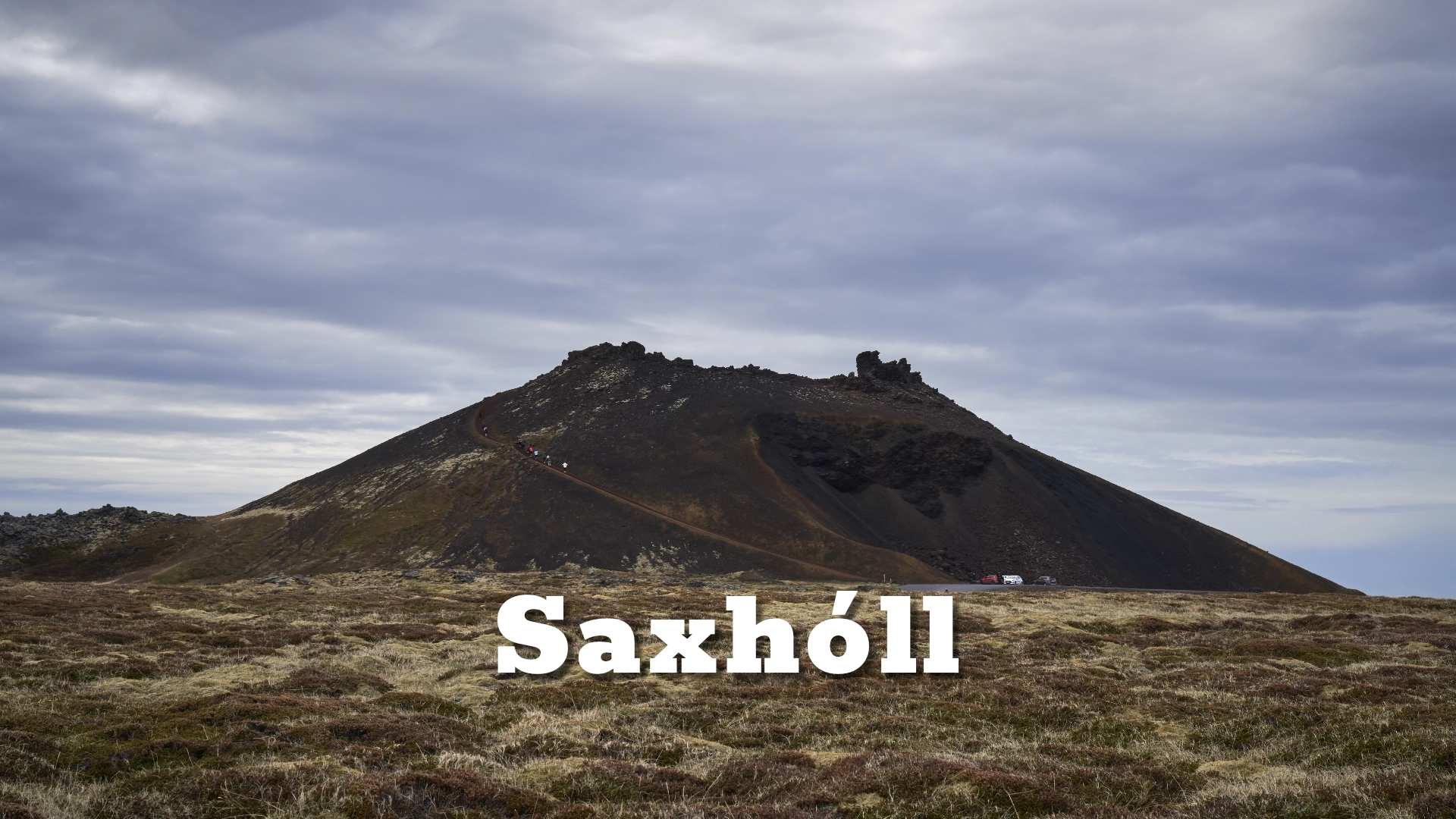
Saxhóll volcanic crater in Snæfellsnes Iceland
Saxhóll is one of the small volcanic craters scattered across the lowlands of Snæfellsjökull National Park. The cone rises about **40 metres** above the surrounding lava field and is thought to have formed roughly **3,000–4,000 years ago**.
What makes Saxhóll unusual today is not only the crater itself, but the way people reach its rim. A purpose-built steel staircase follows the slope to the top, replacing the heavily worn path that once cut across the loose volcanic surface.
The result is a visitor site where access and protection have been designed together. The staircase makes the crater easy to experience, but its more important purpose is to keep people on one durable route and prevent further erosion of the cone.
The location of Saxhóll volcanic crater in Snæfellsnes Iceland
Latitude
64.8516
Longitude
-23.9268
Saxhóll volcanic crater in Snæfellsnes Iceland
Why there is a staircase
Before the staircase was built, repeated foot traffic had widened and damaged the route up Saxhóll. The cone is made largely of loose scoria, which is easily disturbed and slow to recover once trampled.
The old path had become increasingly worn and slippery, especially where people moved over loose gravel and thin vegetation. As visitor numbers increased, the damage spread farther across the slope.
Rather than cutting a completely new route into the crater, the staircase was placed largely within the line of the already damaged path. That made the new structure a response to an existing problem rather than a new intervention in untouched ground.
The staircase was completed in 2015 and has since become one of the clearest examples in the park of how visitor access can be improved without allowing that access to continue damaging the landscape.
An award-winning piece of landscape design
The staircase was designed by Landslag for Umhverfisstofnun. It is about 160 metres long and roughly 1.5 metres wide, built from modular curved sections that follow the rounded form of the cone.
Steel sides and grated steel treads give the structure a simple, almost industrial character. The steel was left untreated so that it would rust naturally and move closer in colour to the surrounding scoria and vegetation.
That design approach received considerable recognition. The project was nominated for several architecture and landscape awards in 2017 and 2018, and in September 2018 it won the Rosa Barba International Landscape Prize.
The award is significant because it recognised more than the appearance of the stairway. The project combined landscape design, erosion control and visitor access in a way that allowed the crater to remain the dominant feature rather than turning the structure itself into the destination.

The climb to the rim
The climb follows roughly 385 steps, although the exact number matters less than the changing view as you ascend. The cone rises only around 40 metres, but the staircase follows the slope gradually enough for the surrounding landscape to open up step by step.
At the top is a viewing area and orientation disc. From there, the crater itself becomes only part of the picture, with the lava fields around Saxhóll, the coastline and Snæfellsjökull rising inland.
The summit area has also been improved in recent years with additional stonework, seating and finishing around the viewing platform. Saxhóll is therefore a deliberately managed visitor site rather than an unmanaged crater where people choose their own routes.
That management is visible, but it works because it remains subordinate to the landscape. Once on the rim, attention quickly shifts away from the staircase and towards the wider volcanic country around it.
Protecting the crater
The staircase is not there simply to make the climb easier. Its main purpose is to protect the crater from further erosion.
Saxhóll is particularly vulnerable because loose scoria and thin vegetation cover much of the cone. Once people leave the designated route, shortcuts quickly disturb the surface and can create new erosion lines.
Some older damage is still visible in places, although the crater does not appear heavily scarred everywhere. The point of the staircase is to prevent those damaged areas from expanding.
Visitors should therefore stay on the designated staircase and viewing areas rather than crossing the slope directly. The success of the design depends on concentrating foot traffic where the crater can absorb it.
Saxhóll in winter
The staircase can also be used in winter, but conditions change the character of the climb significantly. Snow, frost and wind can turn what is a simple summer ascent into a much more slippery route.
The structure itself remains the same, but footing becomes the main issue. Ice can form on the grated steps and exposed upper sections can become uncomfortable in strong wind.
Winter does not make Saxhóll inaccessible by definition, but it does remove much of the certainty of a dry-season visit. Conditions on the day matter more than the nominal difficulty of the route.
Interesting facts:
- Saxhóll rises about 40 metres above the surrounding lava field.
- The crater is thought to be around 3,000–4,000 years old.
- The modern staircase was completed in 2015.
- It follows the line of an older worn path that had been damaged by repeated foot traffic.
- The staircase is about 160 metres long.
- The structure was designed by Landslag.
- Its untreated steel was intended to rust and blend visually with the surrounding volcanic landscape.
- The project won the Rosa Barba International Landscape Prize in 2018.
- The staircase contains roughly 385 steps.
- From the top there are views over lava fields, the coast and Snæfellsjökull.
Image Gallery


Photography tips:
- Use the staircase itself as a strong graphic subject. Its curved geometry works especially well against the rounded form of the crater.
- Photograph from both above and below. The relationship between the stairway and the slope changes substantially depending on direction.
- The rusted steel contrasts well with the darker scoria and moss-covered lava, particularly in soft or directional light.
- From the rim, shift attention away from the staircase and use the crater as foreground for the wider landscape.
- Include Snæfellsjökull where visibility allows. The mountain places Saxhóll within the larger volcanic system rather than leaving it as an isolated cone.
- Low-angle light can reveal texture in both the crater surface and surrounding lava field more clearly than flat midday light.
- Longer focal lengths can simplify the lines of the staircase, while wider lenses work better for showing its relationship with the whole cone.
- In winter, snow and frost can make the staircase visually very strong, but icy steps and wind take priority over the photograph.
Destinations nearby