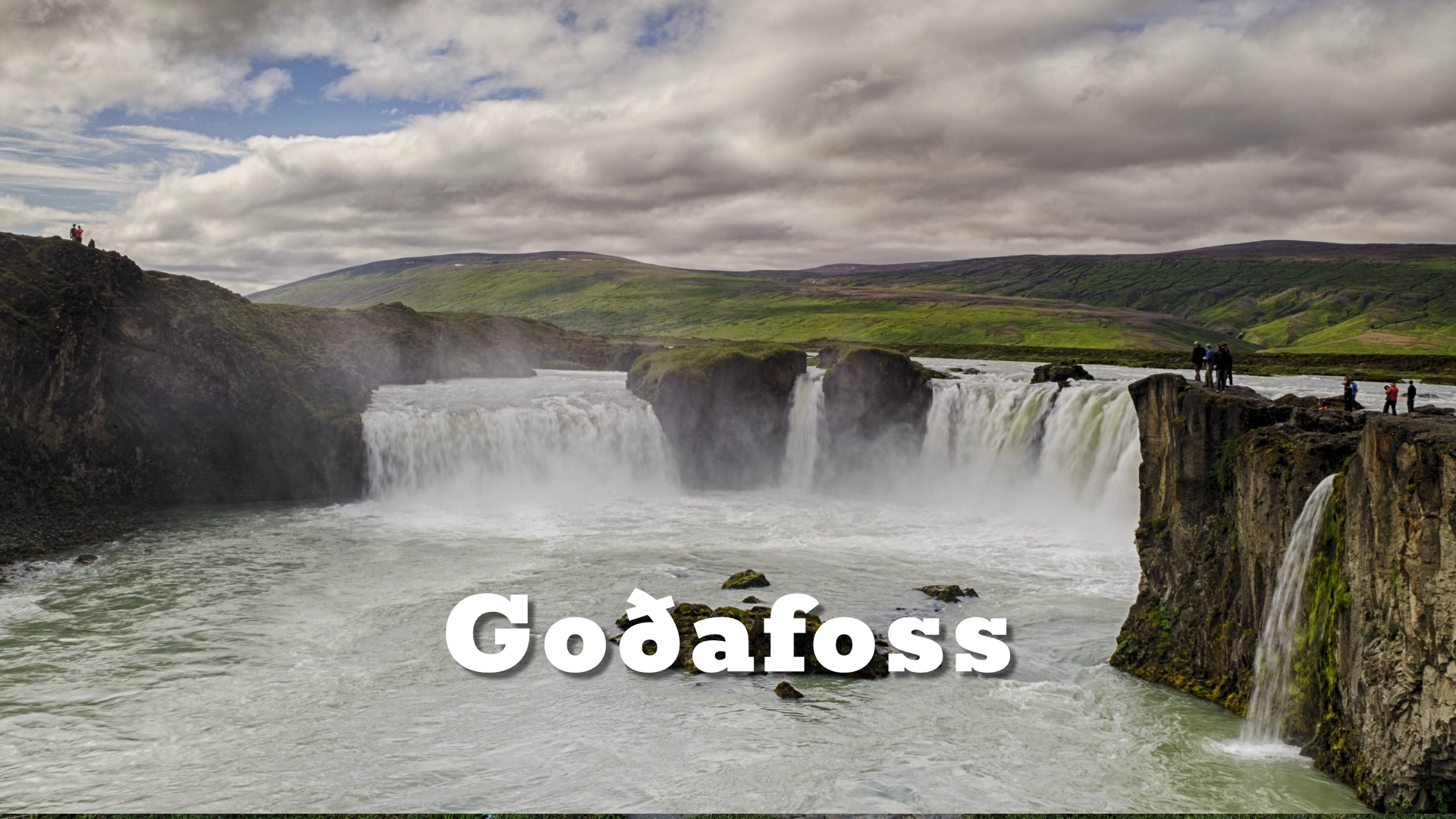
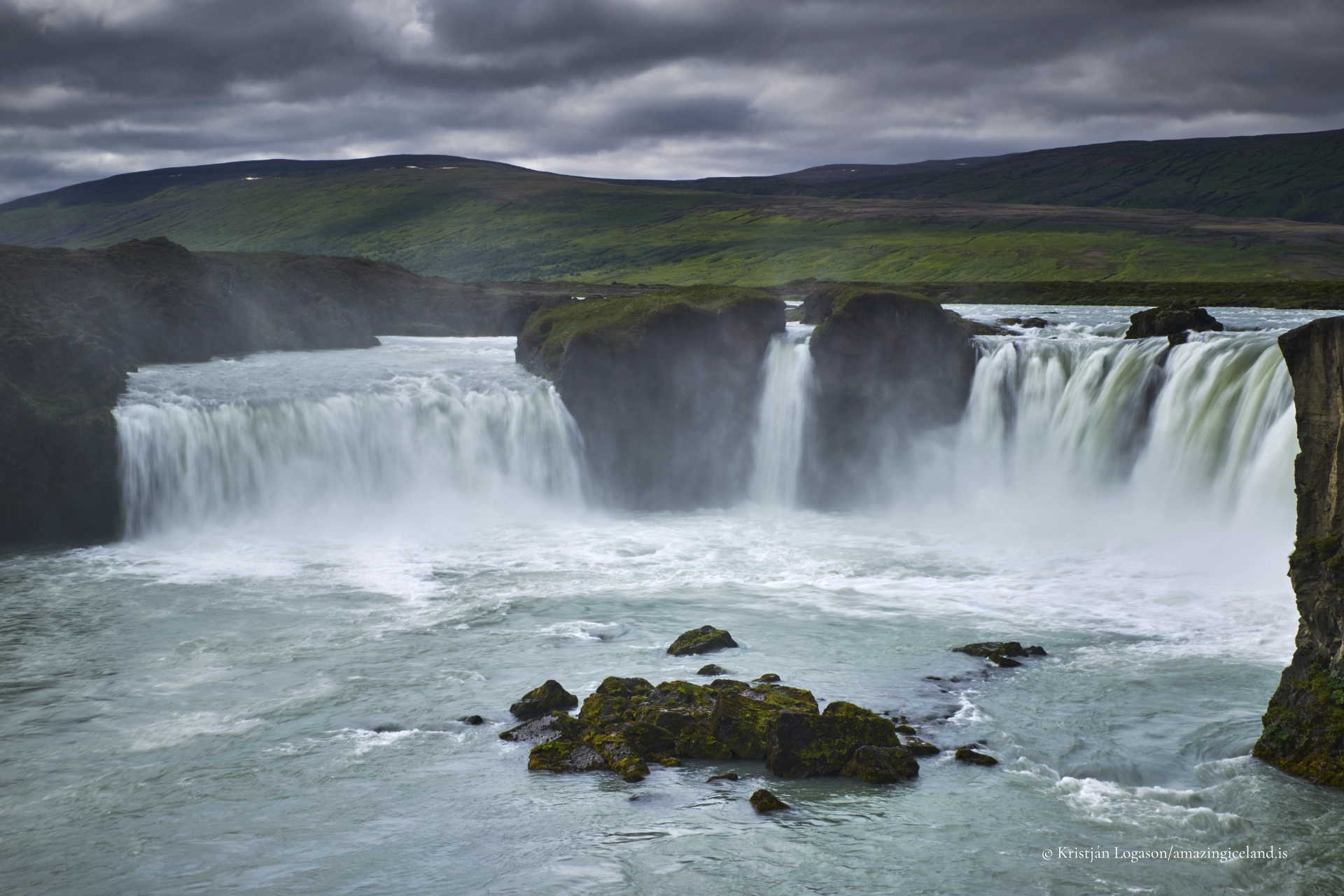
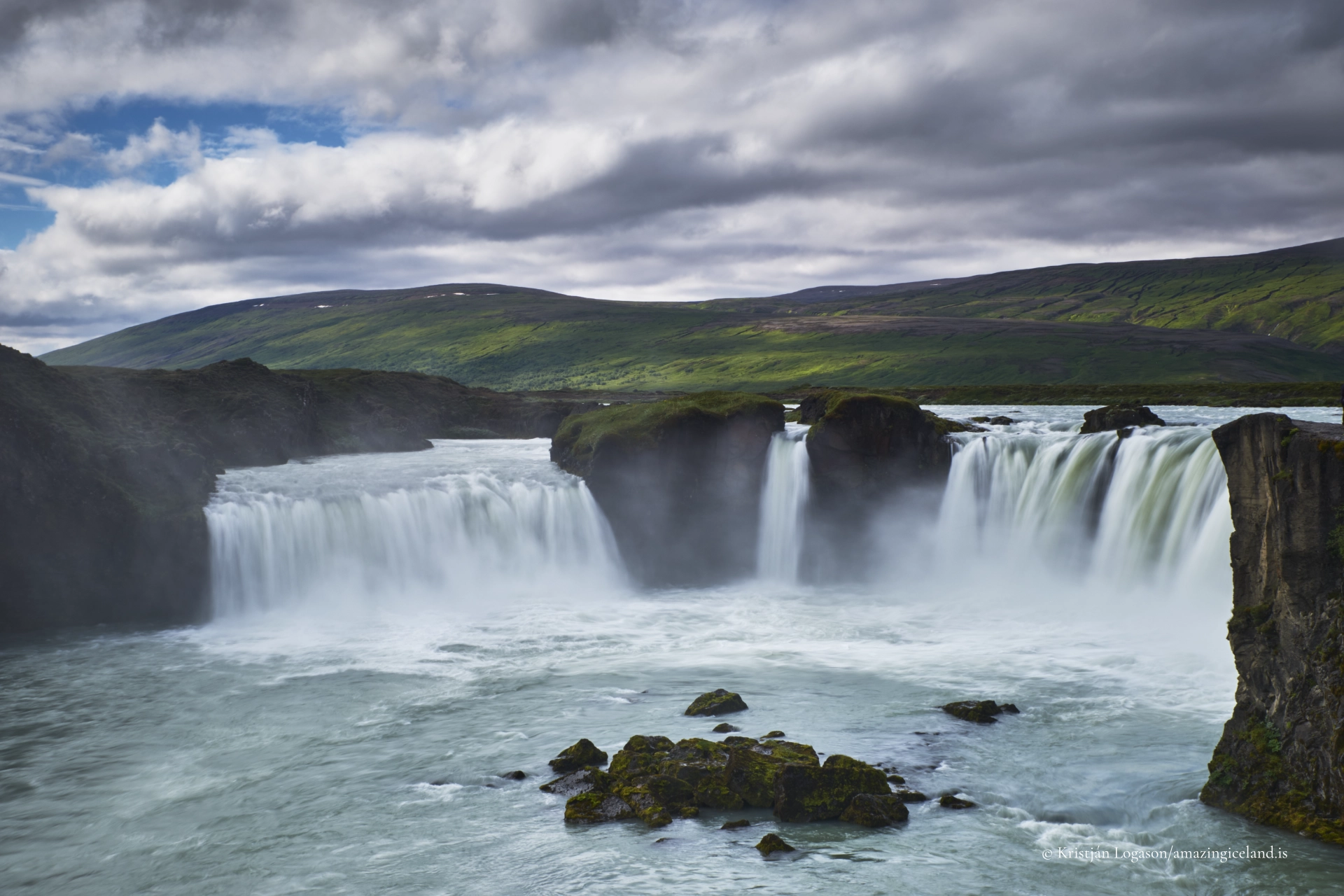
Located just east of Akureyri in North Iceland, Goðafoss is one of the country’s most emblematic waterfalls. Its wide, horseshoe-shaped drop contrasts sharply with the confined force of upstream falls such as Aldeyjarfoss and Hrafnabjargafoss, marking a transition in both river behavior and interpretive scale. Here, the Skjálfandafljót opens outward—geologically and symbolically.
The location of Goðafoss waterfall
Latitude
65.6827
Longitude
-17.5486
Goðafoss waterfall
Geological structure and river morphology
Goðafoss lies along the Skjálfandafljót, downstream from the basalt canyons of Bárðardalur. At this point, the river encounters a step in the basaltic lava sequence—an erosional threshold formed by successive lava flows associated with volcanic activity in the North Iceland volcanic zone.
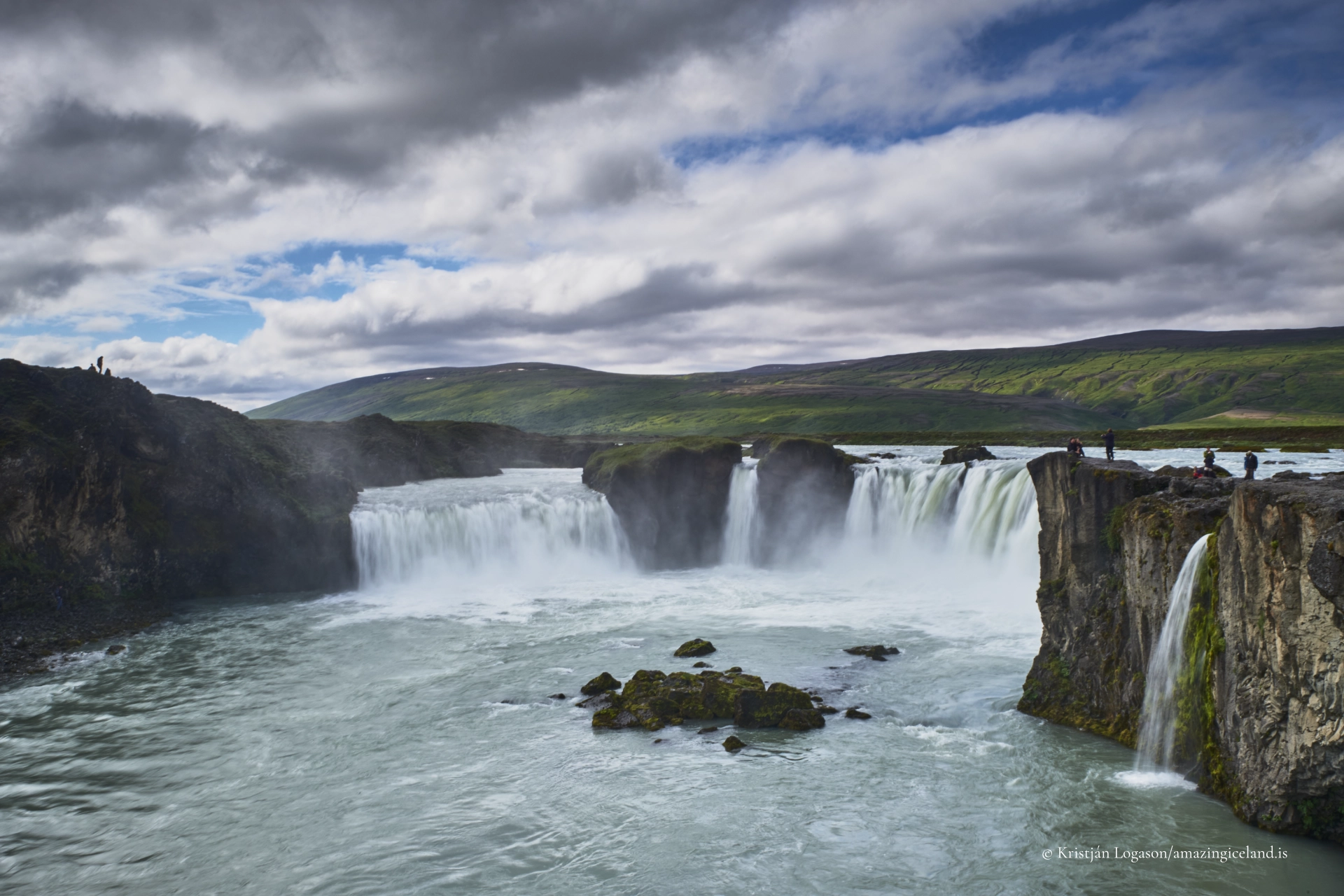
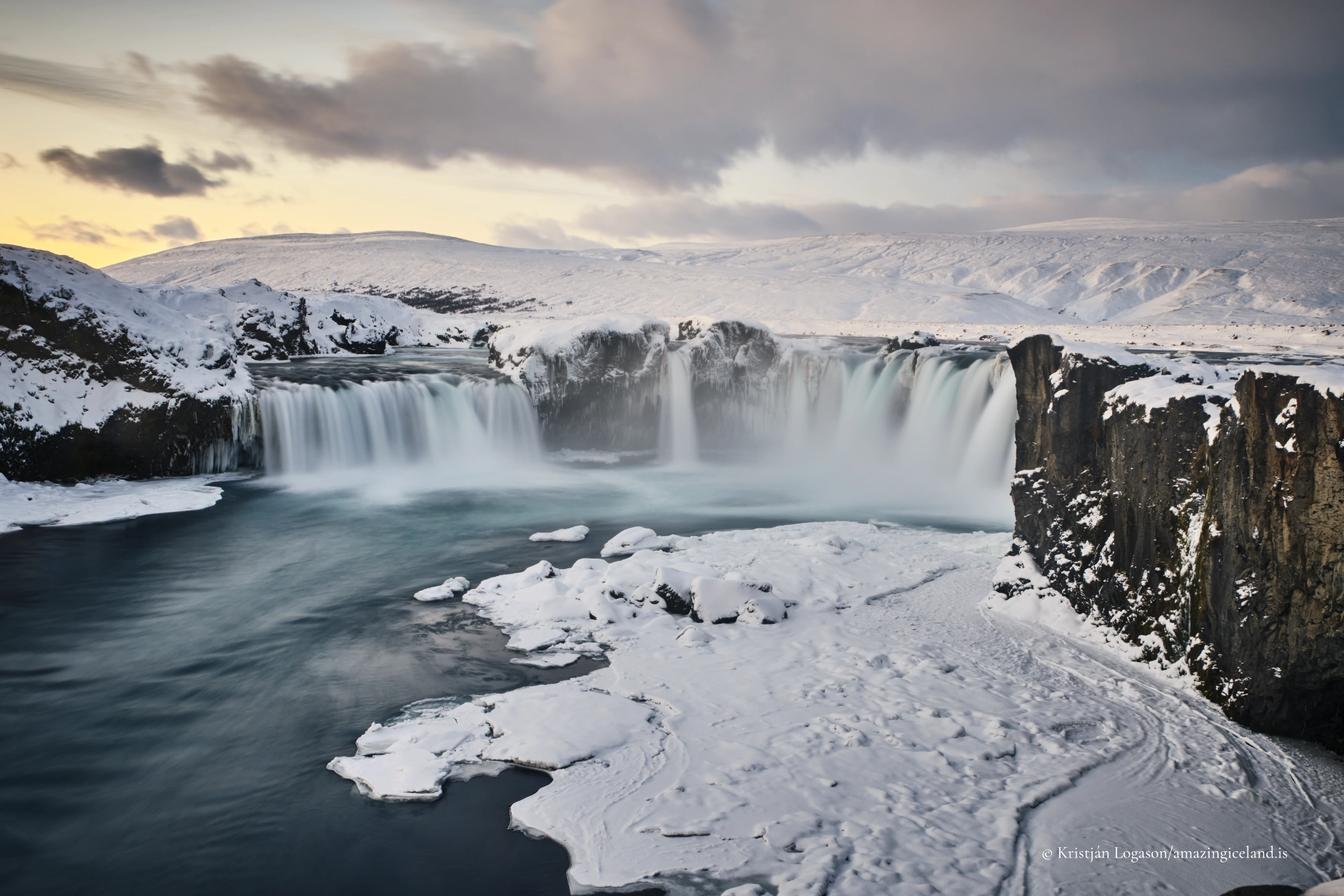
Unlike column-dominated sites such as Aldeyjarfoss, Goðafoss is shaped primarily by layered basalt and jointed lava sheets rather than tightly packed columnar structures. These layers create a broad, relatively even lip over which the river spills, producing the waterfall’s characteristic crescent shape. The height is modest—approximately 12 metres—but the width, roughly 30 metres, allows the river’s full discharge to be expressed simultaneously.
From a geomorphological perspective, Goðafoss illustrates knickpoint stability in uniform bedrock. The waterfall retreats upstream very slowly due to the durability of basalt, maintaining its form over long timescales. Erosion occurs mainly through undercutting at the base and incremental block failure along joint planes, rather than rapid headward collapse.
The surrounding canyon walls are lower and more open than those upstream, allowing light, wind, and sound to disperse. This openness contributes significantly to the waterfall’s visual accessibility and reinforces its role as a natural gathering point rather than a site of confinement.
Cultural history and symbolic landscape
Goðafoss is inseparable from one of the most frequently cited episodes in Icelandic history. According to medieval sources, most notably Íslendingabók, the lawspeaker Þorgeir Ljósvetningagoði cast his pagan idols into the waterfall around the year 1000 CE after Iceland formally adopted Christianity at the Alþingi. Whether literal or symbolic, the act permanently linked the site to a moment of negotiated transition rather than violent conversion.
This narrative has shaped how Goðafoss is perceived and presented. Unlike many Icelandic waterfalls that are interpreted almost exclusively through geology, Goðafoss functions as a cultural landscape, where physical form and historical meaning reinforce one another. The broad, open geometry of the falls aligns naturally with the idea of communal decision-making and collective identity.
The story illustrates how landscapes become mnemonic devices. The waterfall itself did not cause historical change, but it became a durable anchor for memory—an example of how natural features are absorbed into social and legal narratives in settlement-era Iceland.
Importantly, the cultural framing does not diminish geological significance. Instead, it broadens interpretive depth: Goðafoss demonstrates how Icelandic landscapes are often read simultaneously as physical systems and historical texts.
Visiting Goðafoss—access, scale, and seasonality
Goðafoss is among the most accessible major waterfalls in Iceland, located directly off Route 1 (the Ring Road). Well-maintained paths lead to viewpoints on both the east and west sides of the river, each offering distinct compositional and experiential perspectives. This accessibility makes Goðafoss a frequent stop, particularly during summer.
Despite infrastructure, the site retains physical authority. Spray zones expand with higher discharge, winter ice alters footing and depth perception, and the river’s volume demands respect. Safety barriers exist in key areas, but visitors should still exercise caution near the edge, especially in icy or windy conditions.
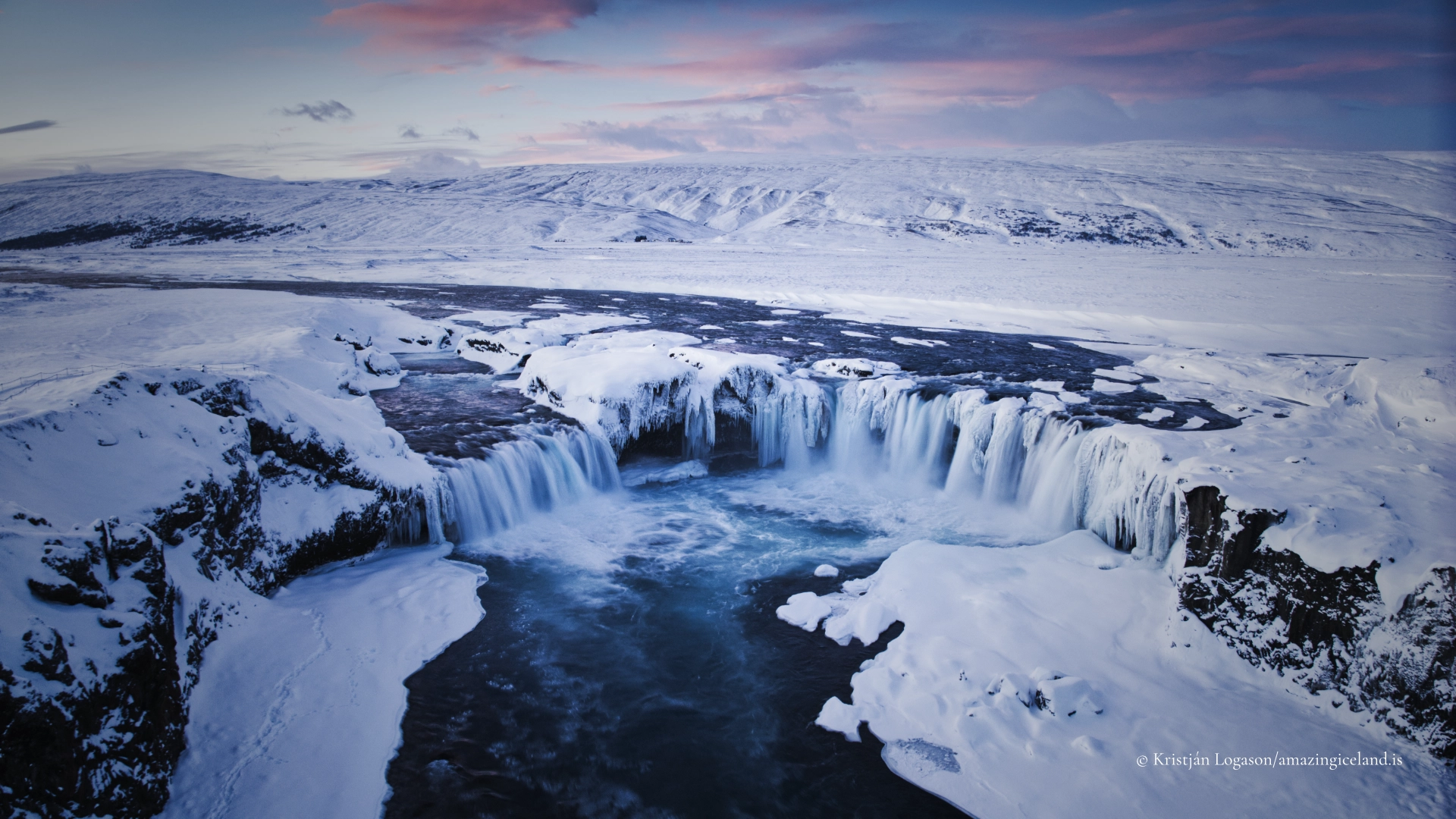
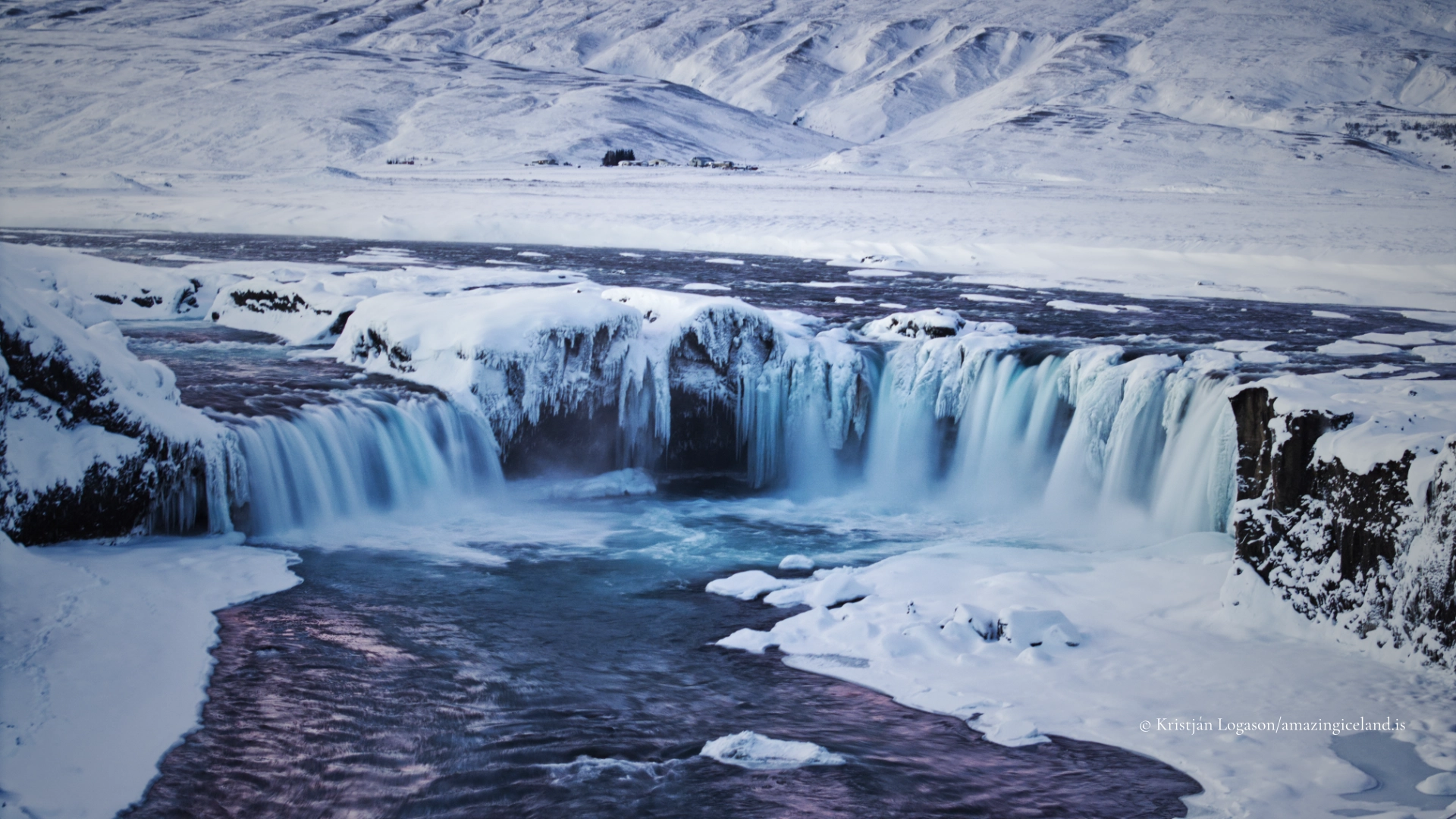
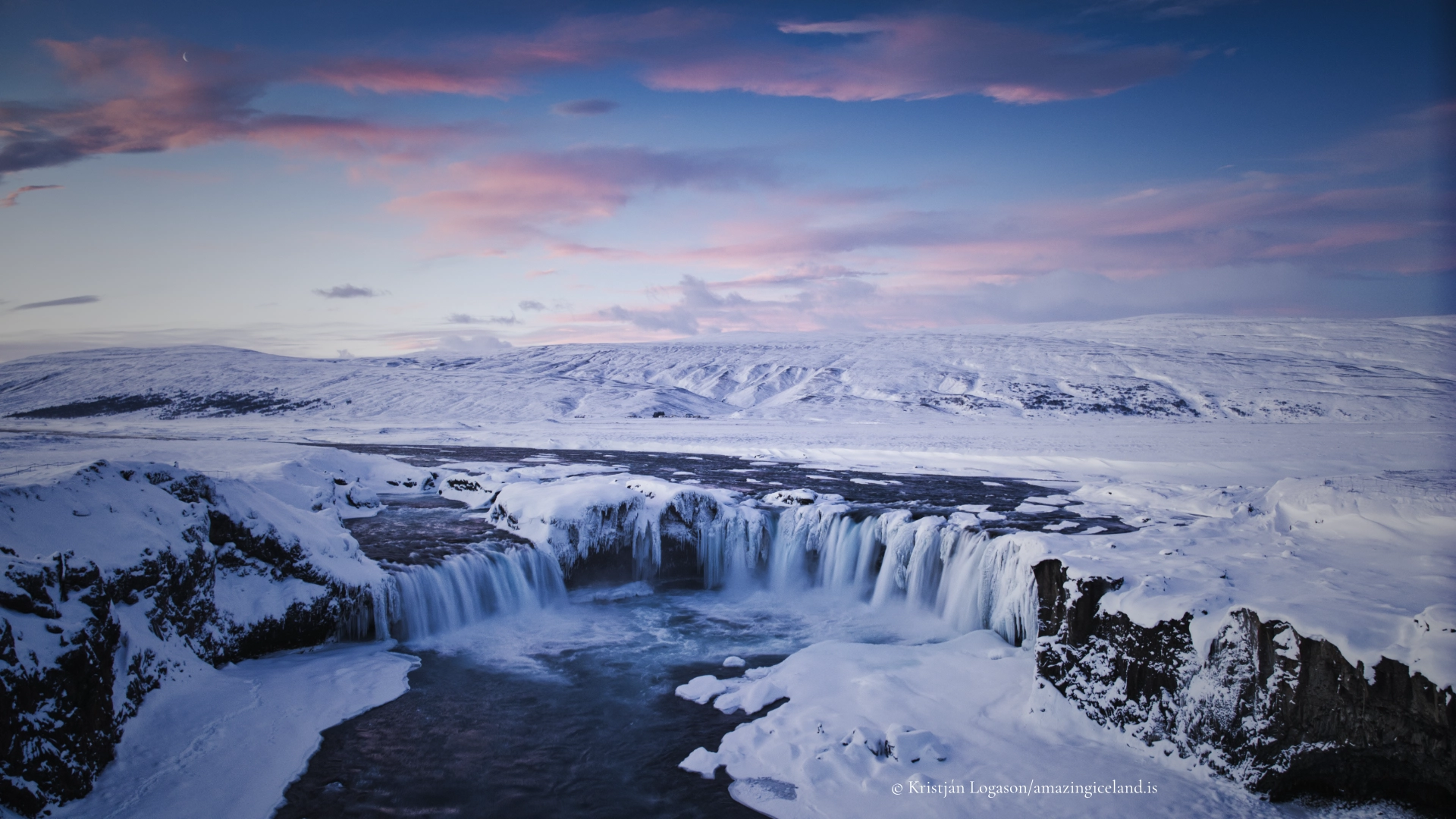
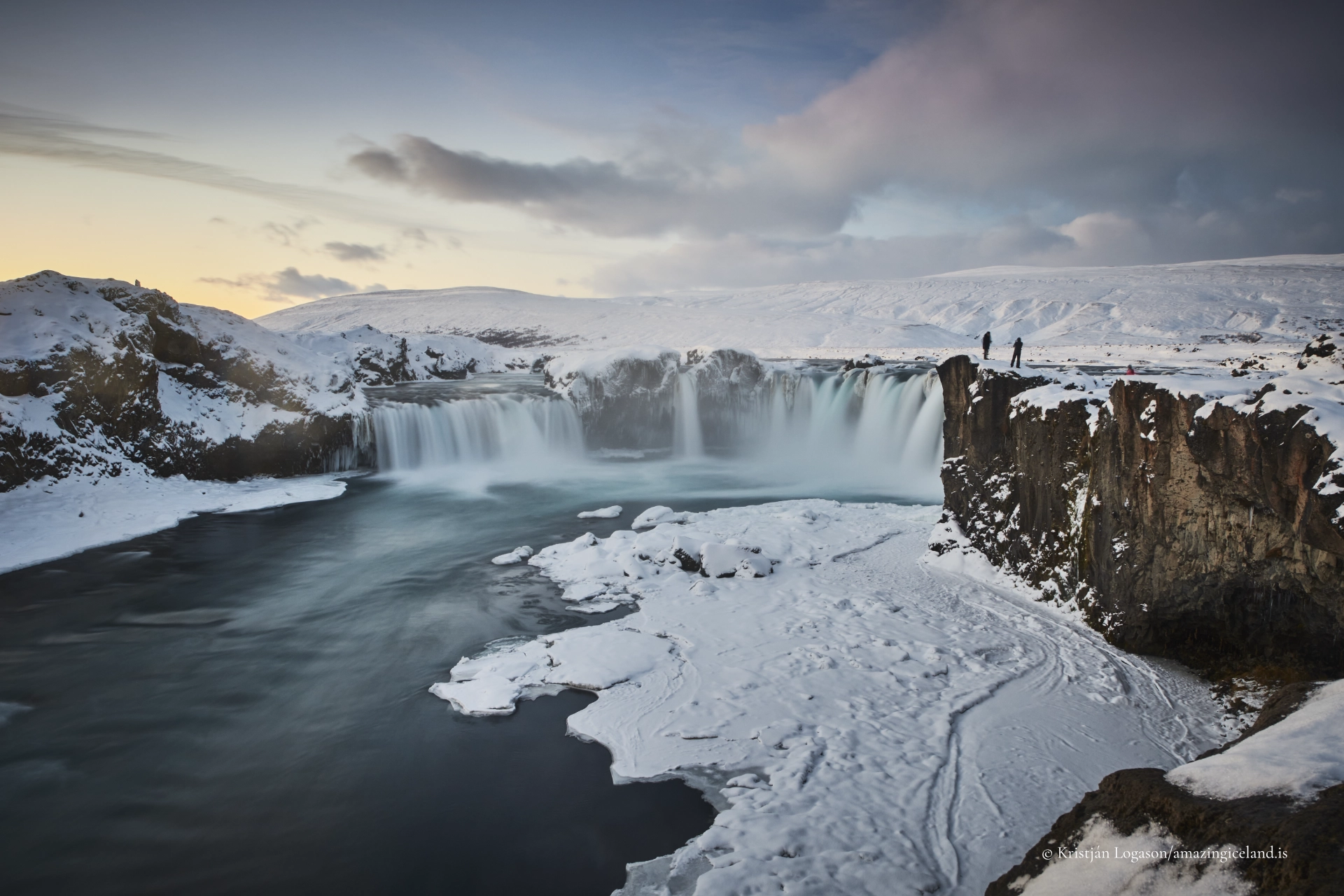
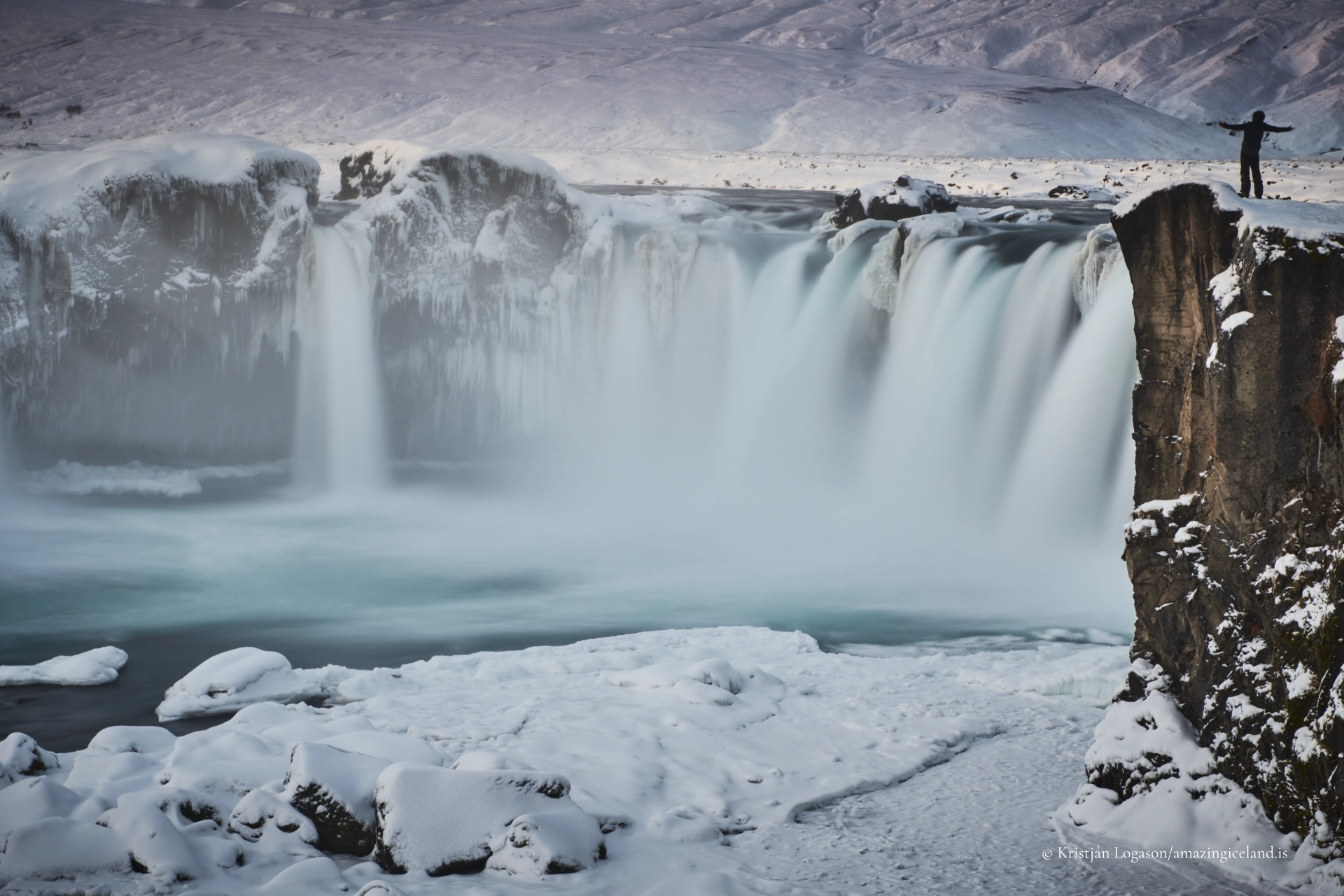
Seasonal variation is pronounced. In summer, glacial melt increases flow and enhances the waterfall’s breadth and soundscape. In winter, partial freezing introduces sculptural ice formations along the basalt edges, shifting emphasis from movement to form. Both conditions are valid expressions of the site, and neither should be considered secondary.
Experientially, Goðafoss rewards slow observation rather than movement. Its geometry is immediately readable, but its subtleties—water distribution, flow asymmetry, light interaction—emerge over time. This makes it a site that supports both casual visitation and extended photographic or interpretive engagement.
Interesting facts:
- Goðafoss means “Waterfall of the Gods”, referencing its association with the conversion to Christianity.
- The waterfall is approximately 12 metres high and 30 metres wide, emphasizing breadth over height.
- It is formed entirely in basaltic lava, with erosion controlled by jointed lava layers.
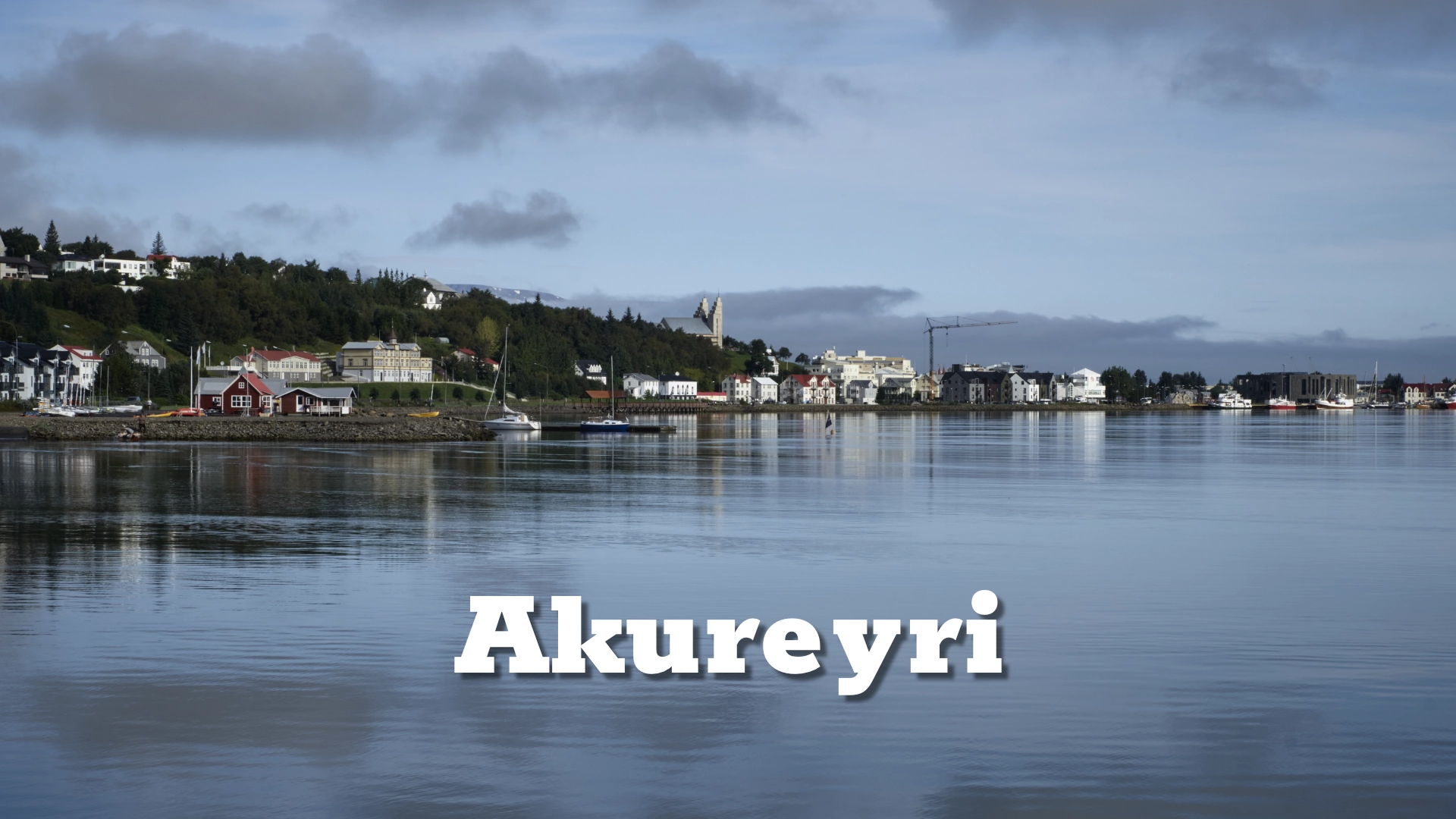
- Goðafoss lies only a short drive from Akureyri, North Iceland’s largest town.
- The site has been referenced in medieval Icelandic literature, giving it enduring cultural resonance.
Image Gallery
The Locomotive Elite
What do Donald Trump and Iceland’s Locomotive Elite have in common?
Far more than you think.
In The Locomotive Elite, you’ll uncover how a tiny clique in Iceland captured extensive control—of banks, courts, media, and even the central bank.
For decades they ruled, first democratically, then through corruption and in the end through crime, enriching themselves and their cronies while dismantling oversight.
The result?
One of the most spectacular financial collapses in modern history.
Photography tips:
- Use wide lenses deliberately: Goðafoss benefits from horizontal framing that emphasizes symmetry and scale.
- Explore both riverbanks: eastern and western viewpoints produce materially different compositions.
- Winter offers structural clarity: ice outlines flow paths and basalt edges with graphic precision.
- Manage highlights carefully: white water can clip quickly under strong light.
- Avoid crowd compression: step back from main viewpoints to isolate form and reduce visual noise.
Good cameras for Iceland
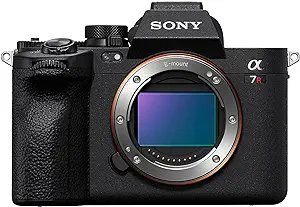
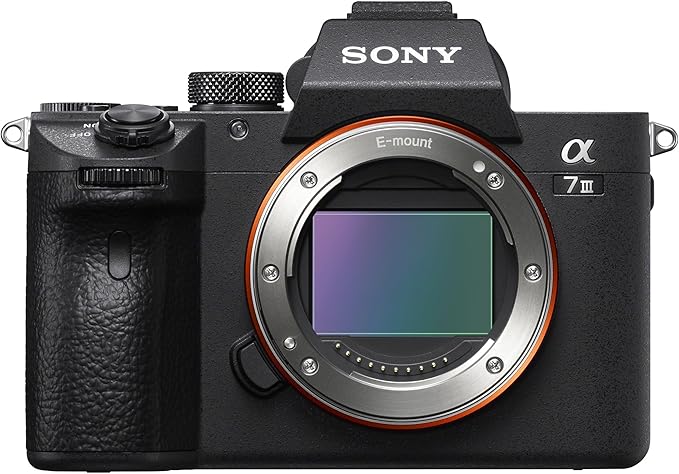
Sony A7R V
Sony A7s lll
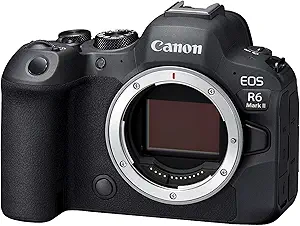
Canon R6
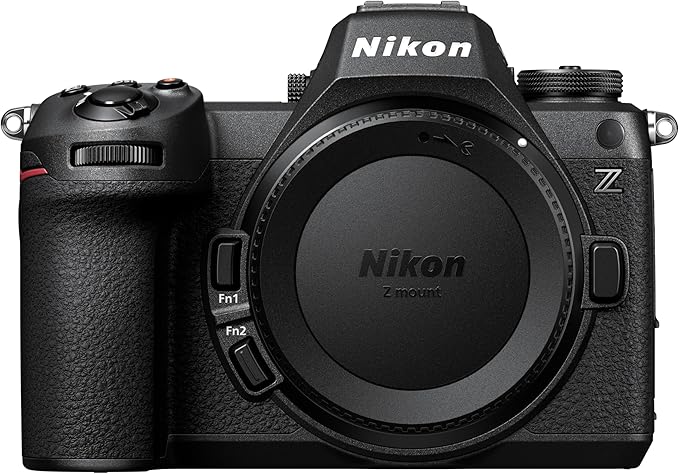
Nikon Z6 lll
Destinations nearby
Good to have in Iceland