Viking village film set in east Iceland
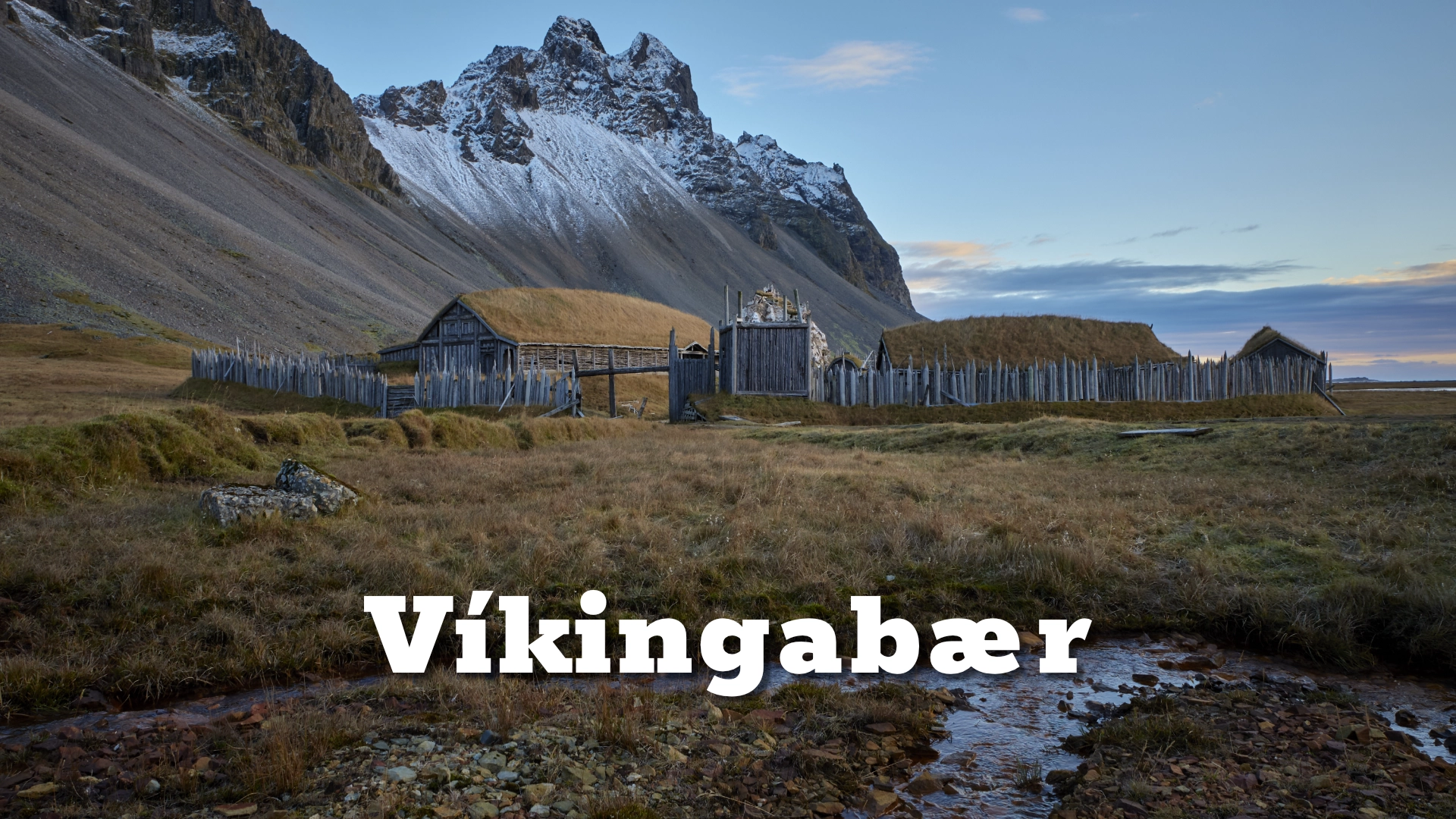
On the flats below Vestrahorn, turf-covered roofs and timber walls form what appears at first to be an old Icelandic settlement. It is neither an archaeological site nor a historical reconstruction. The village is a film set, constructed for the camera rather than as a place in which people were meant to live.
Its unfinished history is part of what makes it interesting. The production for which it was created never reached the screen, but the village remained. Years of exposure to wind, rain and salt have aged its surfaces, making the boundary between modern production design and the appearance of history less immediately obvious.
The location of Viking village film set in east Iceland
Latitude
64.30135725628347
Longitude
-14.976710313756996
Viking village film set in east Iceland
Built for Vikingr
Construction of the village began in 2009 for Vikingr, a planned film by Icelandic director Baltasar Kormákur. The project was not completed, leaving the purpose-built settlement standing at Stokksnes without the film for which it had been made.
In 2014, Kormákur reached an agreement with Universal Pictures concerning Vikingr. The agreement came several years after construction of the village and belongs to a later stage in the history of the proposed film. The project was ultimately never realised.
What survives at Stokksnes is therefore not a location preserved from a completed film, but the physical remnant of a production that never happened.
A village made for the camera
The buildings were designed to create the outward appearance of a Viking-age settlement. Timber walls, turf roofs and the arrangement of the structures establish that illusion when seen across the surrounding flats or framed against the mountains.
They were not built as complete, functioning houses. The exteriors carry the visual impression, while the structures lack the finished interiors expected of real dwellings. Visitors may walk around the village, but the interiors are not open to visitors.
Time has altered the set in ways its builders may not have anticipated. The original structures have weathered and deteriorated, while a replica Viking ship was added to the site years later. The result is neither a preserved historical village nor an untouched film set, but a visitor location that has continued to change since its construction.

The screen life it found later
Although Vikingr was never made, the village eventually appeared on screen in another production. It was used in Netflix’s The Witcher: Blood Origin, filmed in Iceland in 2021, where it represented the settlement of Inis Dubh.
That later use gives the set an unusual production history. It was created for one fictional world, remained after that project disappeared, and was eventually adapted to represent another. Its life as a location has therefore lasted far longer than the production for which it was originally constructed.
Visiting the village
The village stands within the privately managed Stokksnes area, and access is included with admission to the headland. It is reached on foot from the Viking Café in approximately fifteen minutes.
Visitors can walk among and around the structures, but the interiors are not open. The set has stood exposed since 2009 and parts of it have deteriorated, so the buildings should be viewed from outside.
The character of the village changes with viewpoint. From some positions it resembles an isolated old settlement; from others, its construction as a film location becomes much clearer. Current access arrangements and any temporary restrictions are best checked on arrival.
Interesting facts:
-
- Construction began in 2009 for Baltasar Kormákur’s proposed film Vikingr.
- Kormákur reached an agreement with Universal Pictures concerning the project in 2014.
- Vikingr was never made, but the set remained at Stokksnes.
- The buildings were created primarily as convincing exteriors rather than complete dwellings.
- The village represented Inis Dubh in The Witcher: Blood Origin, filmed in Iceland in 2021.
- A replica Viking ship was added years after the original set was built.
Image Gallery


Photography tips:
- Wider views can show the scale of the settlement against the Vestrahorn range and the open flats of Stokksnes.
- Closer compositions can concentrate on turf, weathered timber and construction details.
- Different viewpoints can either preserve the impression of an old settlement or reveal the village’s origin as a film set.
- Changing light, cloud and seasonal conditions alter how the buildings separate from the surrounding land and mountain backdrop.
- Before using a drone, check current local rules and any temporary restrictions.
Destinations nearby