Gunnuhver hot spring on Reykjanes peninsula
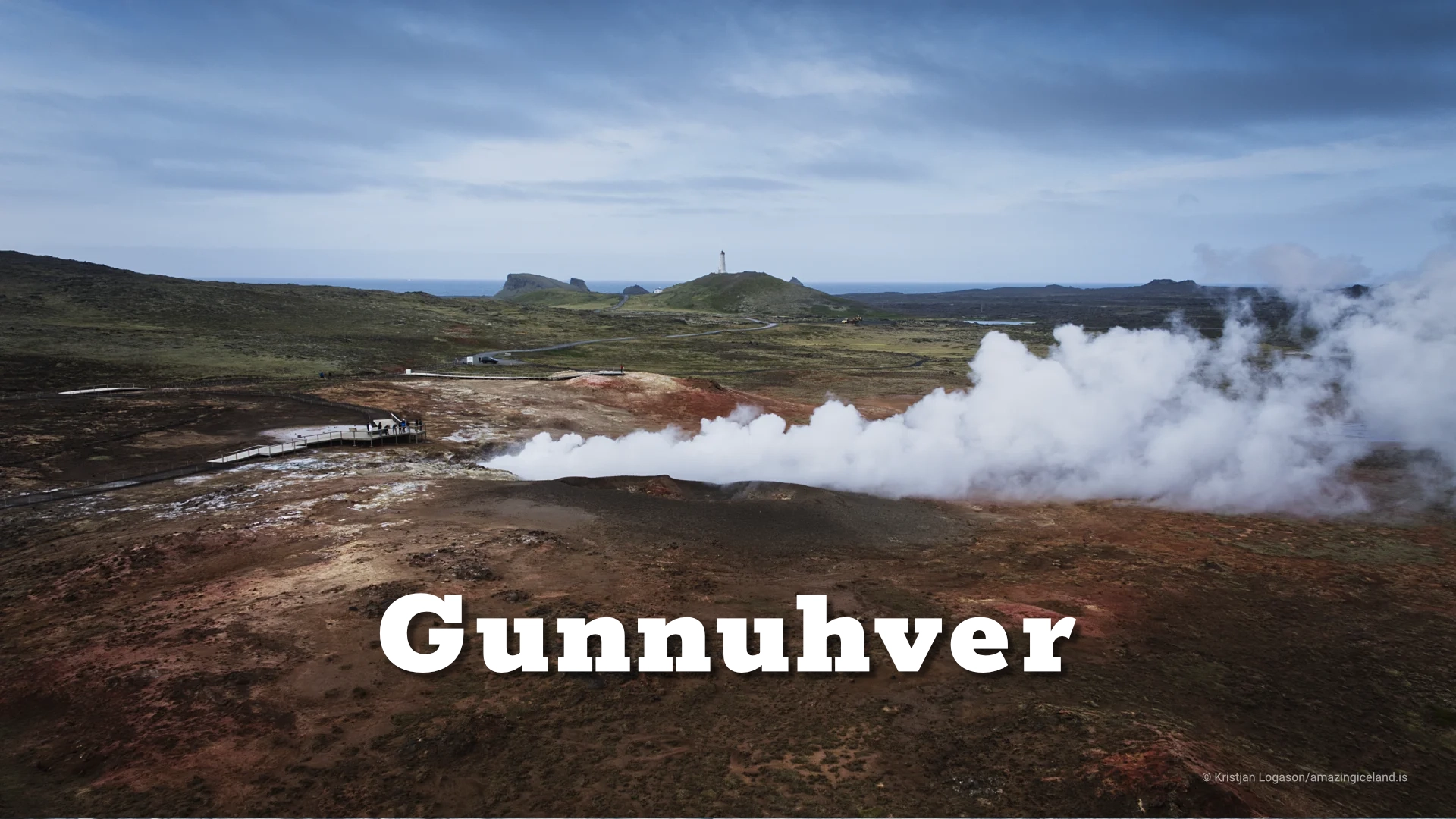
Gunnuhver lies in the geothermal area just east of Reykjanesviti lighthouse on the western tip of the Reykjanes Peninsula. The spring is generally described as Iceland’s largest mud pool, measuring about **20 metres across**.
Steam rises continuously from the ground, boiling mud moves below the viewing platforms, and the entire area forms part of a high-temperature geothermal system that is unusual even by Icelandic standards.
Gunnuhver is also tied to one of the best-known ghost stories of Reykjanes. According to folklore, the spring takes its name from **Guðrún, usually called Gunna**, whose ghost terrorised the area until **Séra Eiríkur Magnússon of Vogsósar** finally found a way to deal with her.
The result is a place where geology and folklore fit unusually well together. The boiling ground explains the landscape, while the story of Gunna explains how people once interpreted it.
The location of Gunnuhver hot spring on Reykjanes peninsula
Latitude
63.8199
Longitude
-22.6874
Gunnuhver hot spring on Reykjanes peninsula
A geothermal system fed by the sea
The Reykjanes geothermal system differs from many of Iceland’s other high-temperature areas because much of the water circulating deep underground is derived from seawater.
Seawater penetrates fractures in the volcanic bedrock and circulates downward, where it is heated by the geothermal system. As it moves through the basalt, the water reacts chemically with the surrounding rock before rising again through fractures and faults.
At the surface, steam and geothermal gases mix with groundwater. Gases such as carbon dioxide and hydrogen sulphide contribute to making the water acidic, gradually altering the volcanic rock into clay.
That process is what creates the mud pools at Gunnuhver. The largest is approximately 20 metres across and boils vigorously within a rim of altered clay. Unlike a clear hot spring, the water is mixed with fine clay particles produced by geothermal alteration, giving the pool its thick grey appearance.
The geothermal landscape is not static. Pressure, temperature and groundwater conditions beneath the surface change, so visible activity can shift from one part of the field to another.
A particularly noticeable change occurred in 2006, when electricity production began in the nearby Reykjanes geothermal field. Withdrawal of geothermal fluid lowered pressure within the reservoir, and surface steaming in the area increased significantly.
The resulting period of stronger geothermal activity damaged some of the road and walking infrastructure then in place. New walkways and viewing platforms were later constructed, allowing visitors to experience the field without walking directly onto active geothermal ground.
Visiting Gunnuhver
Gunnuhver is reached from Road 425 on the western Reykjanes Peninsula, close to Reykjanesviti lighthouse. Parking is available beside the geothermal area, and wooden walkways lead towards the viewing points.
There are two principal viewpoints. One lies close to Gunnuhver itself, where the scale, sound and movement of the mud pool are most apparent. From there, you can look down into the active area and hear the constant hissing and boiling of the geothermal system.
The second viewpoint is on Kísilhól, a nearby silica-covered hill. From there, the perspective is wider and gives a better sense of Gunnuhver within the surrounding geothermal field rather than focusing only on the main pool.
The present walkways and viewing areas provide wheelchair access. Visitors should remain on the marked paths, boardwalks and inside the fenced viewing areas because the ground outside them is active and unstable.
Wind direction can completely change the visit. On some days steam drifts away from the platforms and the mud pool is clearly visible. At other times the wind pushes dense steam directly across one viewpoint and hides almost everything.
When that happens, the other viewing area may give a much clearer view. Gunnuhver does not require a long visit, but it is worth seeing the field from both sides rather than stopping at the first platform.

The story of Gunna
Gunnuhver takes its name from Guðrún, usually called Gunna, whose ghost is said in local folklore to have haunted this part of Reykjanes.
According to the story, a man named Vilhjálmur lived at Kirkjuból in Suðurnes. Gunna was his neighbour and owed him money, but was unable to pay the debt. Vilhjálmur therefore took one of her cooking pots as security.
Some time later, Gunna came to Kirkjuból asking for something to drink. She appeared agitated and was offered consecrated wine, but according to the story she poured it away and instead drank a bucket of water before leaving.
When a man who lived with her returned home from fishing later that day, he found Gunna dead in her bed. A coffin was made, and her body was taken towards Útskálakirkja for burial.
Those carrying the coffin were said to have noticed that it seemed strangely light. Later, while the grave was being prepared, Gunna was reportedly seen among the seaweed at Útskálar and declared that there was no reason to dig deeply because she would not remain in the grave for long.
After that, stories of hauntings began spreading across the area.
Vilhjálmur later attended a gathering at Útskálar and stayed late into the evening. Although he was offered company for the journey home, he refused and never reached Kirkjuból.
The following day he was found badly beaten at Hrossalág. He was taken back to Kirkjuból but died soon afterwards, and Gunna was blamed.
According to the story, her ghost continued causing trouble, entering houses, frightening livestock and making life increasingly difficult for people living in the area.
Eventually two men were sent across the peninsula to seek help from Séra Eiríkur Magnússon of Vogsósar, a clergyman who appears in a number of Icelandic folk stories as a man capable of dealing with supernatural problems.
Eiríkur gave the men a knotted object and instructed them to deliver it to Gunna. When she received it and began unravelling the knots, she reportedly realised who had sent it.
The story gives her words as essentially: “I expected the devil, but not the man from Vogsósar.”
The knot then began moving across Reykjanes and Gunna followed it. It led her over the peninsula until it reached the edge of a boiling hot spring, where she followed too closely and fell in.
From that point onward, according to the story, the spring became known as Gunnuhver — Gunna’s hot spring. The steam rising from the ground later became part of the legend as well, with people saying that Gunna could still sometimes be seen struggling within the mist.
Interesting facts:
- Gunnuhver is generally described as Iceland’s largest mud pool, approximately 20 metres across.
- The Reykjanes geothermal system is largely recharged by seawater rather than only freshwater.
- Acidic geothermal fluids alter volcanic rock into clay, helping create Gunnuhver’s mud pools.
- Geothermal activity at the surface increased noticeably after electricity production began in the Reykjanes geothermal field in 2006.
- Gunnuhver takes its name from Gunna, a ghost in local folklore.
- Séra Eiríkur Magnússon of Vogsósar is the figure traditionally credited with finally dealing with Gunna.
- Two main viewing areas give different perspectives over the geothermal field: one beside Gunnuhver and another on Kísilhól.
- Wind direction can determine whether the main pool is clearly visible or hidden completely by steam.
Image Gallery


Photography tips:
- Wind direction is the single most important variable for photography at Gunnuhver. When steam blows away from the platform, the mud pool and altered ground become much easier to see.
- Check both viewing areas before deciding the conditions are poor. The platform beside Gunnuhver gives the strongest close view, while Kísilhól provides a wider view across the geothermal field.
- Use steam as part of the image rather than always treating it as an obstruction. Brief openings in the mist can reveal only part of the landscape and often create stronger photographs than completely clear views.
- Overcast light works particularly well because it preserves detail in the grey clay, steam and altered ground without producing harsh contrast.
- Longer focal lengths can isolate boiling mud, steam vents and details in the altered ground, while wider lenses are better from Kísilhól when showing the entire geothermal setting.
- The constant movement of steam means compositions can change within seconds. It is often better to hold a position and wait for the wind to reveal the scene than to keep moving.
- Stay on the boardwalks and viewing platforms. The active geothermal ground is not a place to improve a composition by stepping closer.
Destinations nearby