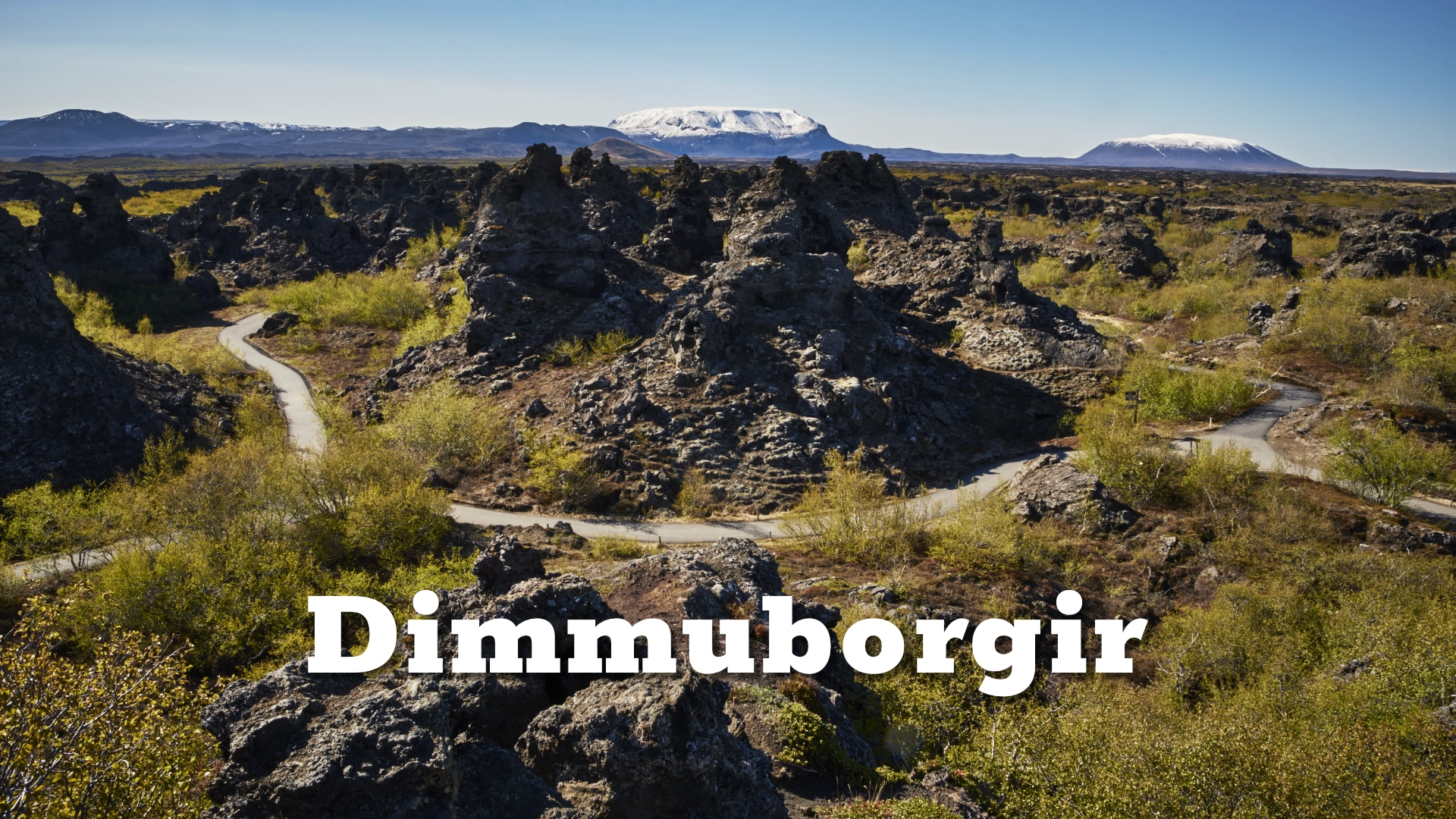
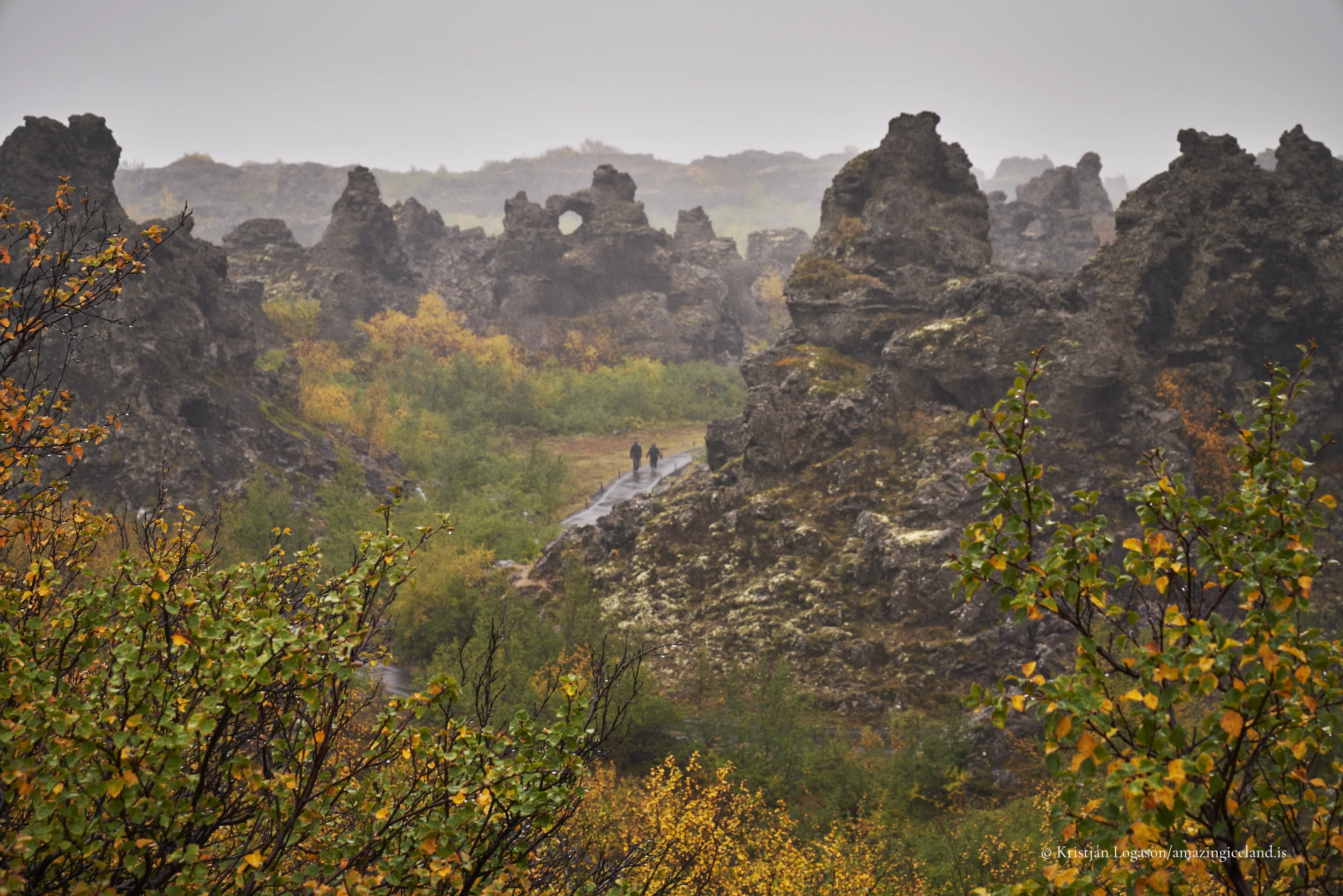
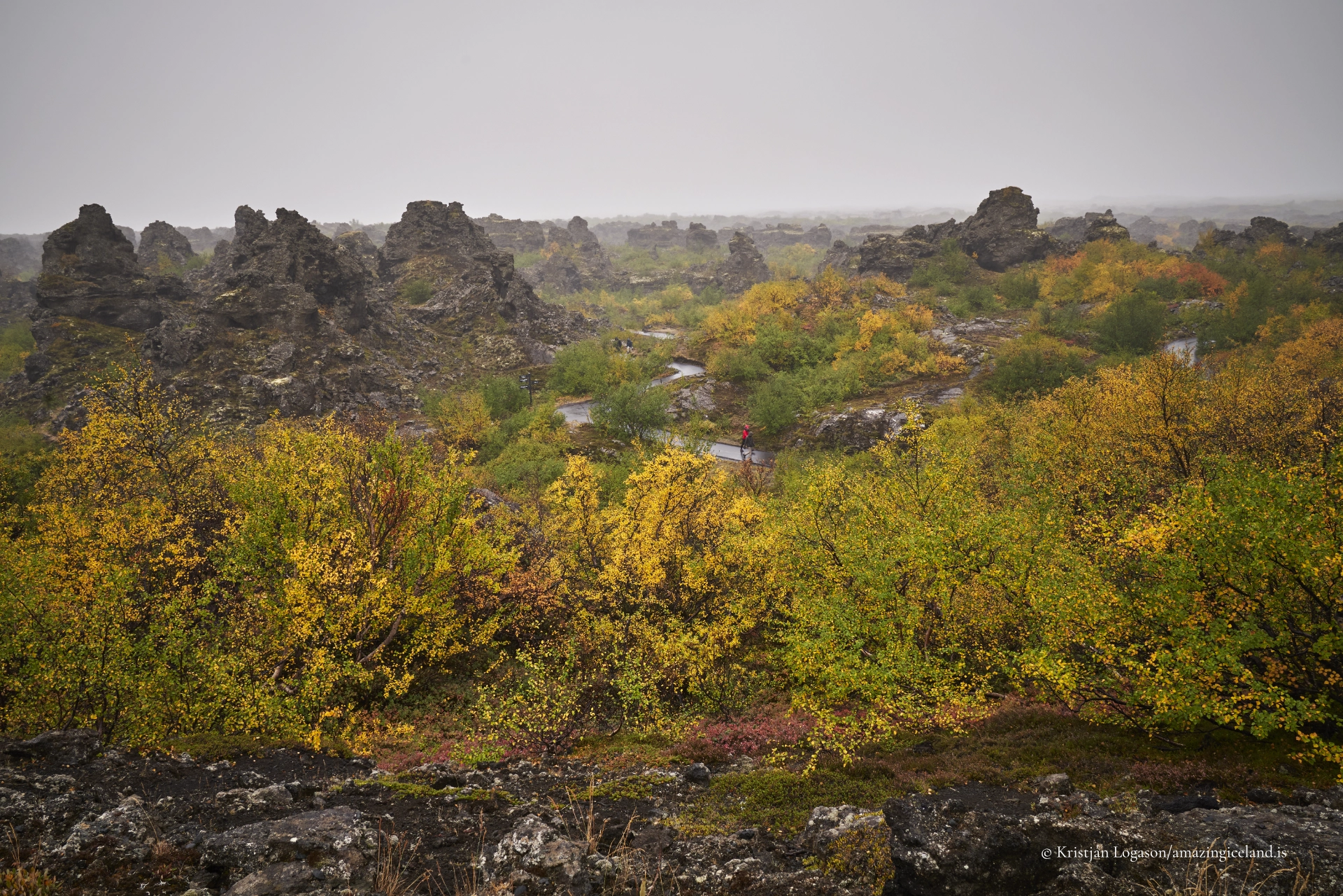
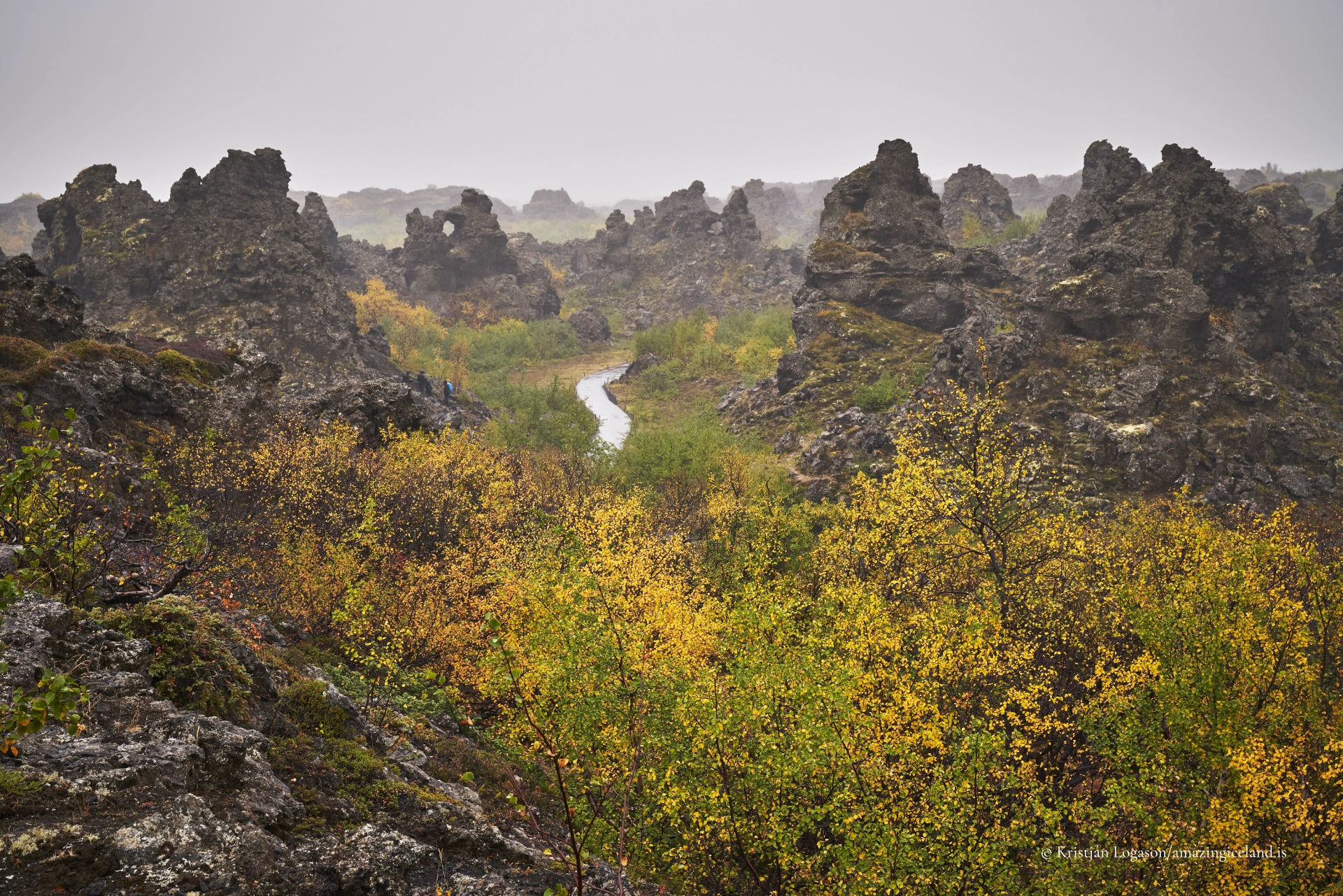
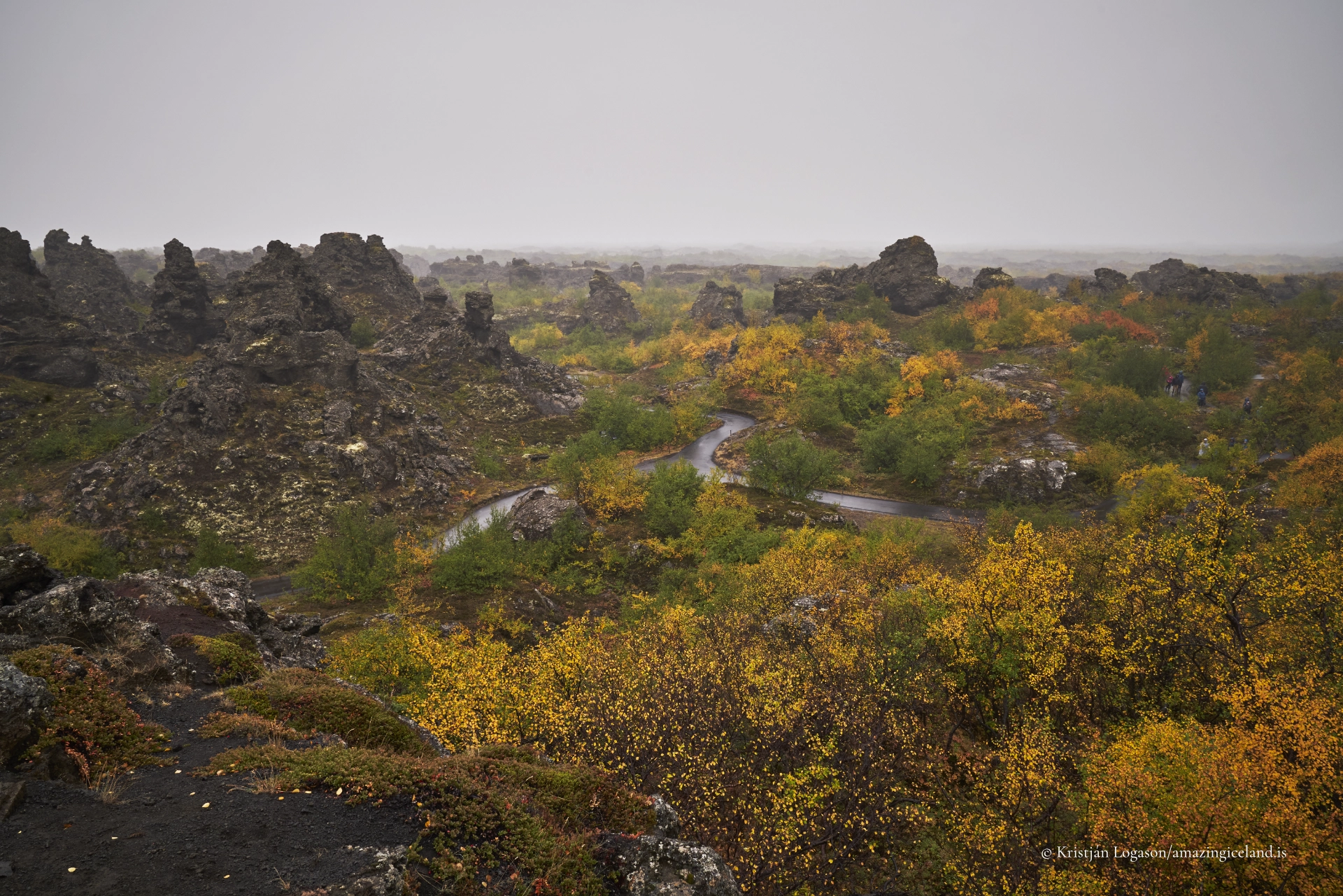
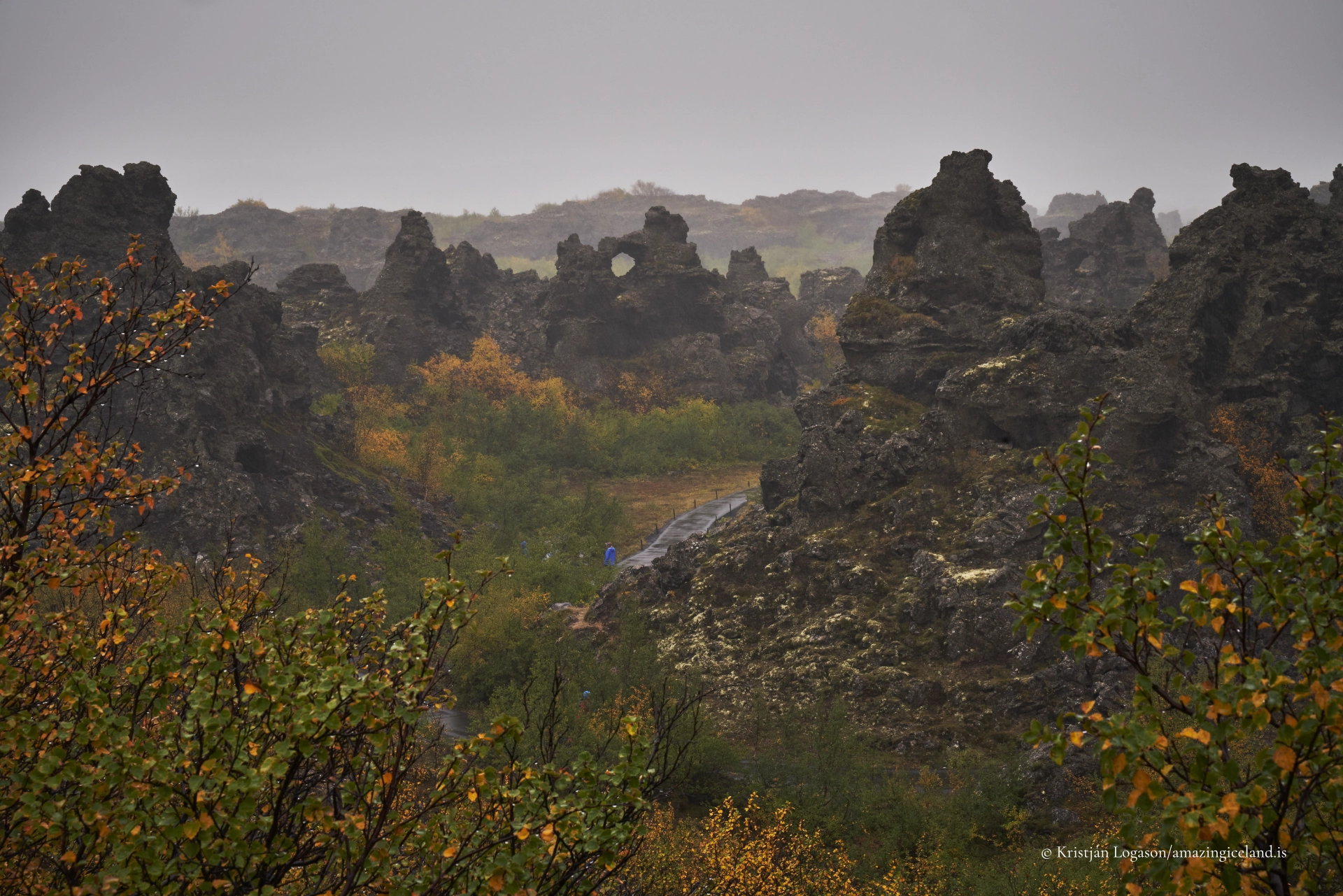
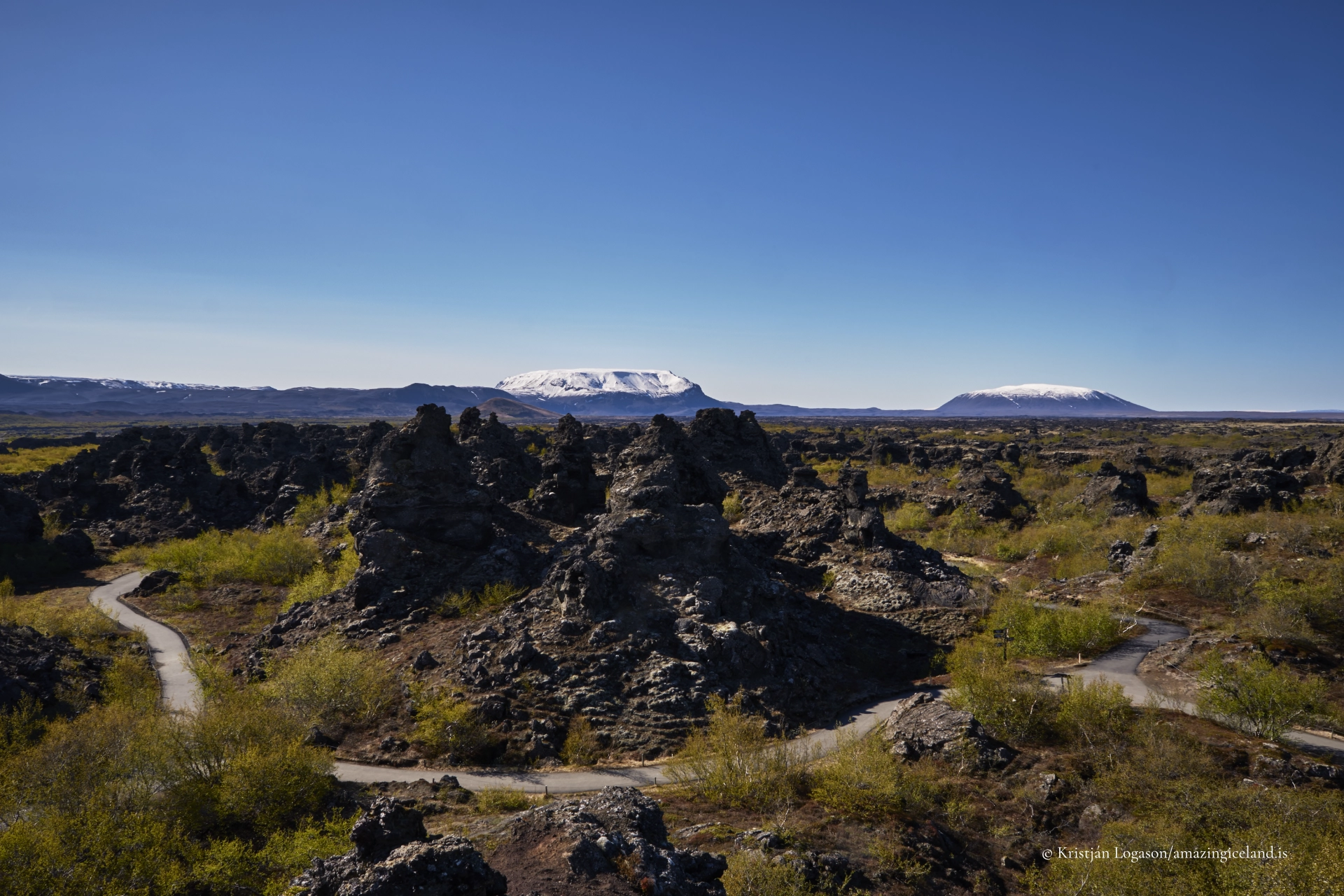
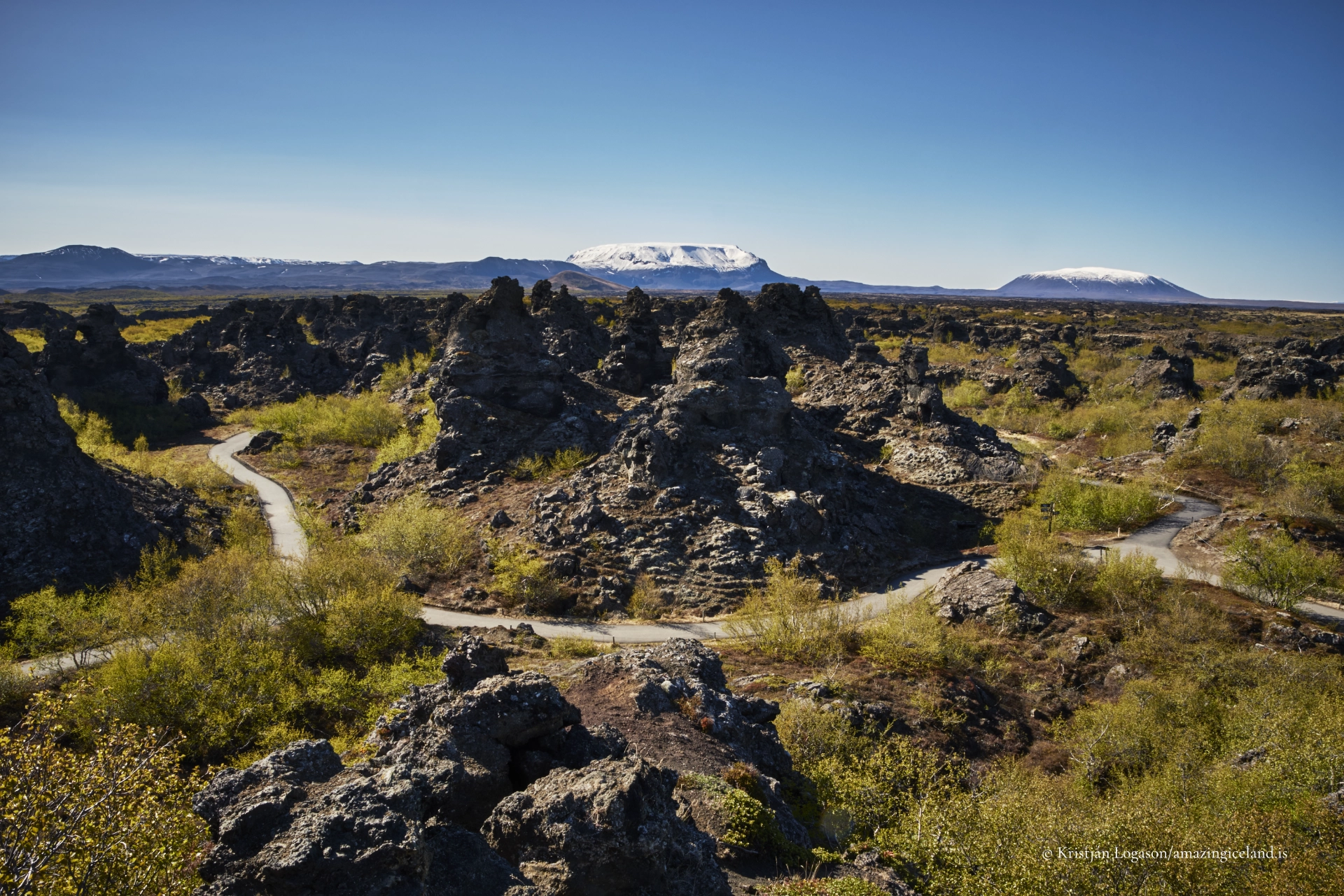
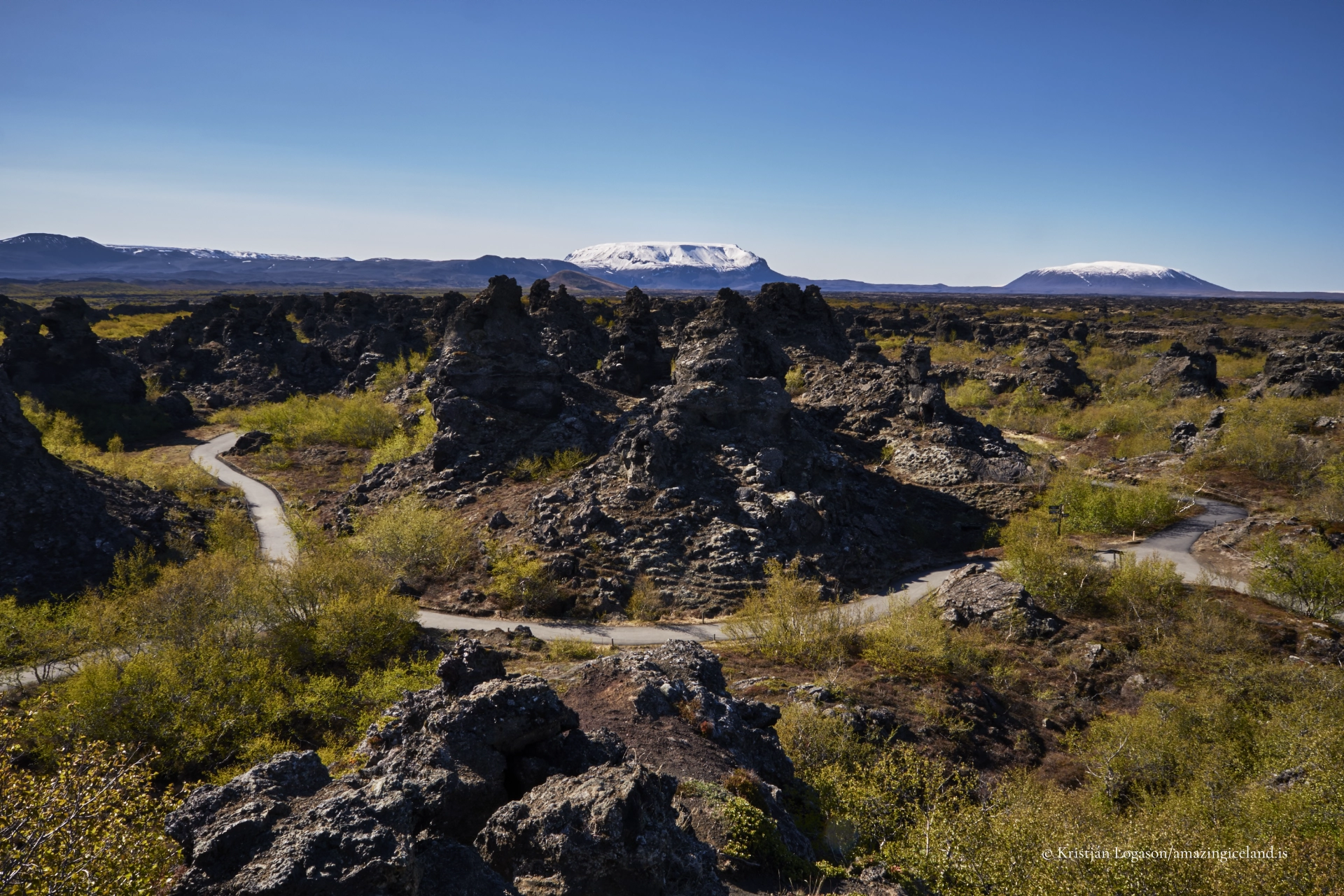
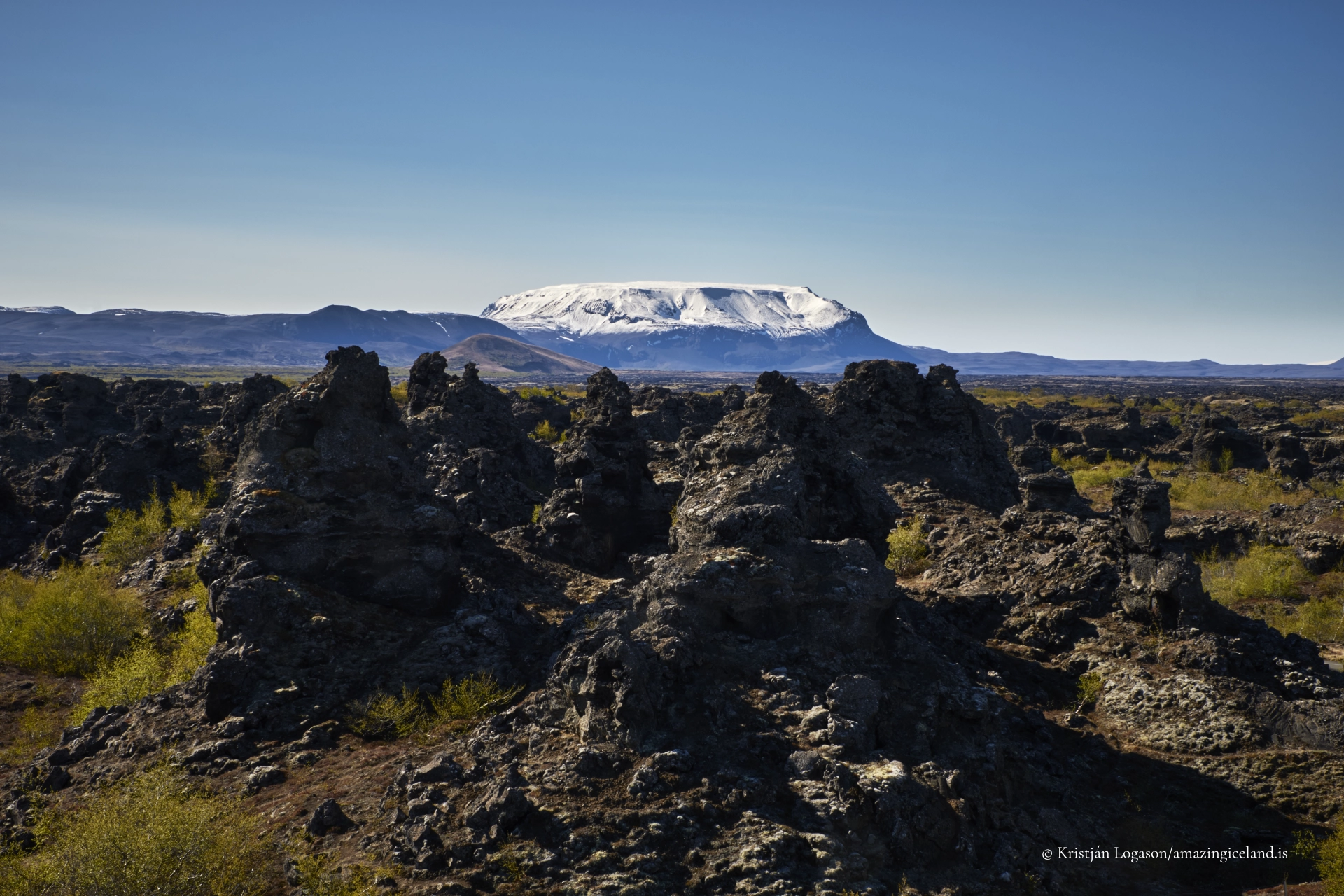
Located east of Lake Mývatn in North Iceland, Dimmuborgir is one of the country’s most distinctive lava landscapes. Unlike open lava plains or singular volcanic cones, Dimmuborgir is defined by complexity at human scale: narrow passages, towering lava walls, and natural arches formed through unusual cooling and collapse processes. It is a place where volcanic mechanics produce spatial experience.
The location of Dimmuborgir lava field
Latitude
65.5908
Longitude
-16.9126
Dimmuborgir lava field
Volcanic origin and lava mechanics
Dimmuborgir was formed approximately 2,300 years ago during eruptions associated with the same volcanic episode that created Lake Mývatn. The lava responsible was basaltic in composition but behaved atypically due to its interaction with standing water and saturated ground. Rather than spreading uniformly, the lava flowed into a shallow lake or wetland environment, creating a thick, ponded lava body.
As the lava surface cooled and solidified, molten material continued to move beneath the crust. Gas pressure built up within the lava, forming large bubbles and cavities. In places where the roof later collapsed, open chambers, arches, and vertical walls were exposed. In other areas, lava drained away, leaving behind hollow tubes and freestanding structures.
From a geological standpoint, Dimmuborgir represents a collapsed lava lake environment, distinct from both simple pāhoehoe flows and classic lava tube systems. The irregular cooling regime produced variable thickness, uneven structural support, and localized collapse—key ingredients for the labyrinthine morphology visible today.
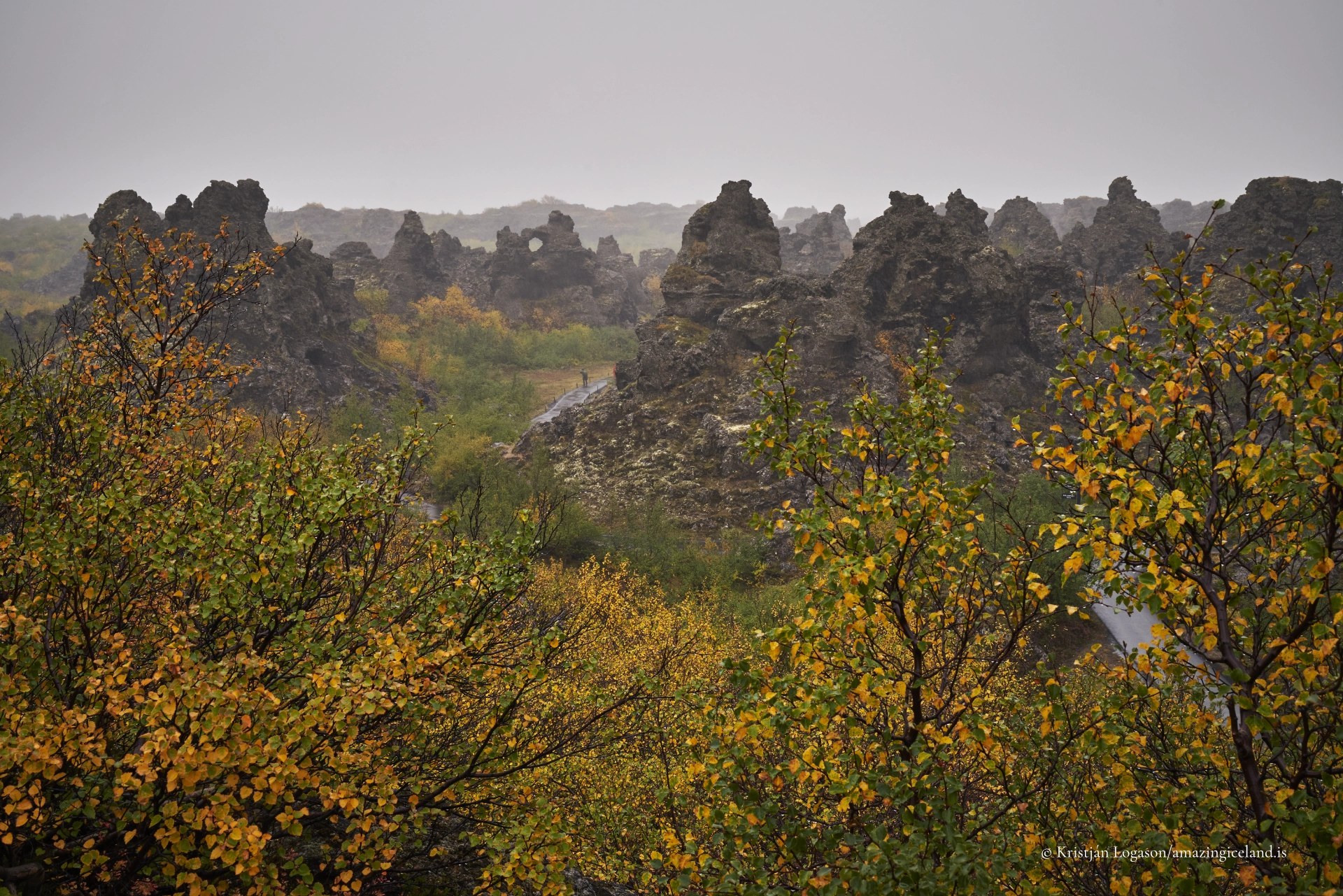
The scale of these features is central to their impact. Unlike massive lava formations that read primarily at landscape scale, Dimmuborgir operates at bodily scale. Walls rise several metres high, passages narrow to shoulder width, and openings frame sky and light with deliberate precision. This is not incidental; it is the direct outcome of lava behaving temporarily like a contained, dynamic fluid rather than an advancing front.
Morphology, erosion, and stability
Structurally, Dimmuborgir is composed of basalt that cooled relatively quickly once exposed, producing brittle rock prone to jointing and fracture. Over time, frost action, minor seismic activity, and weathering have further modified edges and surfaces, sharpening some features while softening others.
Despite its apparent fragility, the lava field is largely stable. Major collapses occurred shortly after formation, and contemporary change is slow and incremental. However, stability varies locally. Thin lava roofs, unsupported arches, and undercut walls remain vulnerable to vibration and physical stress, which is why climbing on formations is prohibited.
The visual darkness implied by the name—“Dark Castles”—is as much about enclosure as color. Light behaves differently here, filtered through narrow openings and interrupted by walls. This creates high contrast and rapid shifts between illumination and shadow, reinforcing the sense of constructed space.
From a geomorphological perspective, Dimmuborgir offers a rare opportunity to study void-dominated volcanic structures. The emphasis is not on accumulation but on absence: spaces where lava once was, now defining form through their emptiness.
Cultural interpretation and folklore
Dimmuborgir occupies a prominent place in Icelandic folklore and cultural imagination. Its name and form have long been associated with the supernatural, most famously as the traditional home of the Yule Cat and the Icelandic Yule Lads in later folklore traditions. These associations are not arbitrary; the enclosed, cave-like spaces and fortress-like walls lend themselves naturally to mythic interpretation.
In older narratives, such landscapes were often understood as liminal zones—places where the ordinary rules of the world weakened. While modern visitors may approach Dimmuborgir primarily through geology or tourism, the persistence of folklore highlights how physical form shapes cultural meaning.
Importantly, this folkloric layer does not conflict with scientific understanding. Instead, it reflects pre-scientific attempts to explain a landscape that visibly defies expectation. Even today, Dimmuborgir resists quick categorization, reinforcing its status as a place where explanation and imagination coexist.
Visiting Dimmuborgir—access, movement, and responsibility
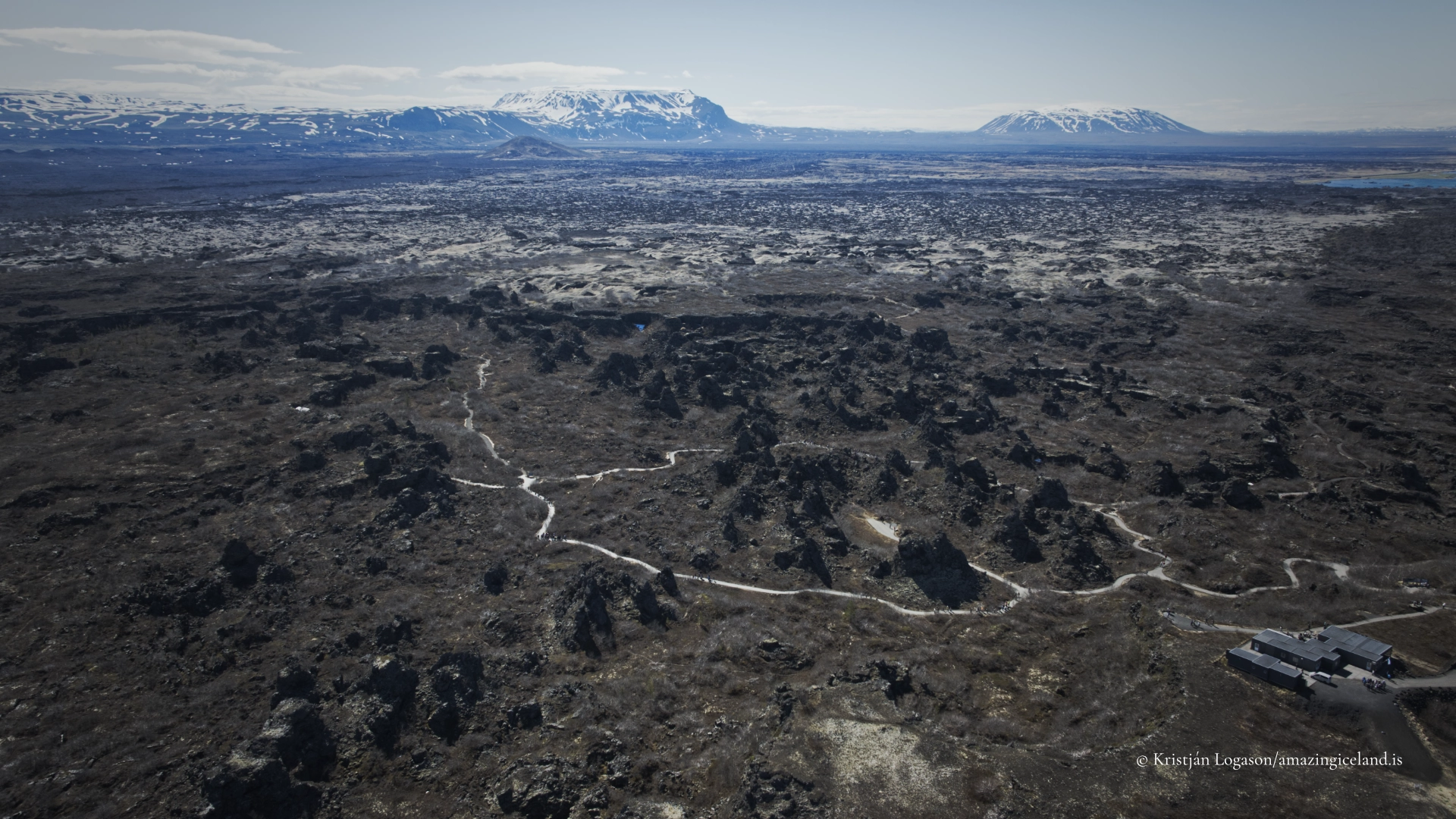
Dimmuborgir is one of the most accessible natural sites in the Mývatn region, with a designated parking area and a network of marked walking trails. These trails vary in length and difficulty, guiding visitors through different structural zones while minimizing impact on fragile surfaces.
Movement through Dimmuborgir is inherently immersive. Unlike viewpoints that frame a scene from a distance, this is a landscape entered bodily. Paths wind between formations, forcing changes in pace, posture, and orientation. This physical engagement is central to the site’s appeal and should be respected through careful movement and adherence to marked routes.
Leaving trails is discouraged not only for conservation reasons but for safety. Lava edges can be sharp, unstable, and deceptively thin. The same voids that create visual drama also create hidden hazards beneath the surface.
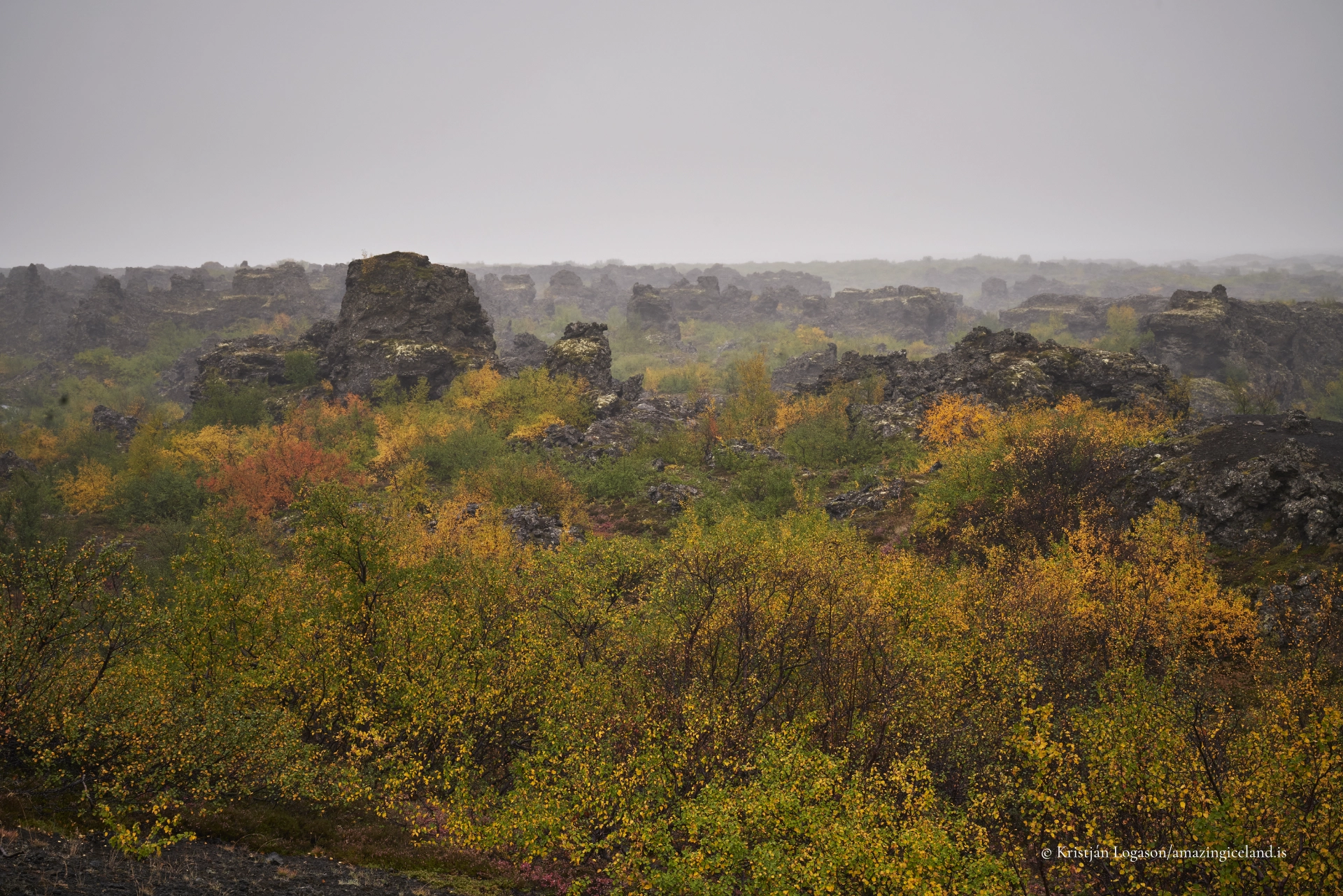
Seasonal conditions significantly alter access. In winter, snow can obscure trail boundaries and conceal cavities, increasing risk. In summer, vegetation softens some edges but also hides unstable ground. Responsible visitation means adapting expectations to conditions rather than treating the site as uniformly benign.
Dimmuborgir within the Mývatn system
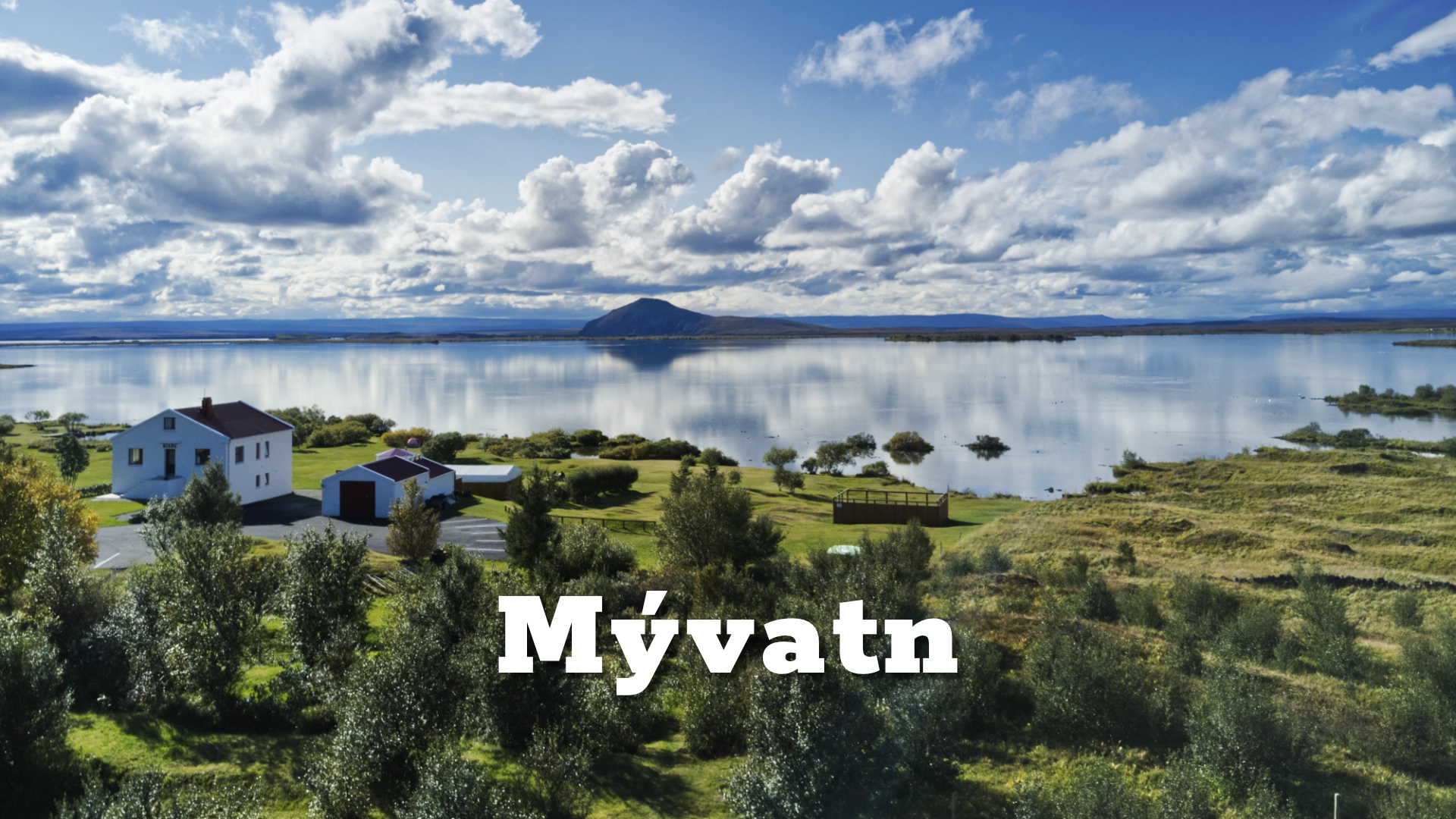
Within the broader Mývatn landscape, Dimmuborgir functions as a structural counterpoint to open water, wetlands, and geothermal fields. Where the lake emphasizes biological productivity and surface continuity, Dimmuborgir emphasizes interruption, enclosure, and verticality.
Together, these sites illustrate the diversity of outcomes produced by a single volcanic episode. Lava that dammed water and nourished ecosystems also produced collapsed voids and labyrinthine forms only a short distance away. This proximity reinforces a central theme of North Iceland: volcanic activity is not a singular force but a generator of radically different environments.
Dimmuborgir therefore rewards contextual visitation. Understanding its relationship to Lake Mývatn, pseudocraters, and surrounding lava fields deepens appreciation and prevents the site from being reduced to a visual novelty.
Interesting facts:
- Dimmuborgir formed around 2,300 years ago, during eruptions linked to the Mývatn area.
- The formations result from a collapsed lava lake, not standard lava flows.
- The name means “Dark Castles,” referencing fortress-like shapes and shadowed spaces.
- The area is closely linked to Icelandic folklore, including later Christmas traditions.
- Dimmuborgir’s structures are defined by voids and cavities, not accumulated mass.
- Dimmuborgir was used as a filming location for Game of Thrones, where its lava formations represented areas north of the Wall, including the camp of the Wildlings.
- The site’s natural arches, enclosed corridors, and fortress-like lava walls required minimal set dressing, making it an ideal stand-in for a harsh, volcanic wilderness beyond human settlement.
- Unlike many filming locations, Dimmuborgir’s visual character is almost entirely natural; production design relied primarily on existing geological structure rather than constructed scenery.
- The association with Game of Thrones significantly increased international visitation, accelerating the need for formal trail systems and conservation-focused visitor management.
Image Gallery
The Locomotive Elite
What do Donald Trump and Iceland’s Locomotive Elite have in common?
Far more than you think.
In The Locomotive Elite, you’ll uncover how a tiny clique in Iceland captured extensive control—of banks, courts, media, and even the central bank.
For decades they ruled, first democratically, then through corruption and in the end through crime, enriching themselves and their cronies while dismantling oversight.
The result?
One of the most spectacular financial collapses in modern history.
Photography tips:
- Work with light transitions: doorways, arches, and narrow gaps frame contrast effectively.
- Avoid ultra-wide distortion: moderate focal lengths preserve spatial realism.
- Shoot sequences: movement through space is part of the story.
- Overcast conditions excel: they reduce harsh contrast and preserve texture.
- Respect scale: avoid climbing formations for perspective—human figures on paths suffice.
Good cameras for Iceland
Sony A7R V

Sony A7s lll

Canon R6

Nikon Z6 lll

Destinations nearby
Good to have in Iceland