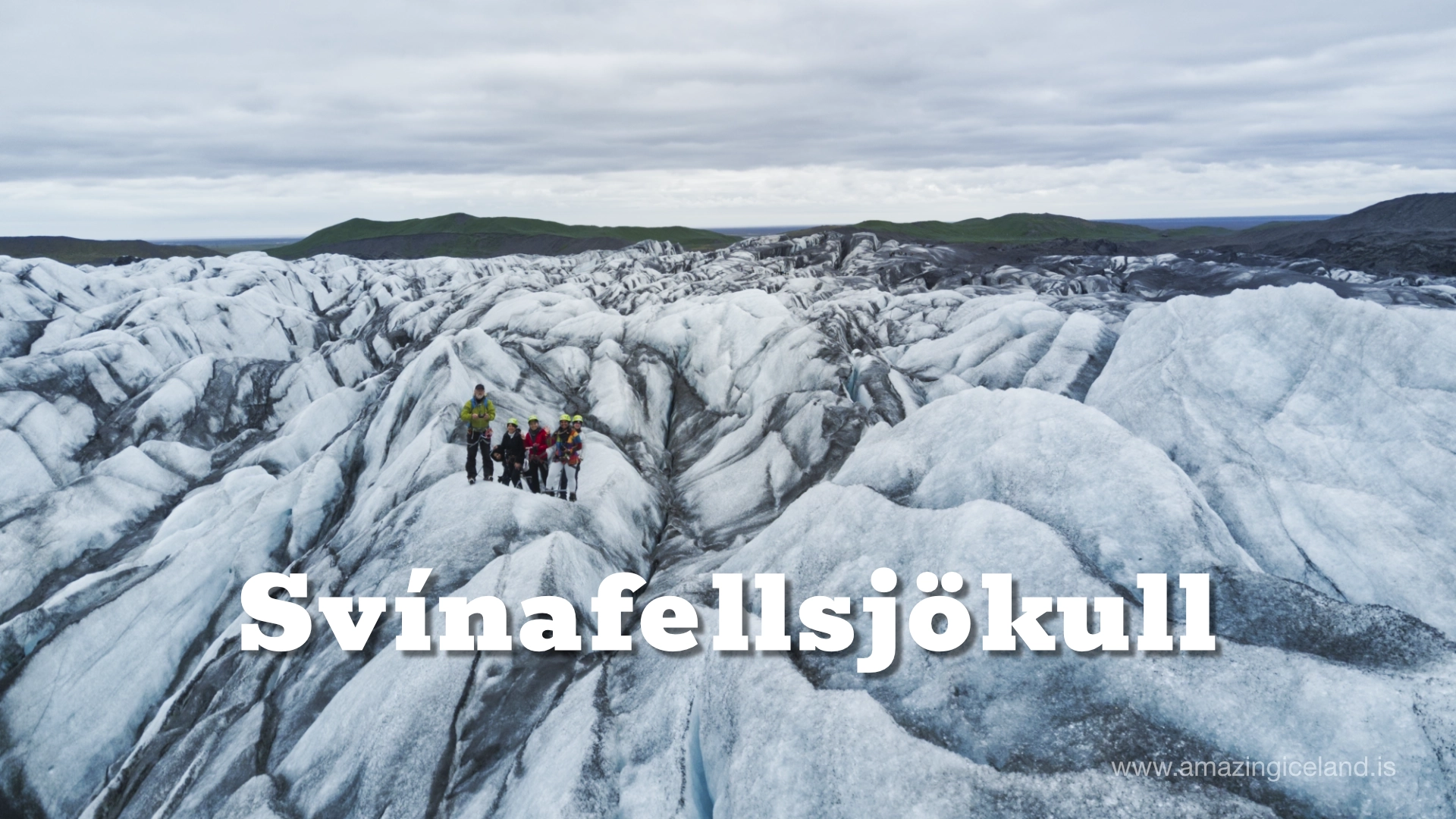
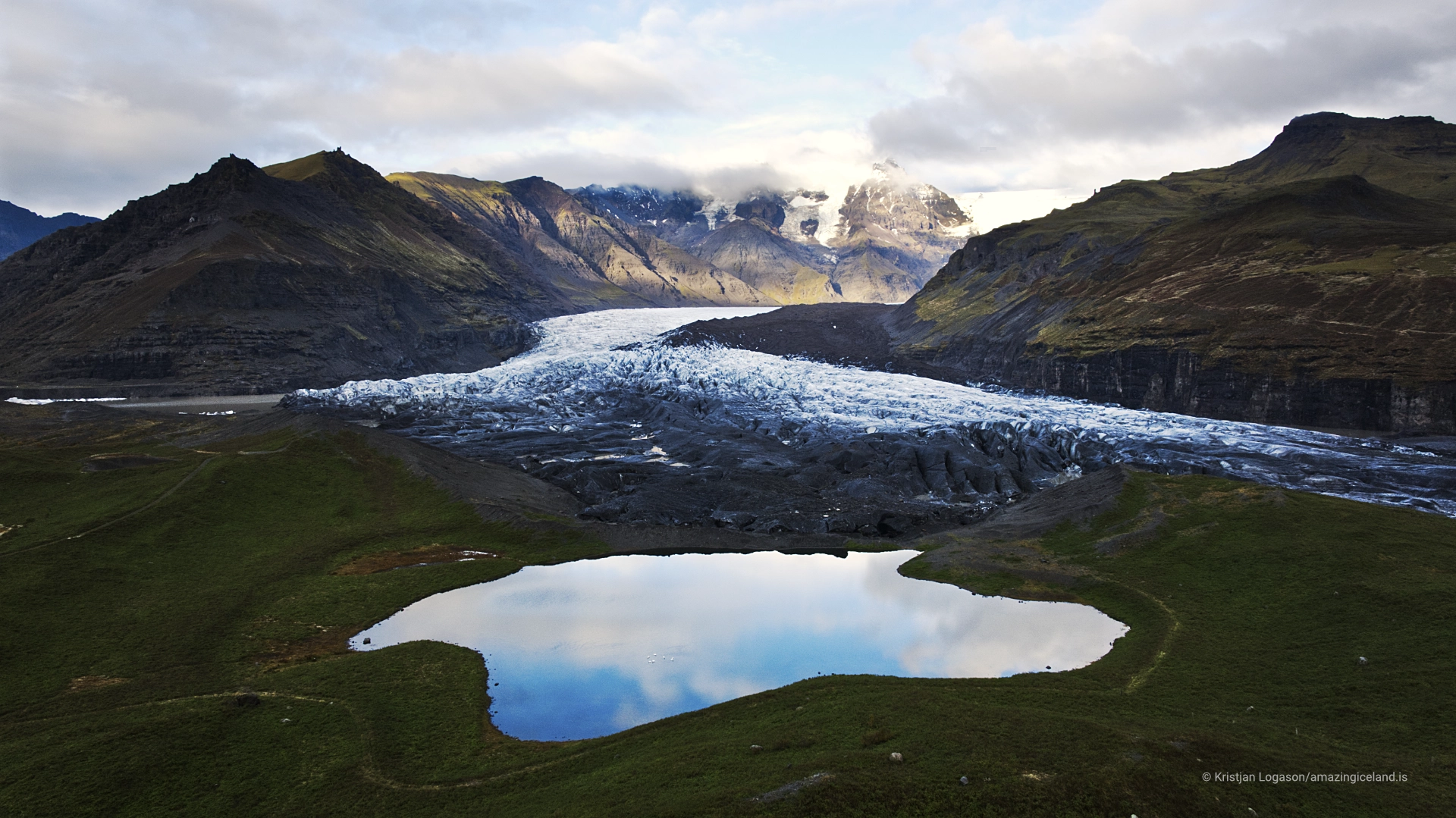
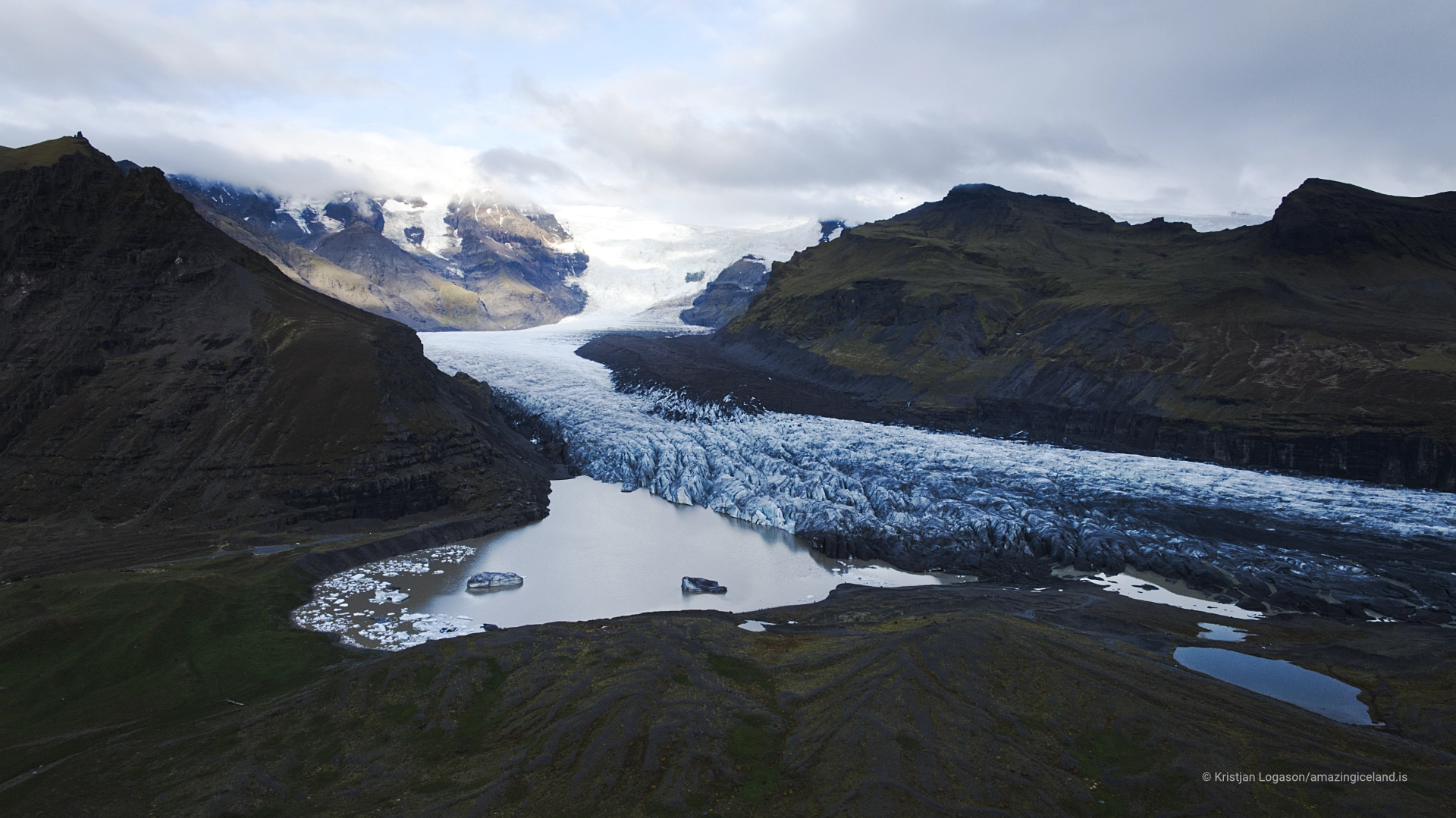
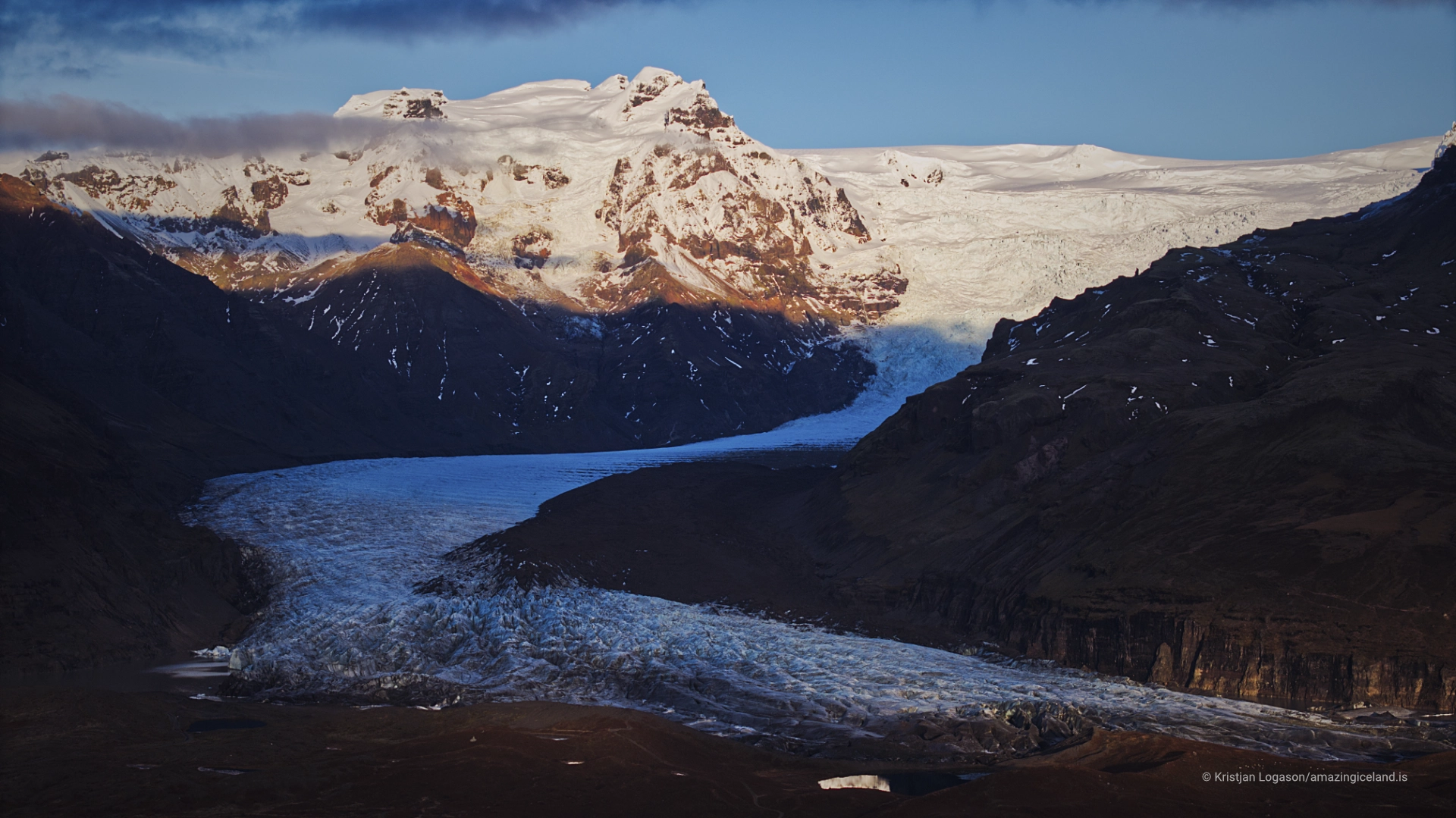
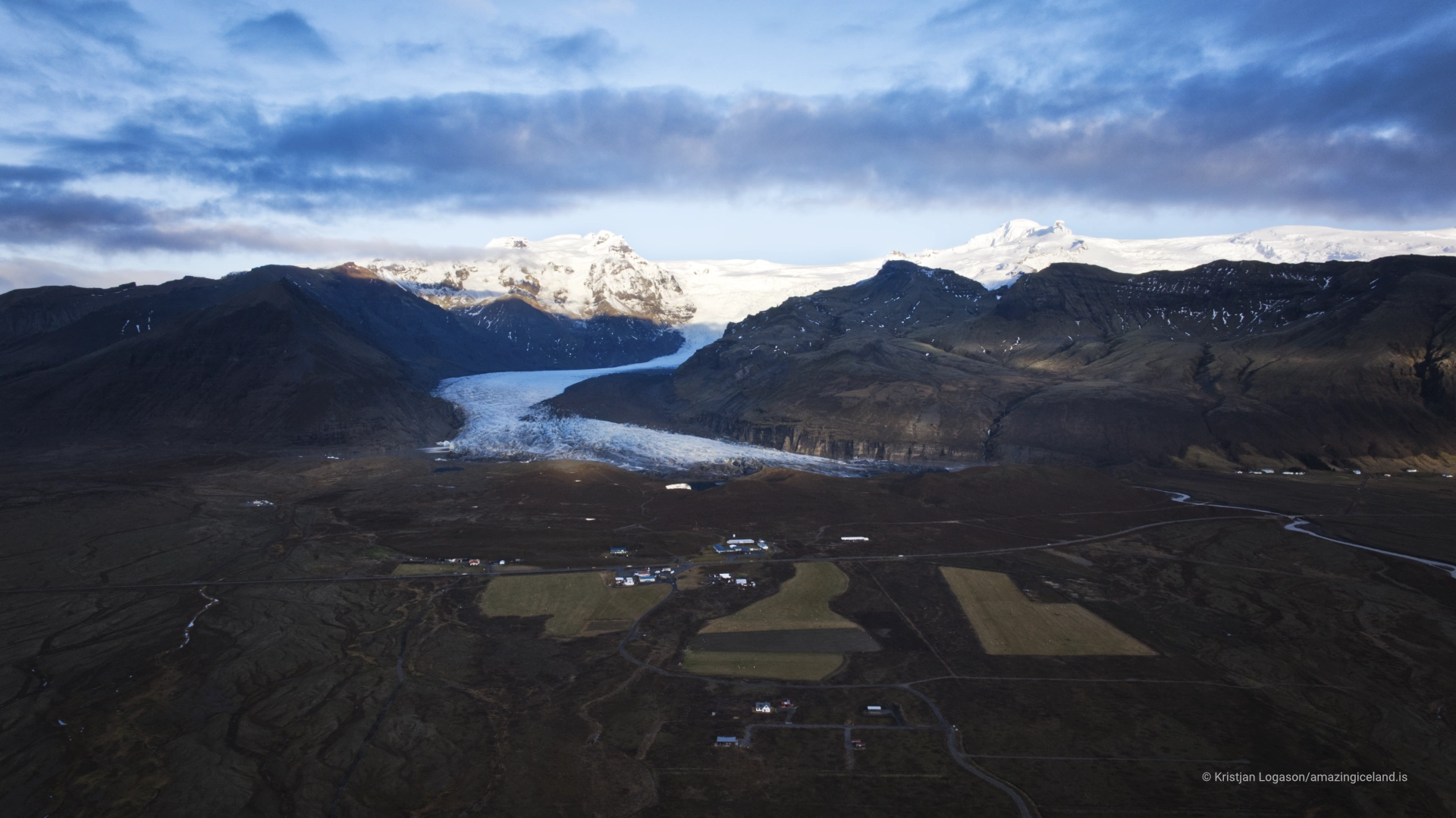
At the southern margin of Vatnajökull, Svínafellsjökull extends into a steep-sided valley near Skaftafell. Known for its heavily crevassed surface and sharply defined icefall, the glacier offers an unusually clear view into the structure and movement of temperate ice—an encounter grounded in observation rather than scale alone.
The location of Svínafellsjökull glacier
64.0037
Latitude
Longitude
-16.9775
Svínafellsjökull glacier
Svínafellsjökull is one of several outlet glaciers flowing southward from Vatnajökull, Europe’s largest ice cap by volume. As an outlet, it functions as a drainage channel, transferring ice from the accumulation zones of the ice cap toward lower elevations where melting dominates. This mass balance—gain at altitude, loss at the margin—defines the glacier’s form and behavior.
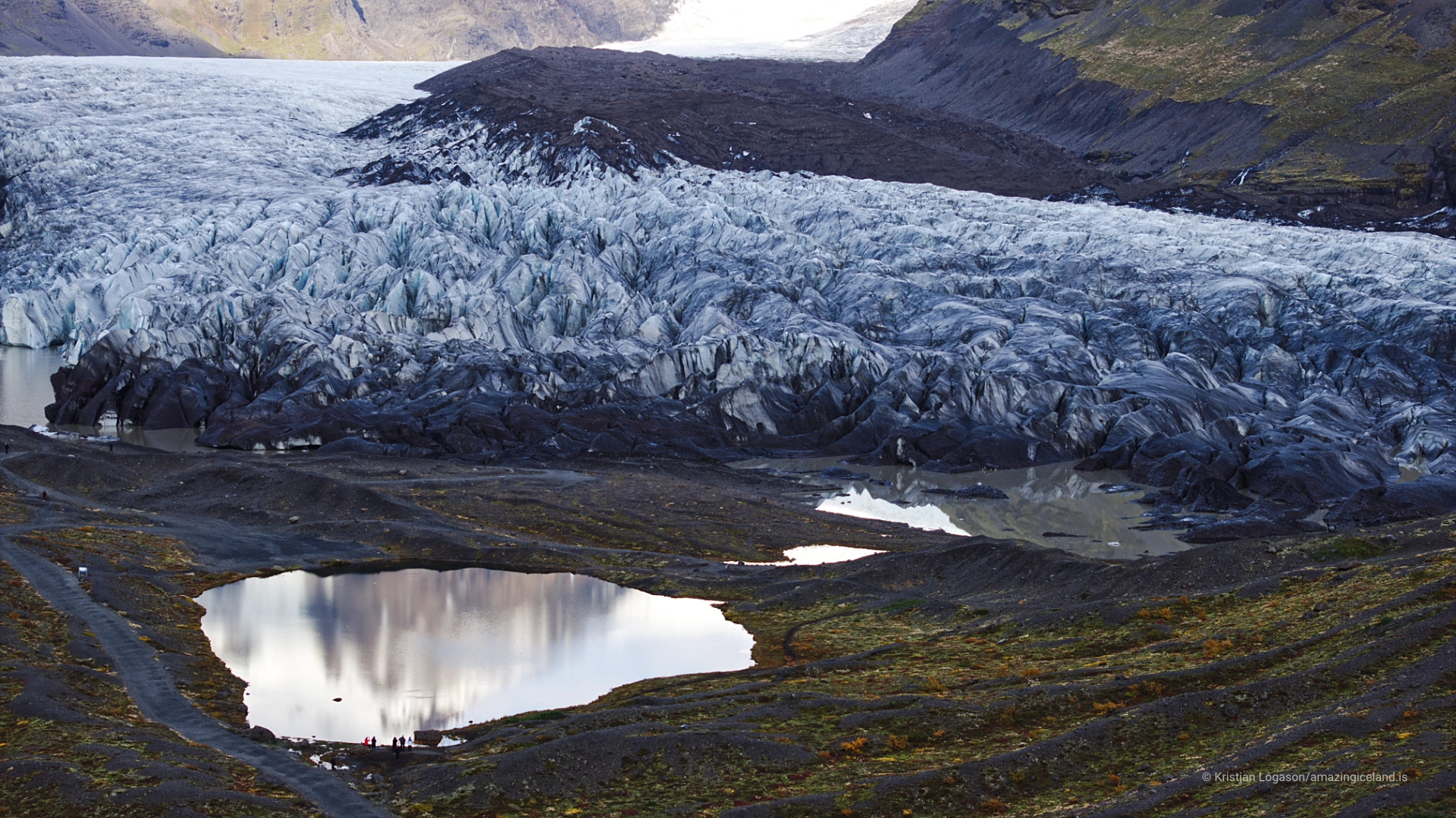
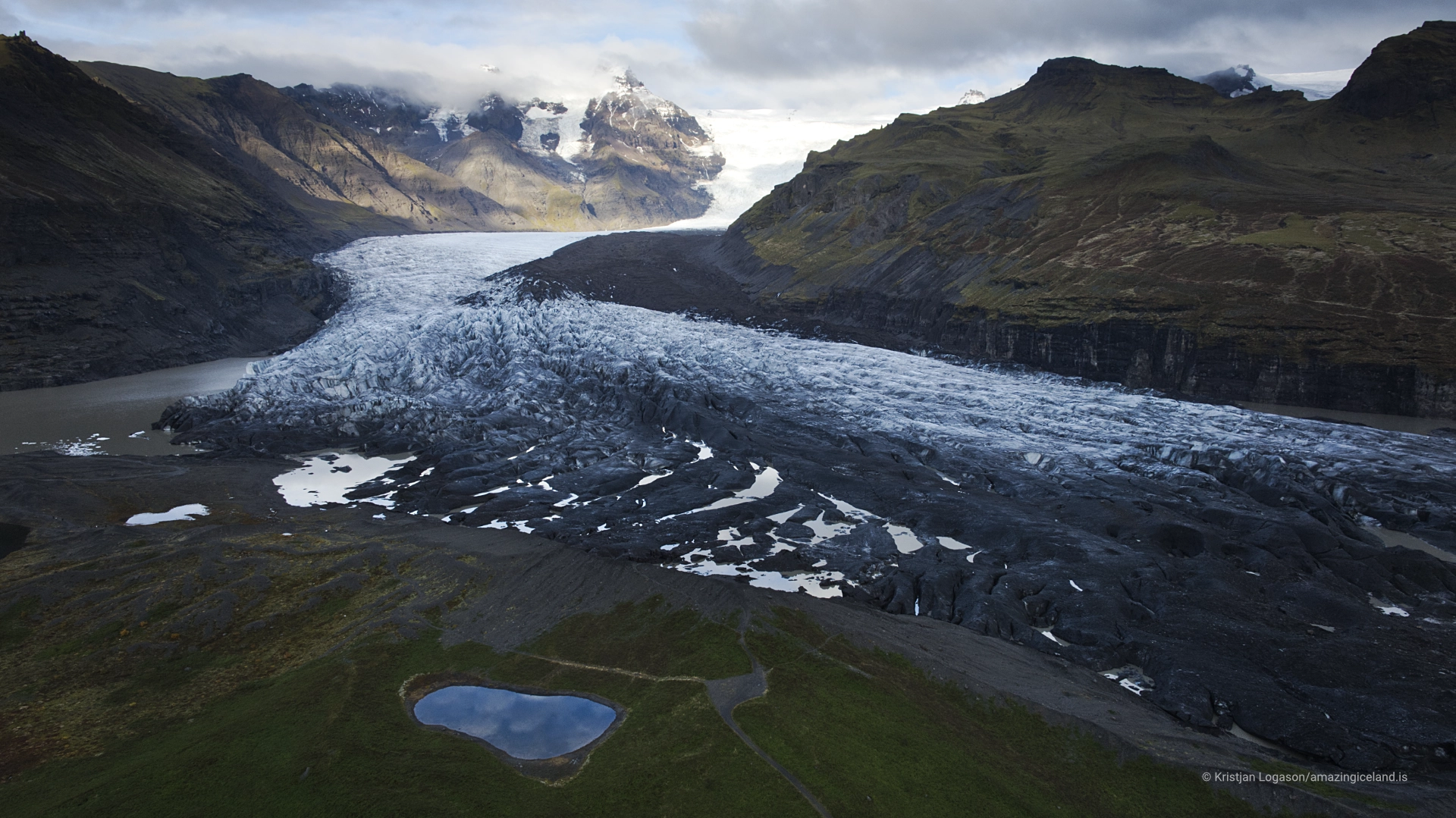
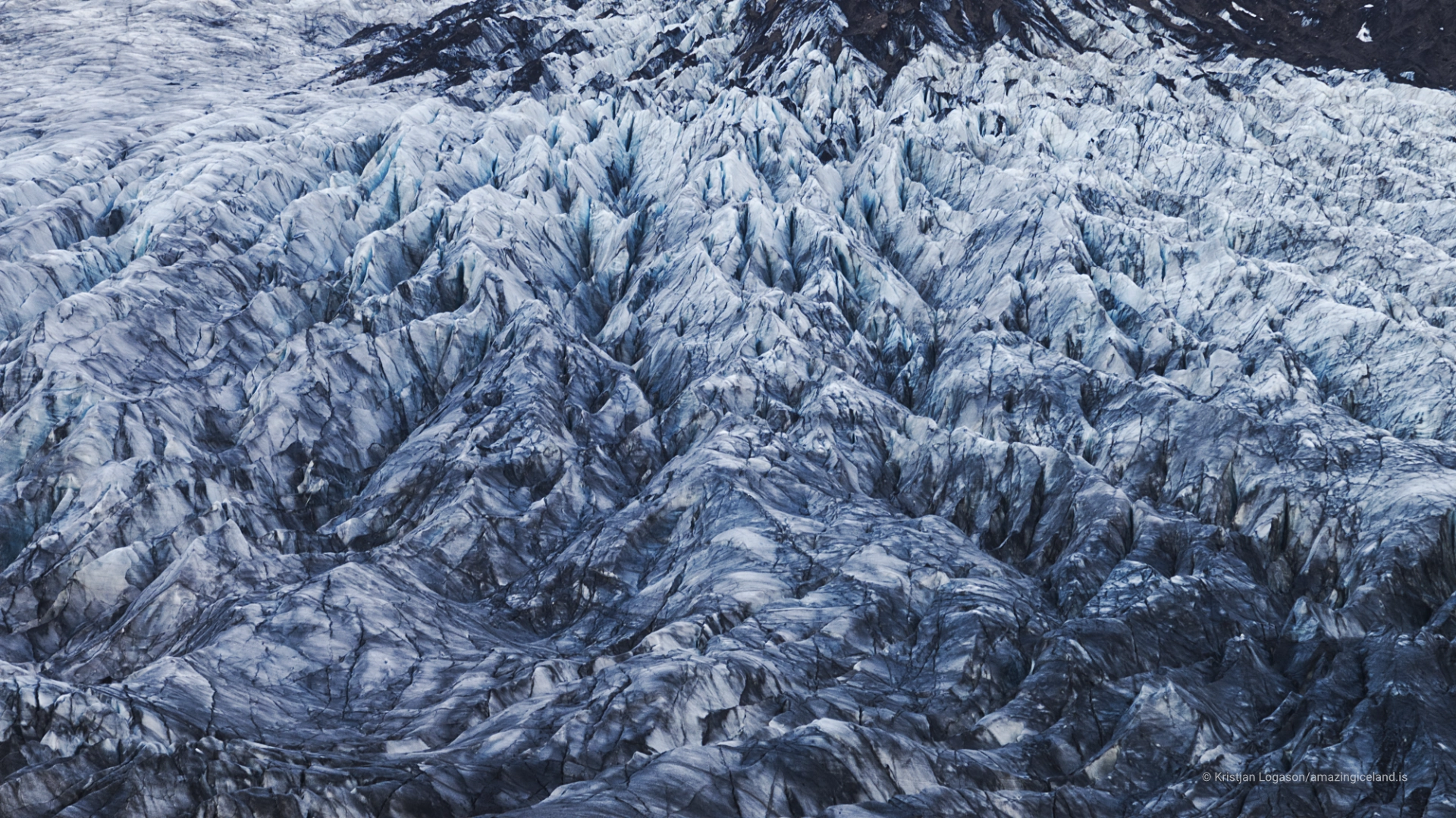
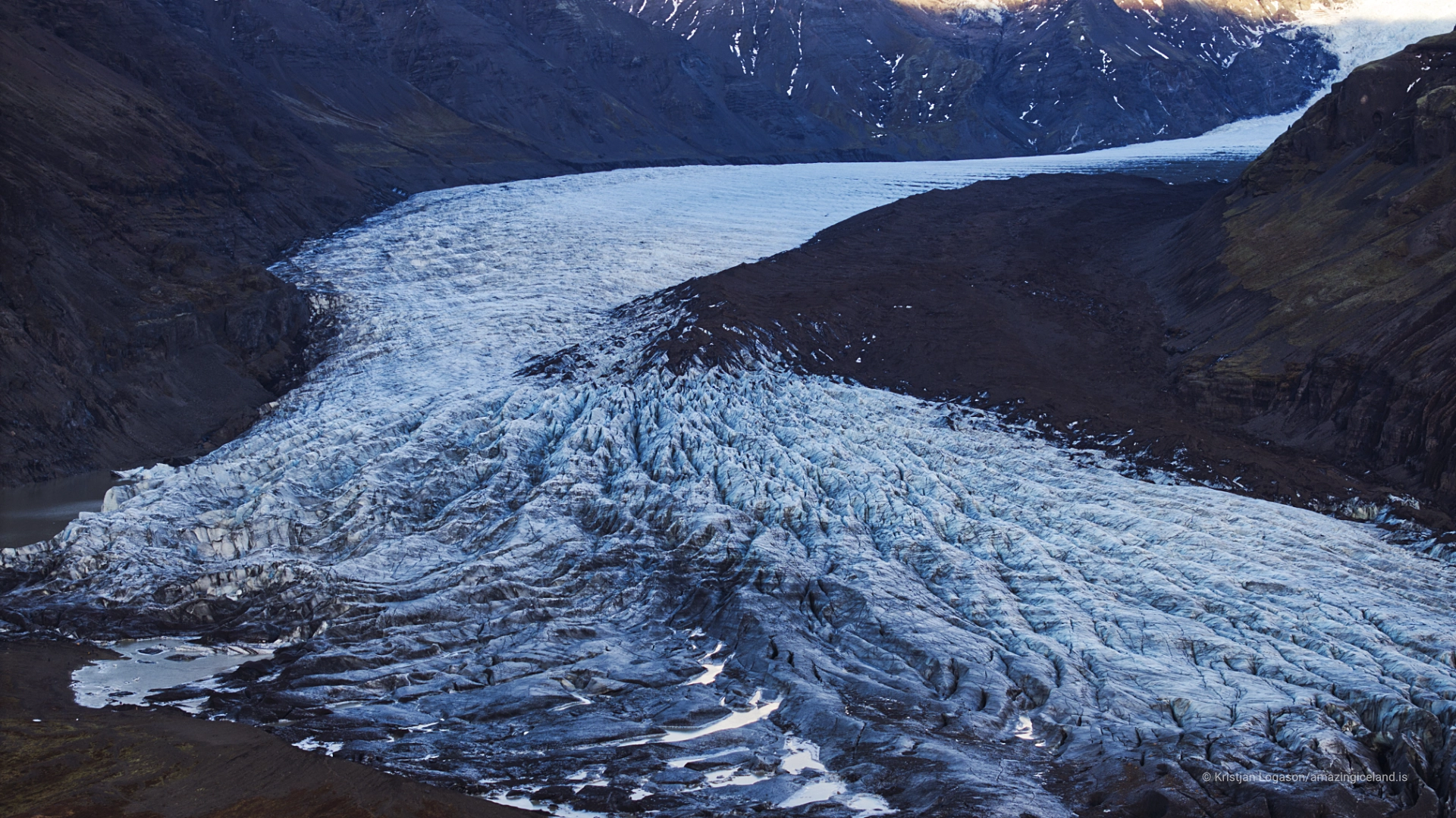
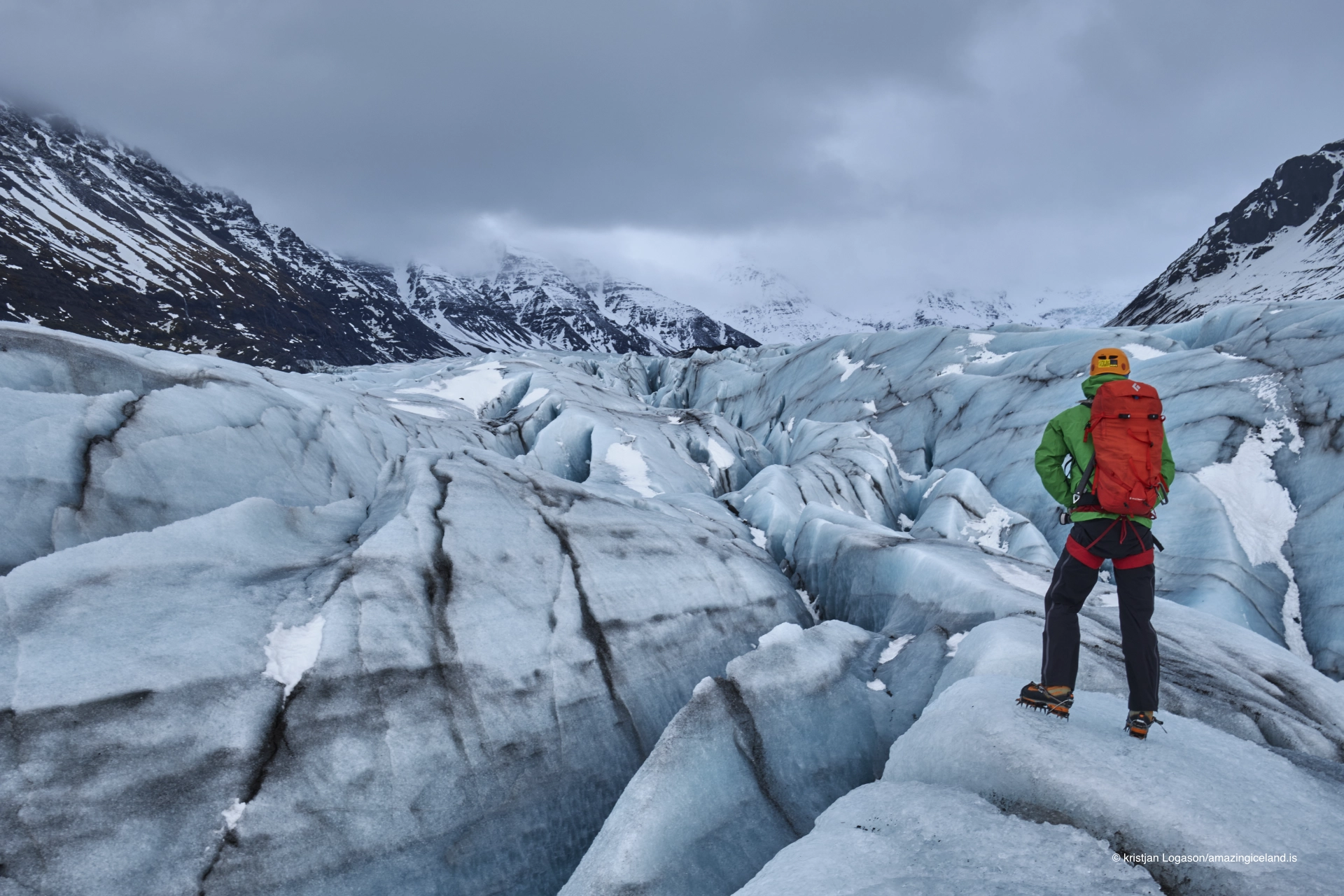
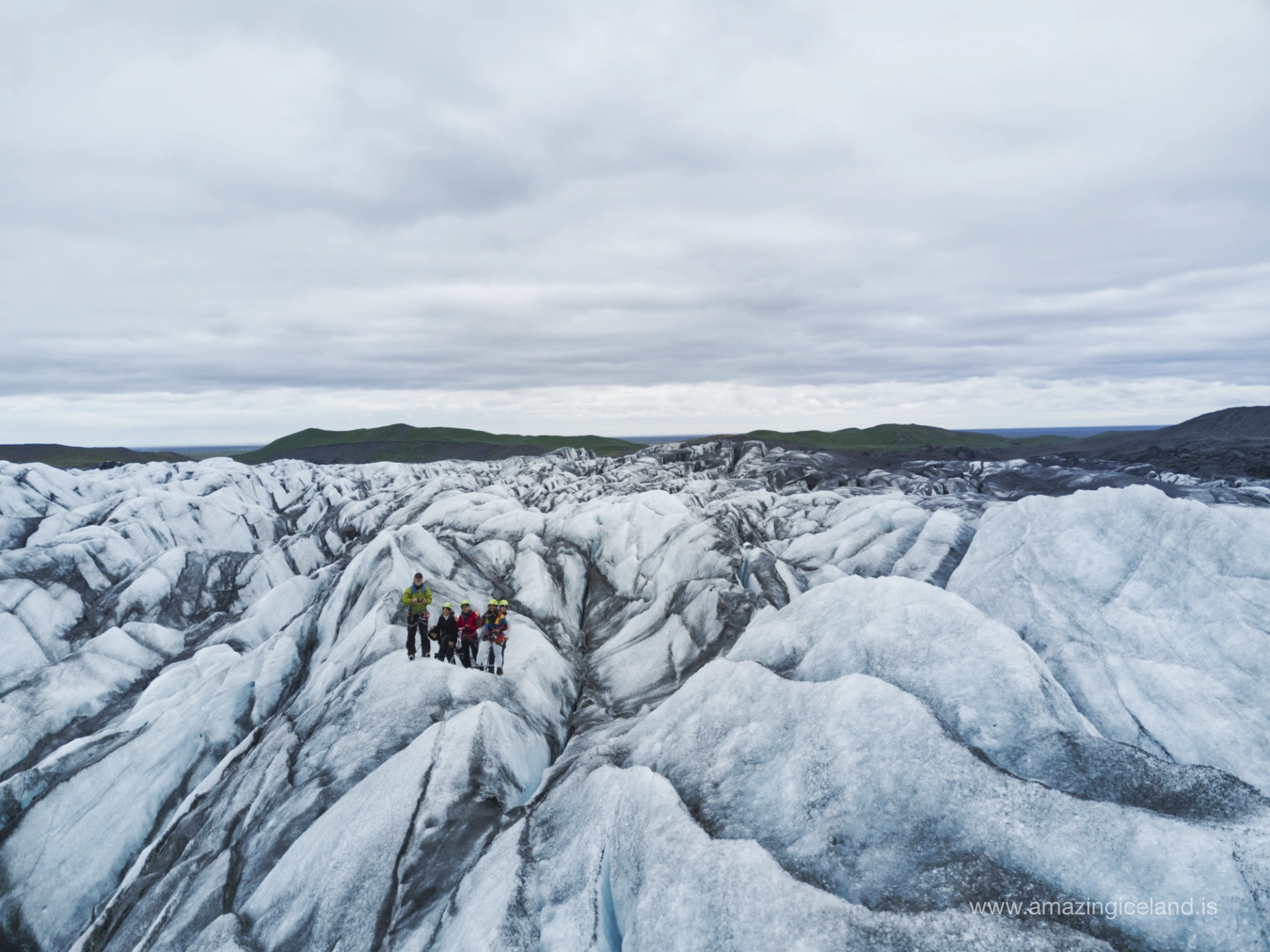
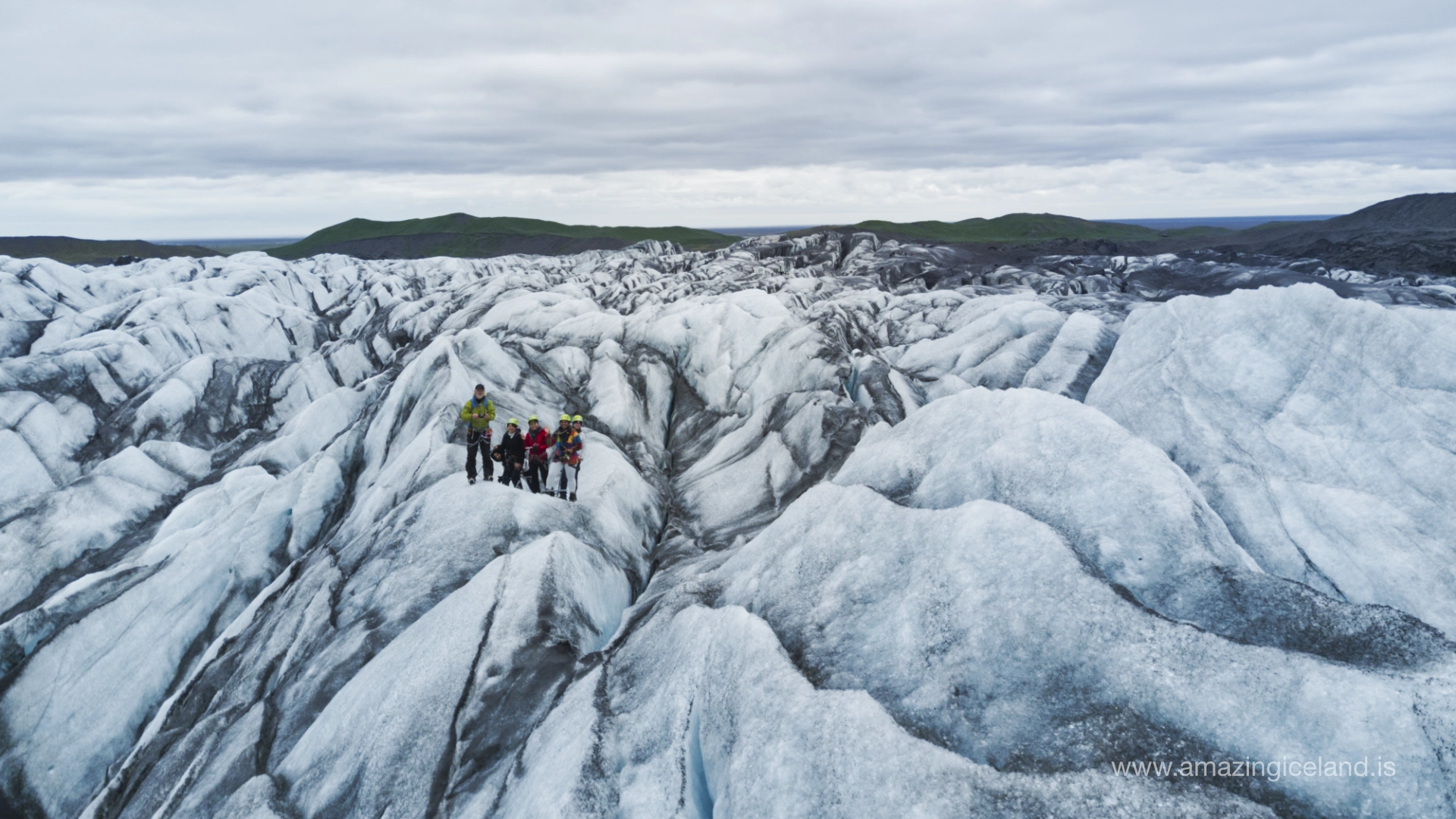
The glacier descends into a narrow valley bordered by steep rock walls and lateral moraines, which confine flow and increase strain within the ice. The result is a surface marked by dense crevasse fields, particularly near the icefall where slope steepens and velocity increases. These fractures are not random; they map stress patterns within the moving ice and provide visual evidence of differential flow rates across the glacier body.
From a glaciological standpoint, Svínafellsjökull is classified as a temperate glacier, meaning the ice is at or near the pressure-melting point throughout much of its thickness. This condition allows meltwater to penetrate crevasses and reach the glacier bed, influencing basal sliding and flow speed. The blue tones often visible in crevasse walls result from compressed ice absorbing longer wavelengths of light—an optical effect tied directly to ice density and structure.
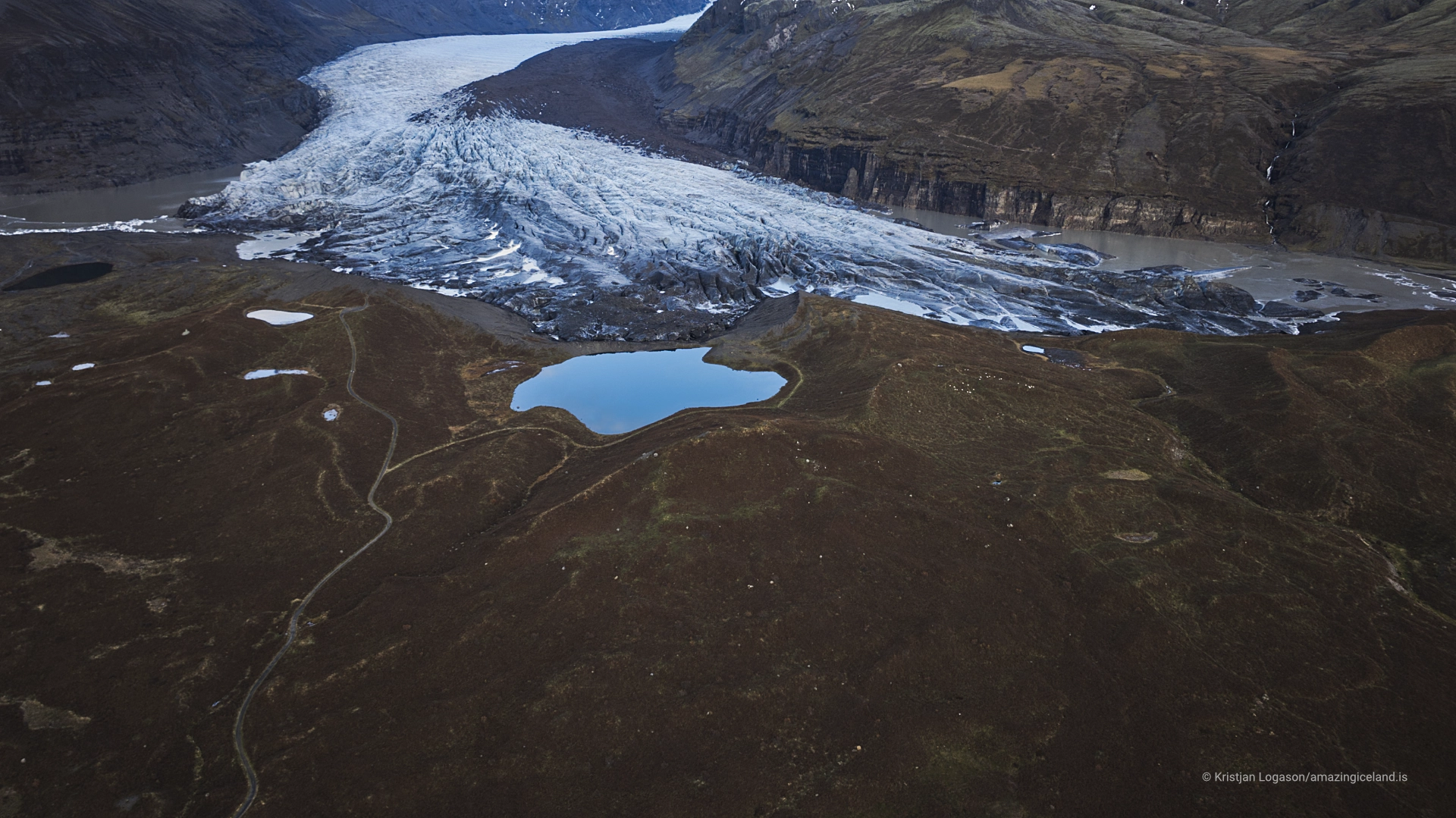
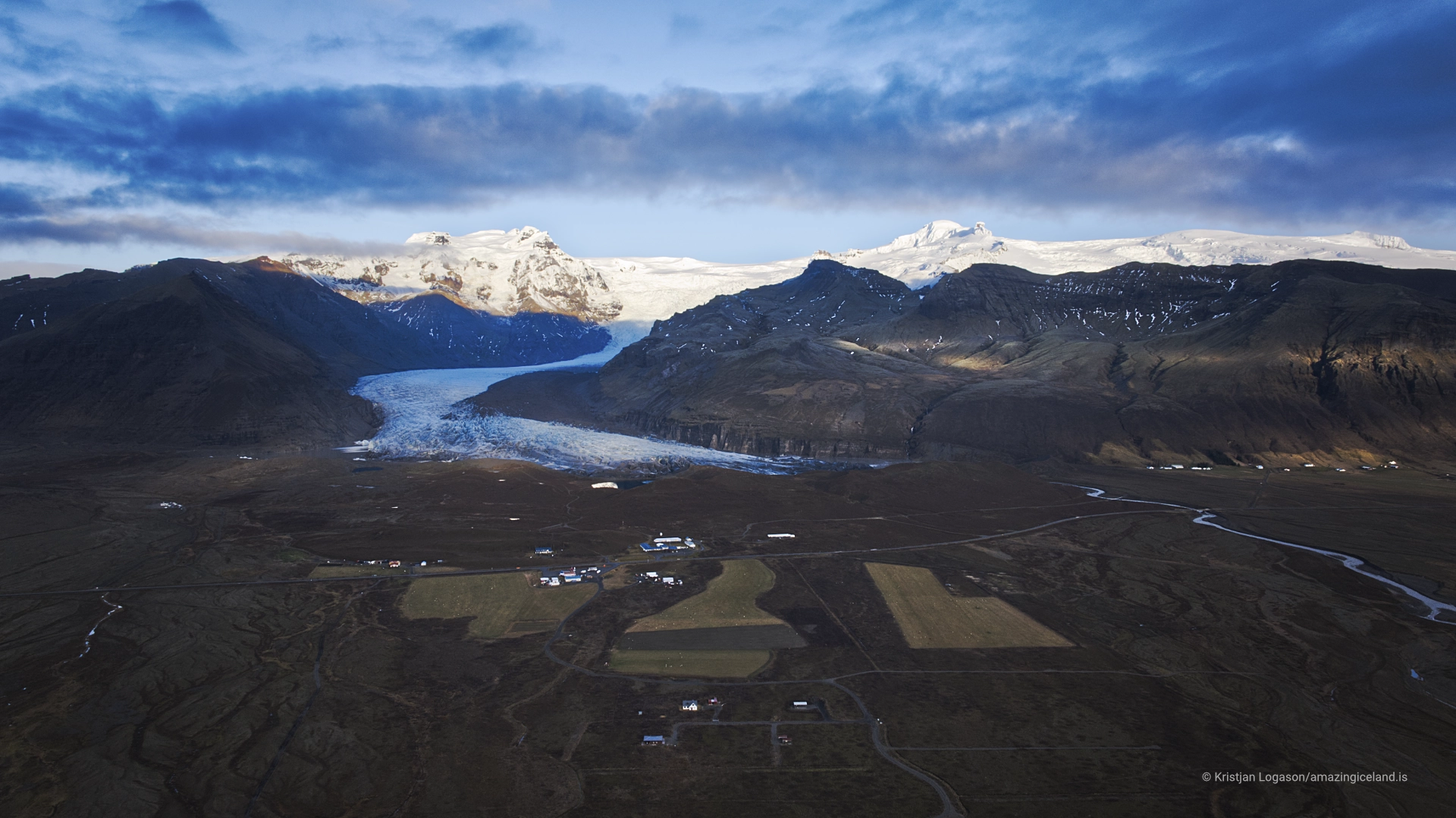
The forefield in front of the glacier is equally instructive. Moraines composed of unsorted sediment mark former ice positions, while meltwater channels cut rapidly through loose material. These features document recent retreat and re-advance phases, making the area a compact archive of short-term climate response.
Svínafellsjökull sits within Vatnajökull National Park, close to the Skaftafell area, which historically served as a hub for glacier observation and access. Unlike broader, flatter outlets, Svínafellsjökull’s steep gradient compresses many glacial processes into a short distance, enhancing legibility for both scientific interpretation and careful visitation.
The glacier has long been favored for guided glacier walks and technical ice climbing, precisely because its crevasse density and serac formations reveal internal ice dynamics so clearly. That same complexity, however, demands respect. Icefall zones are inherently unstable, and collapse events can occur without warning. Contemporary best practice emphasizes guided travel and strict avoidance of unassessed routes.
Hydrologically, meltwater from Svínafellsjökull feeds braided streams that fluctuate rapidly with temperature and rainfall. These outwash systems transport fine sediment downstream, continually reworking the forefield. Over time, this sediment load contributes to the dark plains characteristic of the region—another example of how glacial and volcanic systems intersect in southern Iceland.
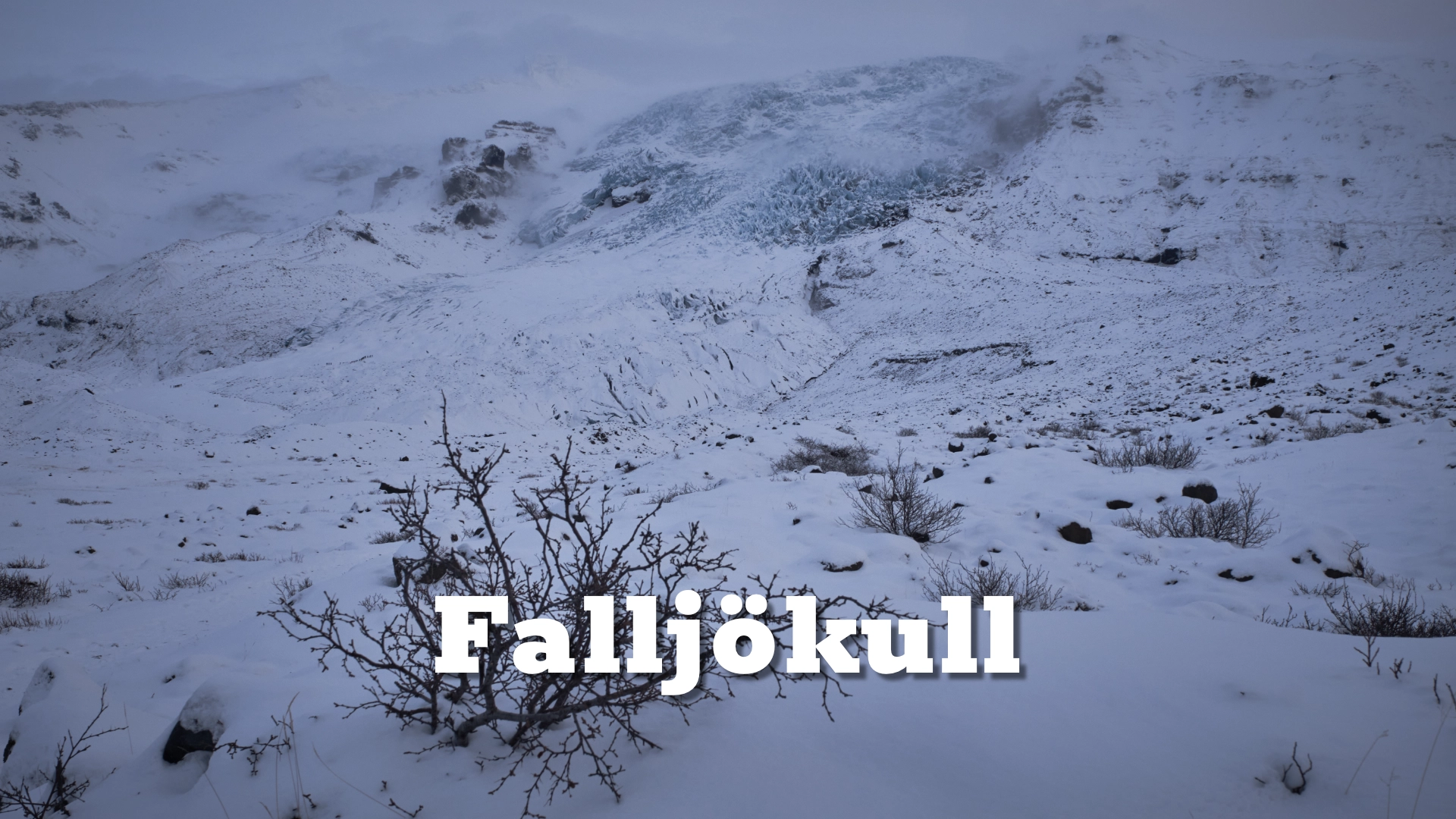
Seasonality strongly influences how Svínafellsjökull is experienced. In winter, snow cover can temporarily mask crevasses, smoothing the surface while increasing objective hazard. In summer, exposed ice reveals fracture patterns and internal layering with greater clarity, but melt intensifies instability at the margins. Each season alters not only appearance, but the balance of risk and access.
Climate trends are written directly into the glacier’s geometry. Like many of Vatnajökull’s outlets, Svínafellsjökull has undergone measurable retreat in recent decades. The terminus position fluctuates annually, but the longer-term signal is one of thinning and shortening. Moraines that once marked the ice front now sit well beyond it, offering fixed reference points against which change becomes unmistakable.
This retreat is not abstract. It changes slope angles, meltwater routing, and crevasse distribution, effectively reshaping the glacier’s internal stress field. For observers, this means the glacier is not a static object to be revisited unchanged, but a system that must be re-read each time.
Visually, Svínafellsjökull is defined by contrast rather than color range. The dominant palette—white and blue ice against black moraine and dark rock—creates a stark, analytical clarity. There is little visual noise. Forms are sharp, transitions abrupt, and scale is communicated through fracture spacing and serac height rather than distant horizons.
Importantly, the surrounding valley constrains viewpoints. Unlike open plains glaciers, Svínafellsjökull is best read from selected positions that reveal flow direction and surface deformation. Choosing where to stand becomes part of understanding what you are looking at.
Svínafellsjökull ultimately functions as a teaching glacier. It shows how ice behaves when forced through narrow terrain, how water interacts with temperate ice, and how climate signals propagate from accumulation zone to terminus. It is not the largest or longest outlet, but it is among the most legible.
In the broader context of Vatnajökull National Park, the glacier underscores a central reality: Iceland’s ice is dynamic, responsive, and currently changing. Observing Svínafellsjökull is therefore not only about appreciating form, but about acknowledging process—ice in motion, landscape in transition.
Interesting facts:
- Svínafellsjökull is an outlet glacier flowing from Vatnajökull.
- It is a temperate glacier, allowing meltwater to influence basal sliding.
- The glacier is known for dense crevasse fields caused by steep gradients and confined flow.
- Moraines in the forefield mark recent retreat phases.
- The area has long been used for guided glacier travel and ice climbing due to structural clarity.
Image Gallery

The Locomotive Elite
What do Donald Trump and Iceland’s Locomotive Elite have in common?
Far more than you think.
In The Locomotive Elite, you’ll uncover how a tiny clique in Iceland captured extensive control—of banks, courts, media, and even the central bank.
For decades they ruled, first democratically, then through corruption and in the end through crime, enriching themselves and their cronies while dismantling oversight.
The result?
One of the most spectacular financial collapses in modern history.
Photography tips:
- Read the stress lines: Use crevasse orientation to guide composition and communicate flow direction.
- Avoid flat light extremes: Soft overcast reveals texture; harsh sun can erase detail on ice surfaces.
- Foreground discipline: Moraines and melt channels provide scale and context—use them intentionally.
- Safety first: Do not approach crevasse edges for perspective; long lenses preserve both scale and margin.
- Seasonal honesty: Summer emphasizes structure; winter emphasizes mass. Let the season dictate narrative.
Good cameras for Iceland
Sony A7R V

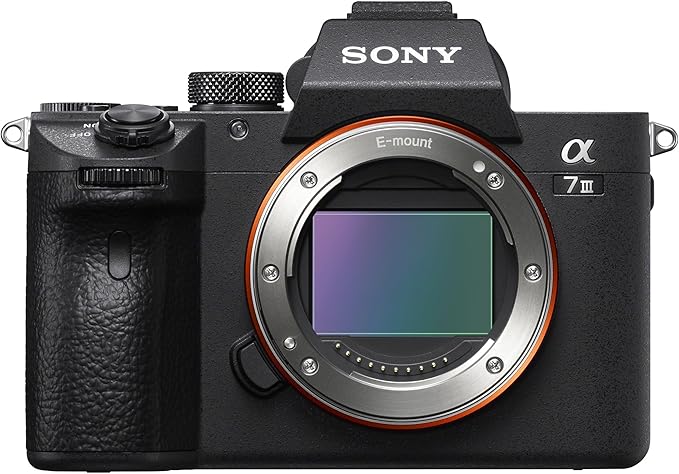
Sony A7s lll
Canon R6

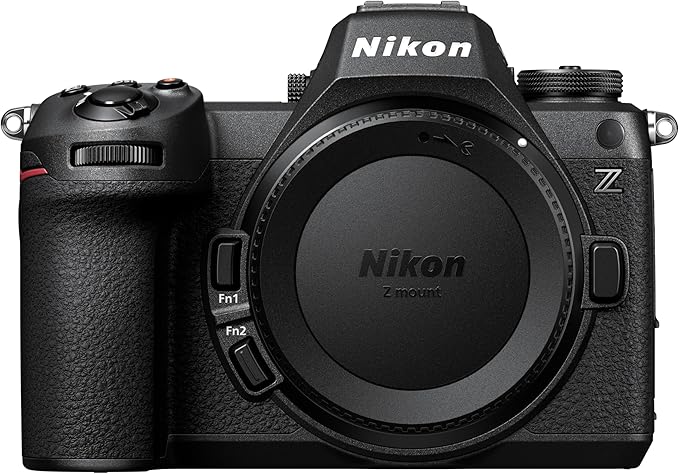
Nikon Z6 lll
Destinations nearby
Good to have in Iceland