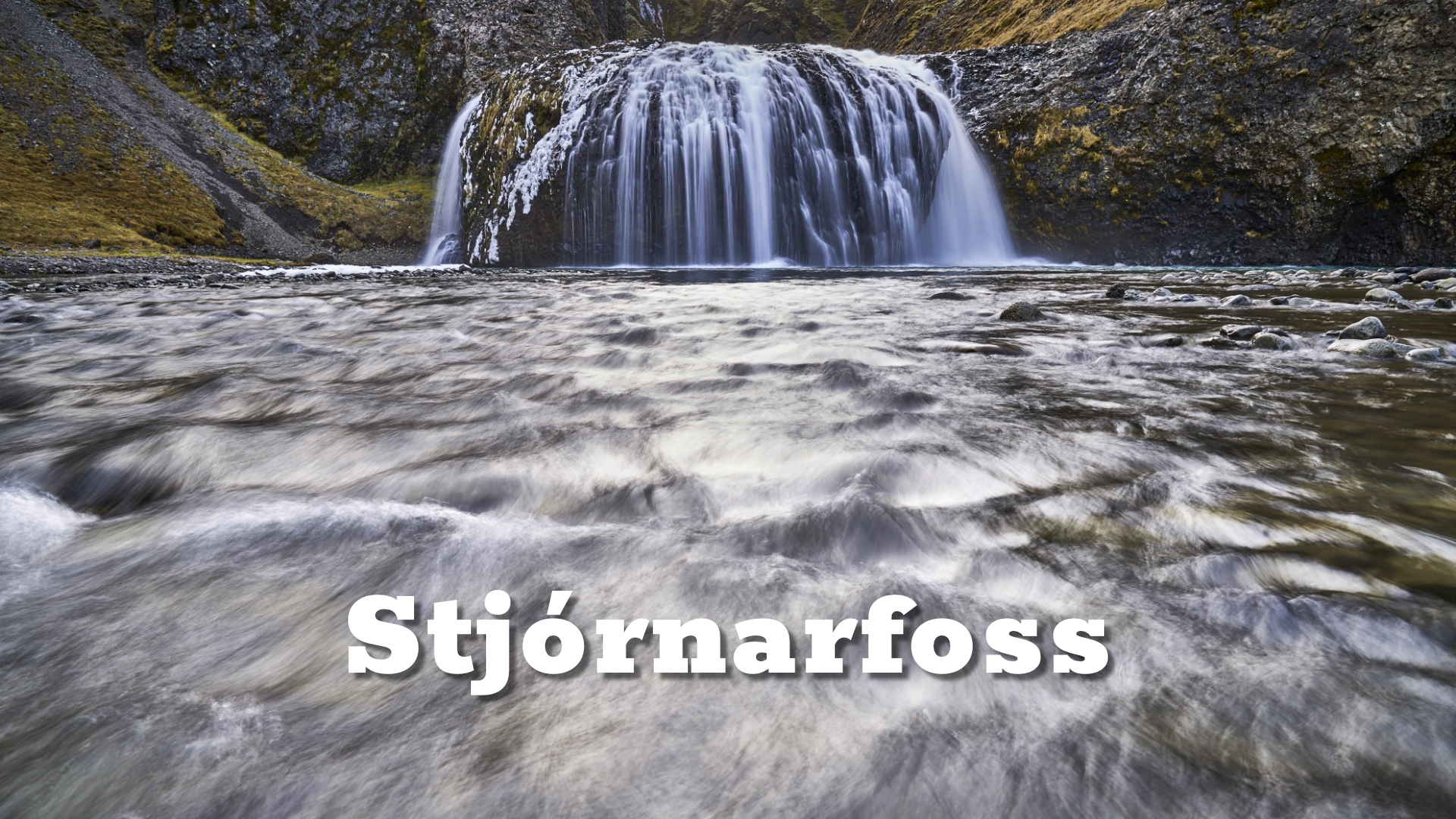
Just outside Kirkjubæjarklaustur on the southeast South Coast, Stjórnarfoss is a small waterfall with an unusually sculpted form: a soft, rounded lip, a wide curtain of water, and a sheltered setting that feels more intimate than the famous “headline” falls along Route 1. It sits by Kleifar—an area described locally as an ancient assembly site—giving the stop a subtle cultural layer as well as strong geology and photography value.
The location of Stjórnarfoss waterfall by Kirkjubæjarklaustur
63.7999
Latitude
Longitude
-18.0613
Stjórnarfoss waterfall by Kirkjubæjarklaustur
Stjórnarfoss is located near the village of Kirkjubæjarklaustur (often shortened to Klaustur) in South Iceland, reached from the Ring Road by turning onto Geirlandsvegur (road 203/F203), roughly a couple of kilometres from town.
Its position matters: you are still in the “South Coast corridor,” but you’ve stepped slightly aside from the main flow of traffic, which is why this waterfall often feels calmer than the better-known giants further west.
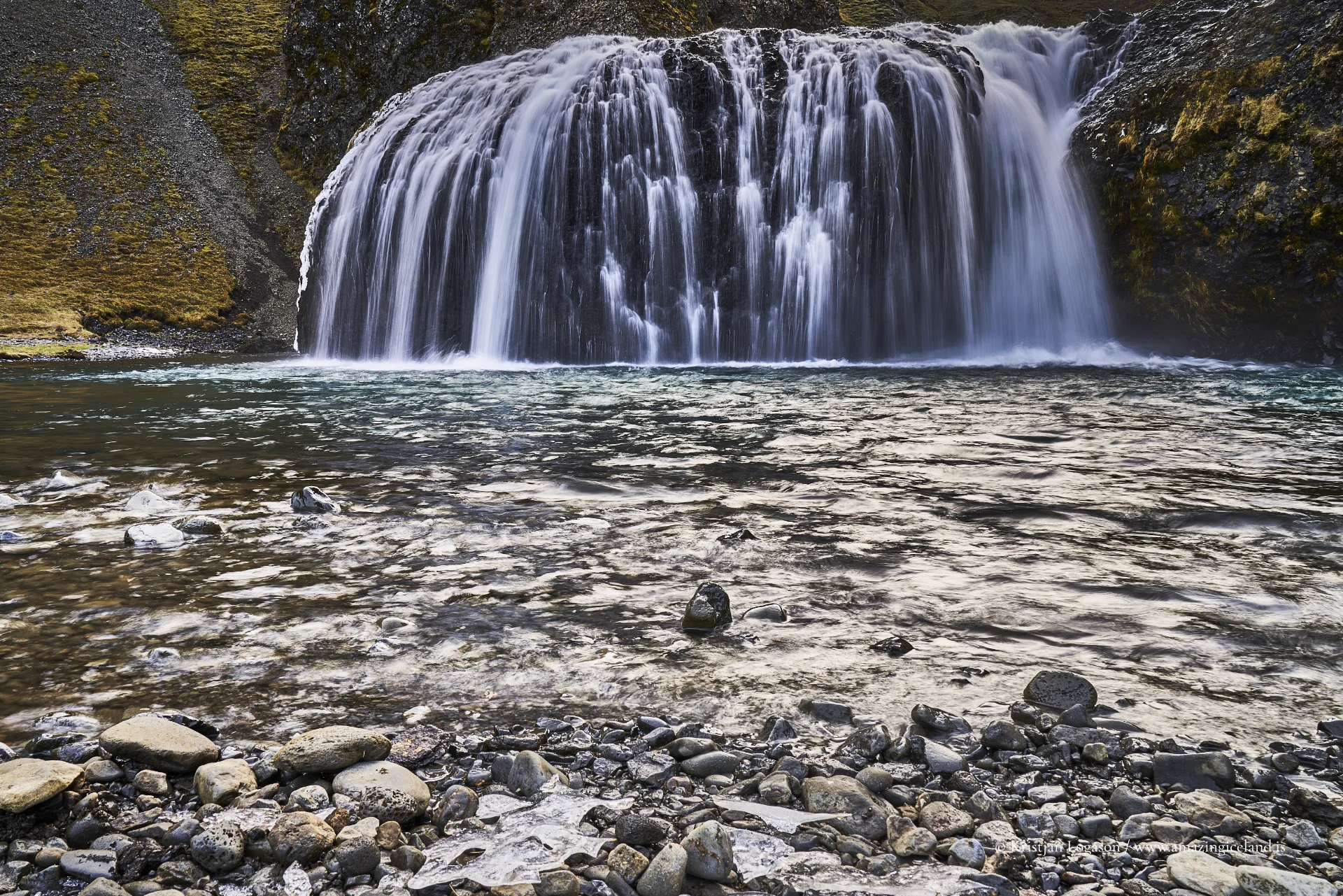
Physically, Stjórnarfoss is not a single dramatic plunge from a towering cliff. It is better understood as a shaped waterfall—defined by the geometry of the rock lip and the way the river spreads into multiple narrow streams. Sources vary on the height, commonly describing it as about 10 m while others give around 15 m; the difference is largely about whether you measure only the main drop or include the upper tier/overall fall line.
In practice, it often reads as “short and wide,” with a rounded edge that makes the water fan out as a curtain into a clear pool.
That rounded, dome-like shape is not an aesthetic accident; it is a clue to the bedrock and erosion style. The cliffs around the waterfall are volcanic, and the scene communicates the classic Icelandic tension between hard rock structure and persistent water action—water shaping, polishing, undercutting, then re-routing itself into multiple channels.
Access, land context, and what the visit is (and isn’t)
From a destination-planning perspective, Stjórnarfoss is valuable because it behaves like a “high reward for low time” stop. You can park nearby and reach the waterfall with a short walk, making it realistic even on a busy Ring Road day.
That said, the setting is not a built attraction—no grand platforms, no heavy infrastructure—so the experience relies on your own field sense: watching footing near the river, respecting vegetation, and reading conditions (wind and spray can turn rocks slick fast).
Stjórnarfoss is next to Kleifar, described as an ancient regional assembly site by the river Stjórn.
Why it photographs so well (and why it stays “under the radar”)
Stjórnarfoss is often called a “hidden gem,” but the more accurate phrasing is that it is structurally photogenic while being slightly off the mainline itinerary.
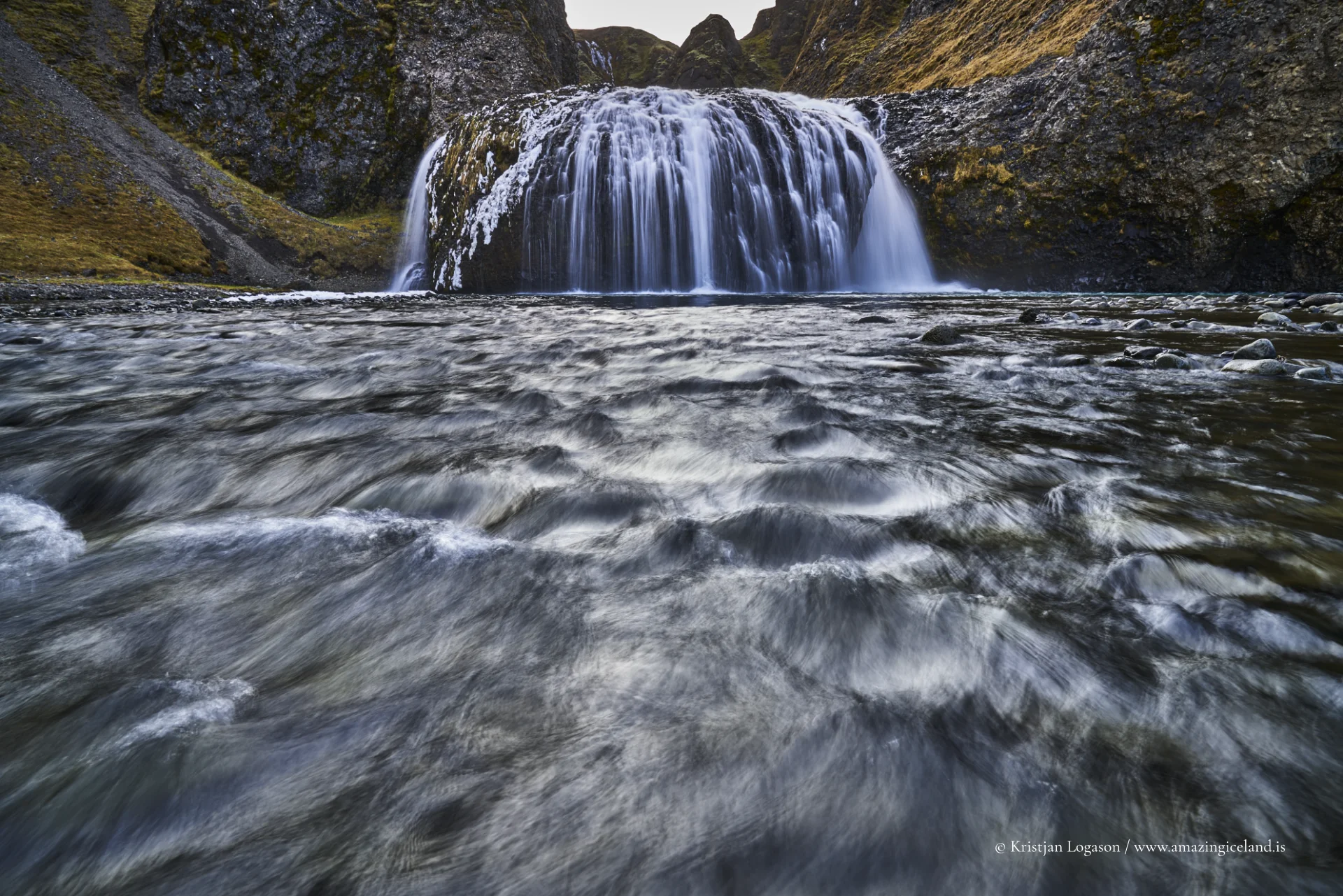
The waterfall’s shape encourages composition: the curved lip creates a clean horizontal element, while the falling water breaks into many vertical lines. In photography terms, it gives you both order and texture—perfect for long exposures, but also strong at faster shutter speeds where you can freeze the separate streams.
Several descriptions emphasize that Stjórnarfoss has a two-stage character (an upper and a lower tier).
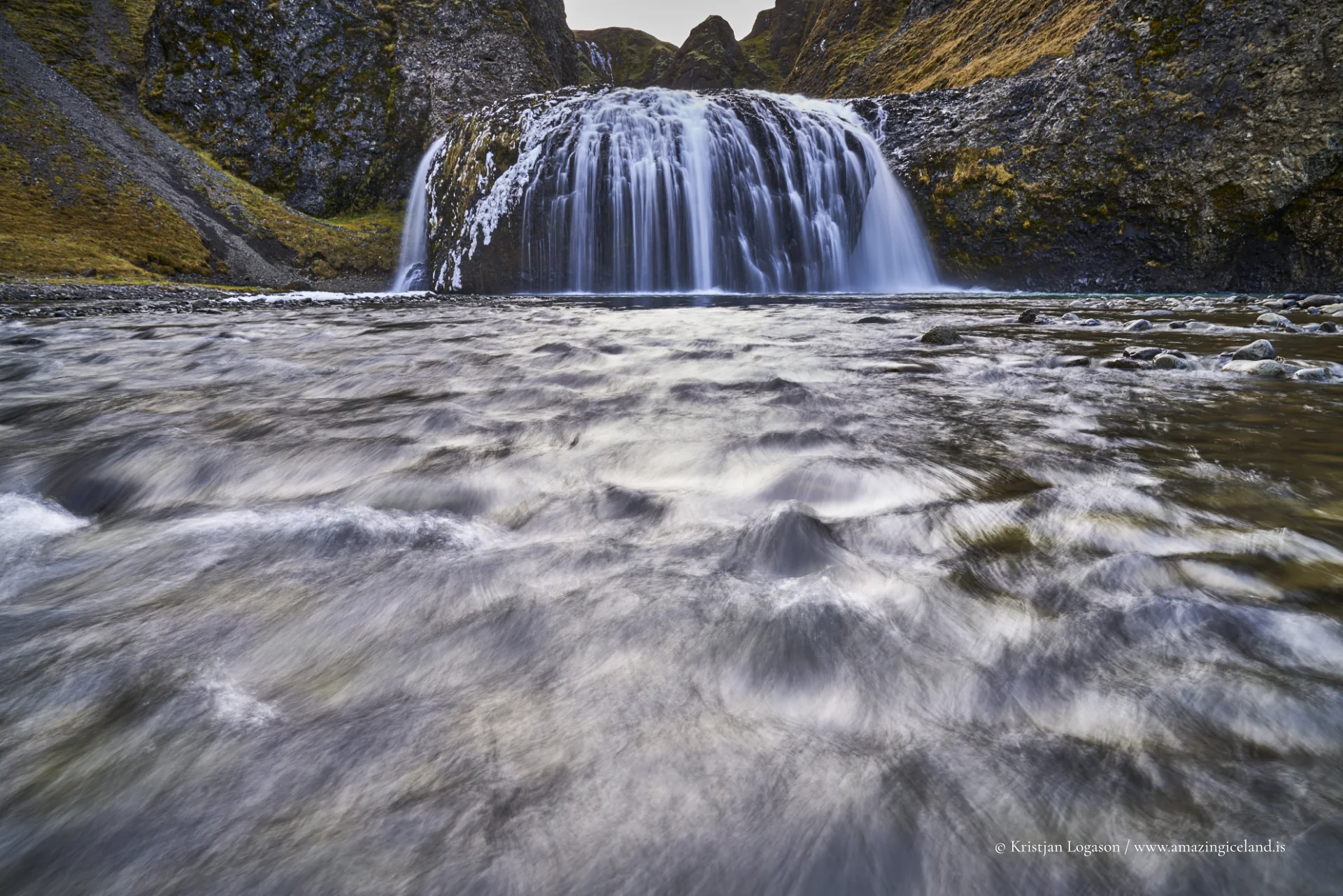
if you only shoot the obvious lower tier from the pool edge, you get a classic “curtain” image; if you step back and work the landscape, you can hint at the upper tier and show how the river arrives, drops, and then spreads into the basin. It’s not a waterfall that demands one iconic angle—it rewards small changes in position.
Finally, Stjórnarfoss sits near Kirkjubæjarklaustur, a natural base for exploring this section of the south coast. So it works well as either:
a short stop when driving east or west, or
a quiet evening/morning shoot when you’re staying locally and want softer light and fewer people.
Interesting facts:
- Local placement: Stjórnarfoss is by Kleifar, described locally as an ancient assembly site near the river Stjórn.
- Close to town: It’s roughly 2 km from Kirkjubæjarklaustur via Geirlandsvegur (203/F203).
- Height depends on definition: Common figures range from ~10 m to ~15 m, reflecting different ways of describing the tiers/overall drop.
- Two-stage look: Many visitors describe it as a two-tier waterfall (upper and lower).
Image Gallery



The Locomotive Elite
What do Donald Trump and Iceland’s Locomotive Elite have in common?
Far more than you think.
In The Locomotive Elite, you’ll uncover how a tiny clique in Iceland captured extensive control—of banks, courts, media, and even the central bank.
For decades they ruled, first democratically, then through corruption and in the end through crime, enriching themselves and their cronies while dismantling oversight.
The result?
One of the most spectacular financial collapses in modern history.
Photography tips:
-
- Exploit the dome: The rounded lip is the signature. Shoot low and centered for symmetry, or offset slightly to show the curtain splitting into strands.
- Two-tier storytelling: Step back to suggest the upper tier in the frame; step forward to isolate the lower curtain and pool.
- Shutter speed discipline:
- 1/250–1/1000 for crisp strands and spray detail
- 0.5–2s for “silk” without turning the whole fall into a blank white slab
- Foreground matters: Use the pool edge and stones to anchor scale—this waterfall can look bigger or smaller depending on what you include.
- Be careful with footing: Slick rock near the pool is common around small falls; move slowly.
Good cameras for Iceland
Sony A7R V

Sony A7s lll

Canon R6

Nikon Z6 lll

Destinations nearby
Good to have in Iceland