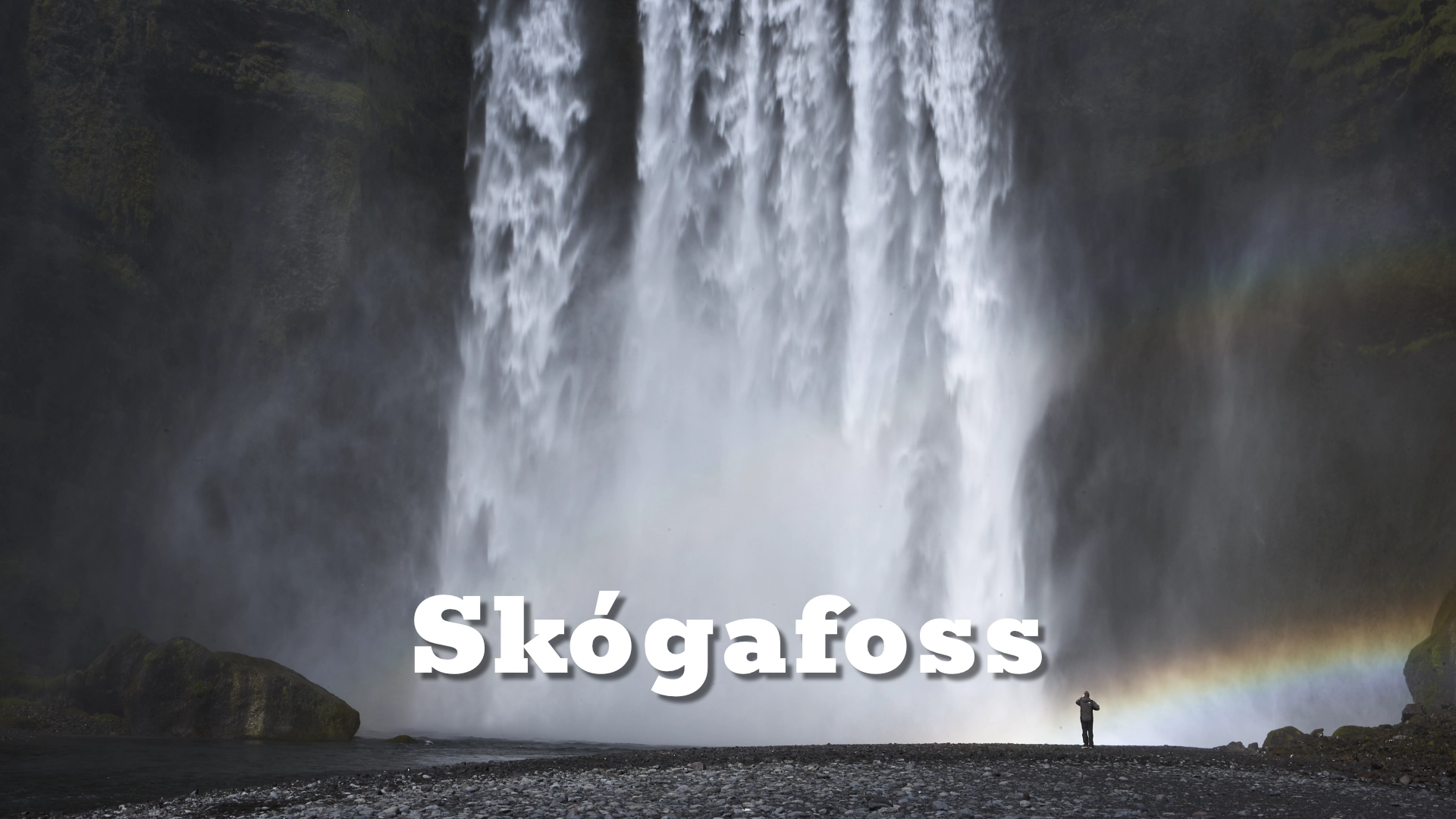
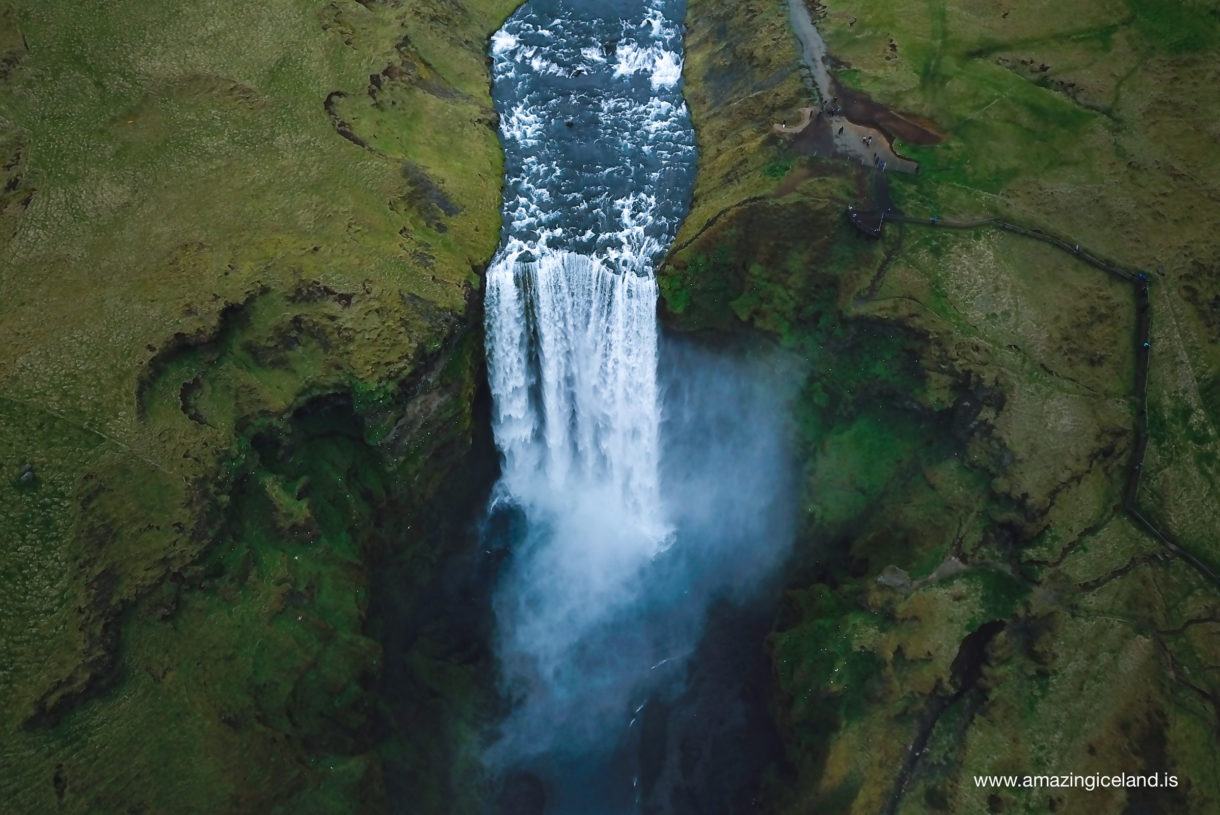
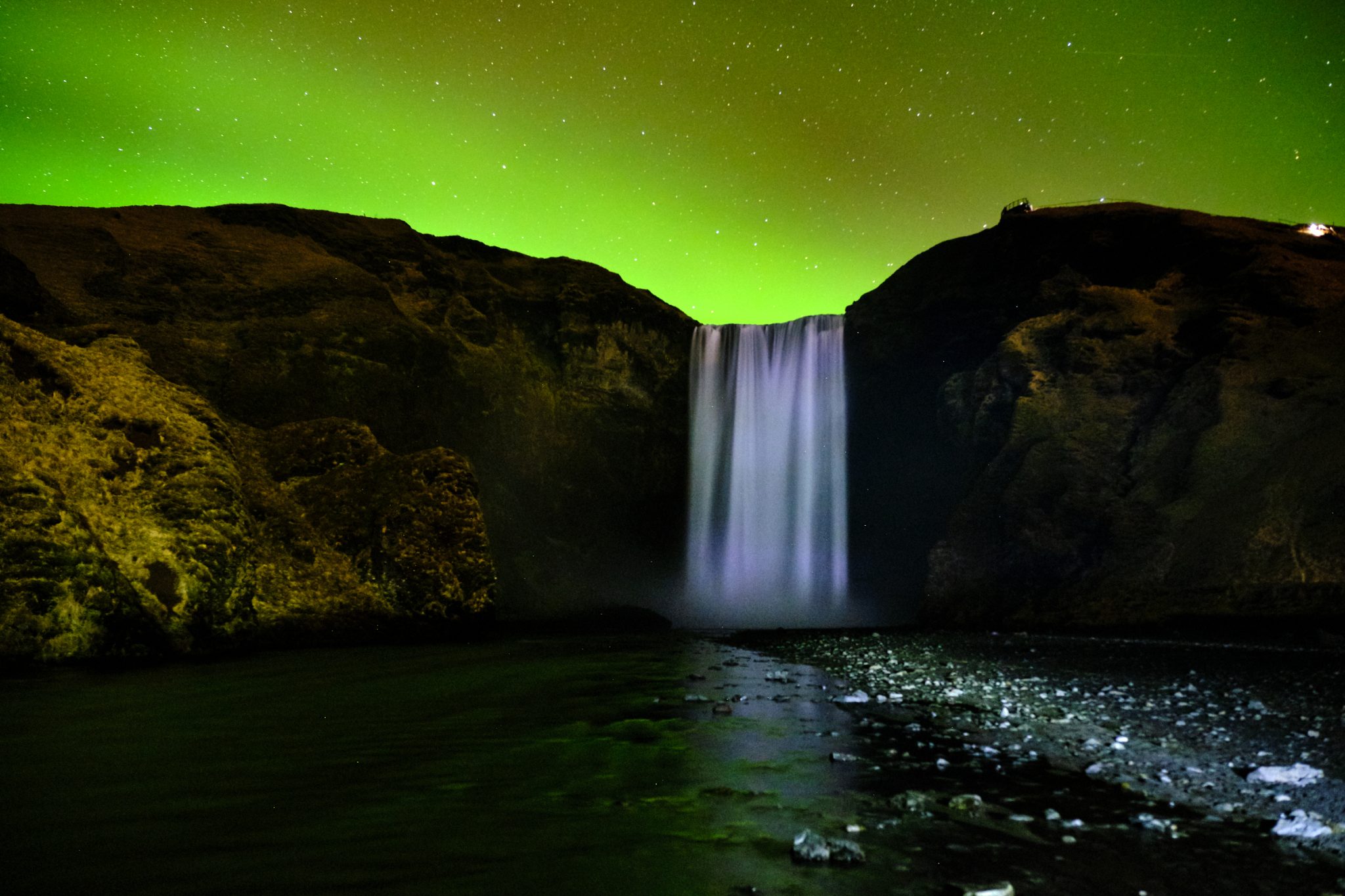
Located on Iceland’s South Coast near the village of Skógar, Skógafoss is among the country’s largest and most iconic waterfalls. Fed by glacial meltwater from Eyjafjallajökull, it plunges 60 metres over a straight basalt escarpment, producing a waterfall that is wide, loud, and relentlessly present. Where Seljalandsfoss invites enclosure, Skógafoss confronts the viewer head-on.
The location of Skogafoss waterfall on the south coast of Iceland
Latitude
63.5321
Longitude
-19.5114
Skogafoss waterfall on the south coast of Iceland
Geological context and formation
Skógafoss is a direct product of Iceland’s post-glacial geological history. The cliff over which it falls once marked the coastline of the island, before isostatic uplift and sediment accumulation shifted the shoreline several kilometres southward. This relict sea cliff now functions as a sharp geomorphological boundary between Iceland’s coastal lowlands and its interior highland slopes.
The waterfall is formed by the Skógá river, which originates on the highlands between Eyjafjallajökull and Mýrdalsjökull. The river drains snowmelt, rainfall, and glacial input, producing a relatively consistent flow throughout the year. Unlike braided glacial rivers that spread across floodplains, Skógá remains narrowly confined, allowing its full discharge to pour over a single lip.
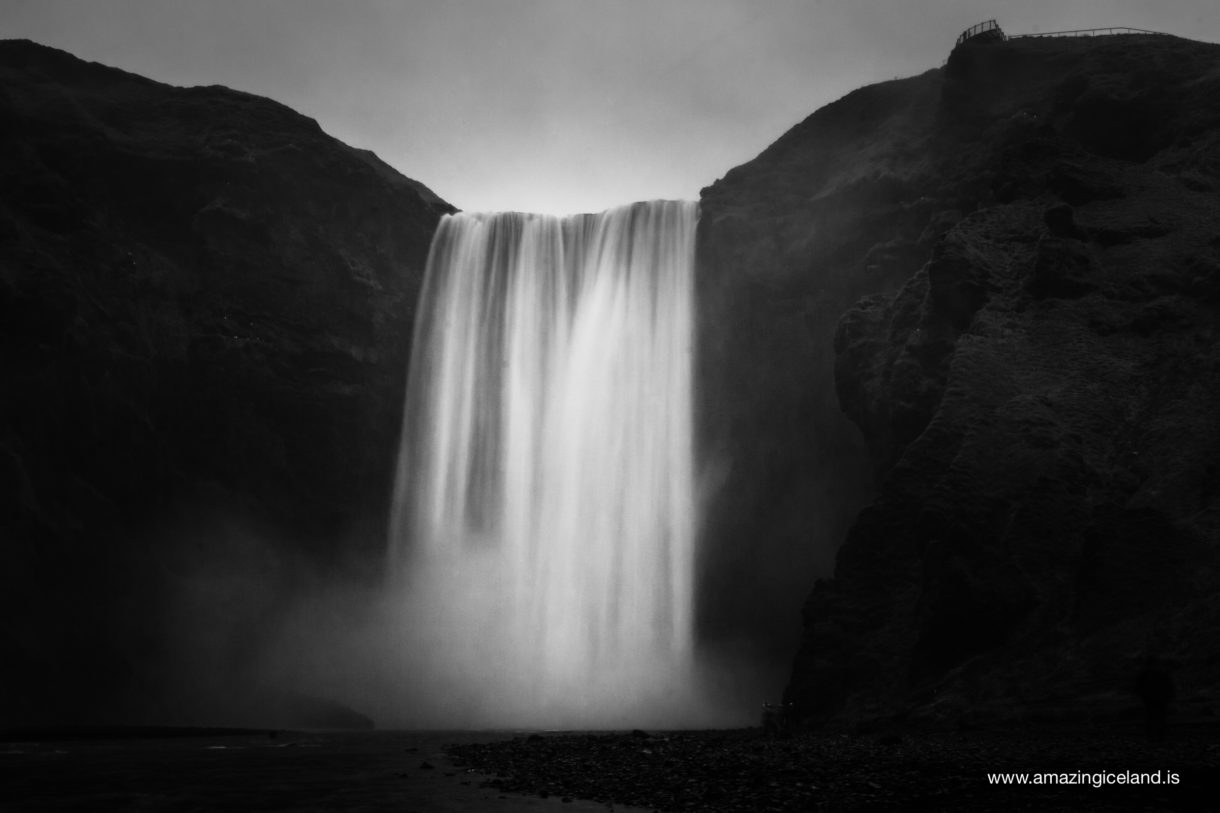
The bedrock at Skógafoss consists primarily of layered basalt lava flows, stacked through repeated volcanic eruptions during Iceland’s geological development. These layers cooled into dense, jointed rock that resists uneven erosion. As a result, the waterfall maintains a remarkably straight and stable edge, with little lateral variation across its 25-metre width.
From a geomorphological perspective, Skógafoss represents uniform erosion in resistant bedrock. Rather than retreating irregularly or forming segmented cascades, the waterfall preserves its form as a clean, continuous drop. This stability contributes to its visual coherence and explains why Skógafoss has retained its iconic appearance over historical time.
Hydrology, scale, and sensory impact
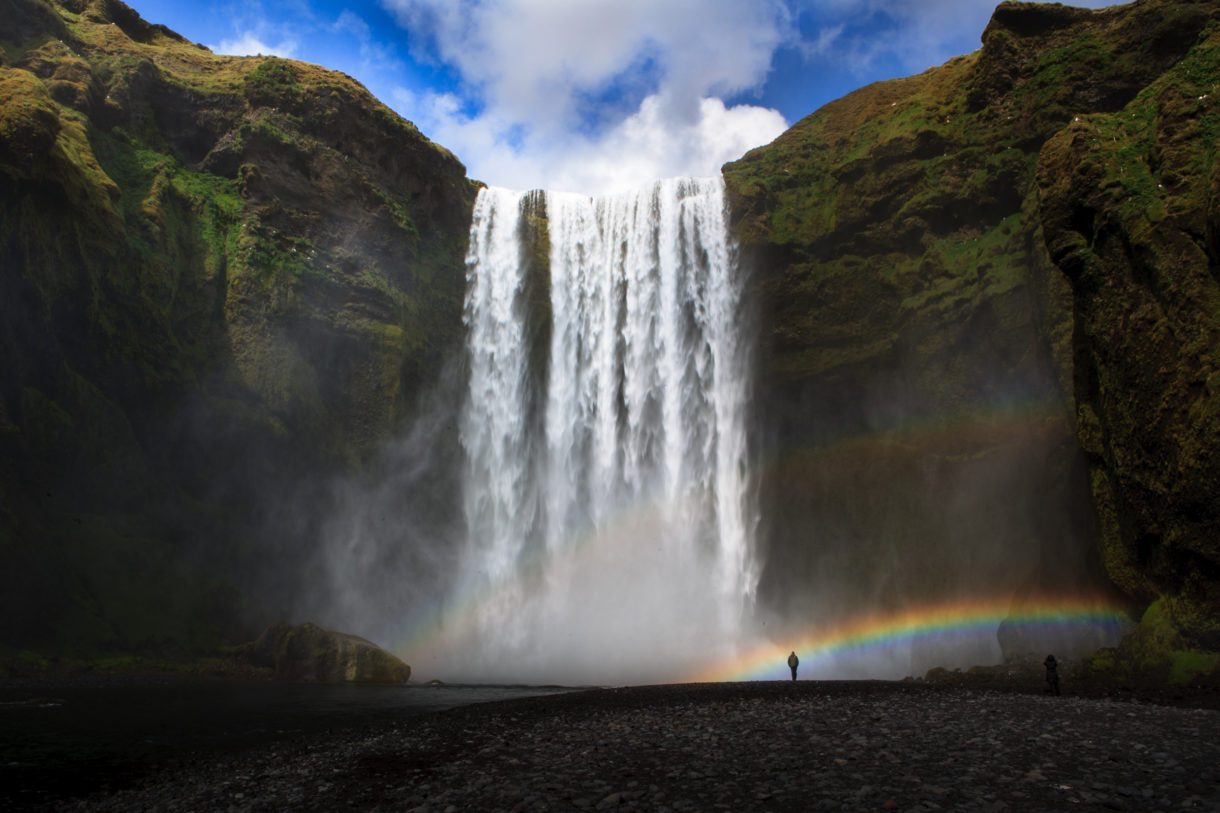
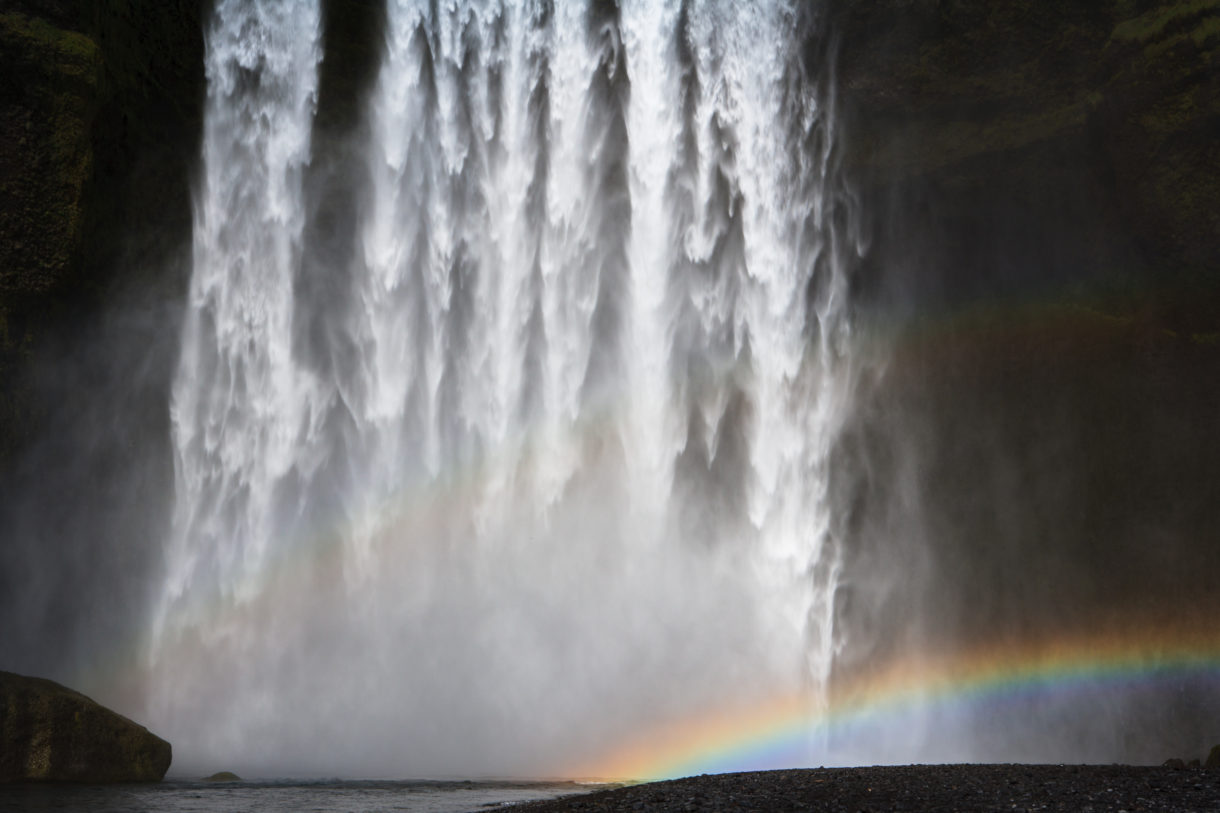
Skógafoss is defined as much by volume as by height. With a vertical drop of approximately 60 metres and a width of roughly 25 metres, it carries a substantial mass of water at all times. This uninterrupted flow generates constant spray at the base, filling the air with mist that frequently produces vivid rainbows under suitable light conditions.
The waterfall’s soundscape is immediate and dominating. Unlike waterfalls confined within gorges, Skógafoss disperses sound outward across the open plain, creating a low-frequency roar audible from considerable distance. This acoustic openness reinforces the sense that the waterfall is not hidden within the landscape but stands as an exposed endpoint of the river’s descent.
Physically, Skógafoss is approachable. Visitors can walk directly to the plunge pool, experiencing the force of the waterfall at close range. This proximity is deceptive, however. The mist saturates ground surfaces, making footing slippery, and wind-driven spray can shift unpredictably. While the site is accessible, it demands attentiveness.
A staircase built into the hillside east of the waterfall allows access to the cliff top, offering a contrasting perspective. From above, the Skógá river appears calm and narrow, emphasizing the abruptness with which it transitions into vertical free fall. This dual perspective—top-down and bottom-up—makes Skógafoss particularly instructive as a hydrological feature.
Cultural presence, access, and landscape role
Skógafoss occupies a prominent place in Icelandic cultural geography. According to local tradition, a Viking settler named Þrasi Þórólfsson is said to have hidden a treasure chest behind the waterfall. While the chest itself is legendary, the story underscores a recurring theme in Icelandic folklore: waterfalls as thresholds between visible and concealed worlds.
In modern times, Skógafoss has become deeply embedded in Iceland’s visual identity. Its symmetry, accessibility, and scale make it a frequent subject in photography, film, and travel media. Despite this exposure, the waterfall retains authority. It does not rely on novelty or selective framing; its impact is immediate and unavoidable.
Skógafoss also marks a transition point in the South Coast landscape. Just inland, the terrain rises toward the highlands, while downstream the river crosses flat agricultural land before reaching the sea. Nearby attractions—including the Skógar Museum and access points to the Fimmvörðuháls hiking route—reinforce the area’s role as a junction between cultural history and natural systems.
Seasonality alters experience rather than identity. In summer, long daylight hours and consistent flow emphasize openness and movement. In winter, ice forms along the cliff edges and plunge pool, introducing structure and contrast without diminishing scale. Unlike Seljalandsfoss, Skógafoss remains largely accessible year-round, though winter conditions require caution.
Ultimately, Skógafoss functions as a reference point. It is often the waterfall against which others are measured—wide, powerful, and direct. Its significance lies not in rarity, but in clarity.
Interesting facts:
- Skógafoss is approximately 60 metres high and 25 metres wide.
- The waterfall drops from a former coastal sea cliff, now located inland.
- It is fed by meltwater originating between Eyjafjallajökull and Mýrdalsjökull.
- Skógafoss frequently produces double rainbows due to persistent mist and open exposure.
- The waterfall has appeared in numerous films, television productions, and music videos, reinforcing its role as a visual symbol of Iceland.
Movies, TV Shows and Music Videos Filmed at Skogafoss
TV Shows:
- Vikings (2017), in the 5th season there is a scene where Floki, (Hrafna-Flóki or Raven Flóki) is seen staring at the alluring waterfall Skógafoss.
- Music Videos :
- The waterfall was the setting for Sólstafir’s 2012 music video Fjara off their album Svartir Sandar.
- The waterfall was used as one of the locations of song Gerua, in 2015 Bollywood movie Dilwale featuring Shahrukh Khan and Kajol.
- Justin Bieber – I’ll Show You (2015) in the video Bieber is seen walking, running, swimming and skateboarding around famous location on the South Coast in Iceland, including Seljalandsfoss, the DC3 plane wreck at Sólheimasandur Black Sand Beach, Dyrholaey Cape, Fjadrargljufur Canyon, Jokulsarlon Glacier Lagoon and of course our Skogafoss waterfall.
- Films:
- The Secret Life of Walter Mitty – among many location in Icleand, Skógafoss was one of them
- Thor: The Dark World (2013) this Marvel Blockbuster was filmed in a few locations in Iceland, Skógafoss being one of them.
- Land Ho! (2014) is a film about two ex brother-in-laws who travel to Iceland and visit all sorts of beautiful places in Iceland including Skógar.
Image Gallery
The Locomotive Elite
What do Donald Trump and Iceland’s Locomotive Elite have in common?
Far more than you think.
In The Locomotive Elite, you’ll uncover how a tiny clique in Iceland captured extensive control—of banks, courts, media, and even the central bank.
For decades they ruled, first democratically, then through corruption and in the end through crime, enriching themselves and their cronies while dismantling oversight.
The result?
One of the most spectacular financial collapses in modern history.
Photography tips:
- Expect heavy mist: waterproof protection and lens cloths are essential.
- Wide-angle lenses capture full width and scale effectively.
- Shutter speeds: 1/10–1/30 sec creates smooth flow; faster speeds isolate texture.
- Use people for scale: figures near the base emphasize height and volume.
- Climb the stairs: top-down perspectives add narrative depth.
- Morning and late evening provide softer light and more frequent rainbow conditions.
Good cameras for Iceland
Sony A7R V

Sony A7s lll

Canon R6

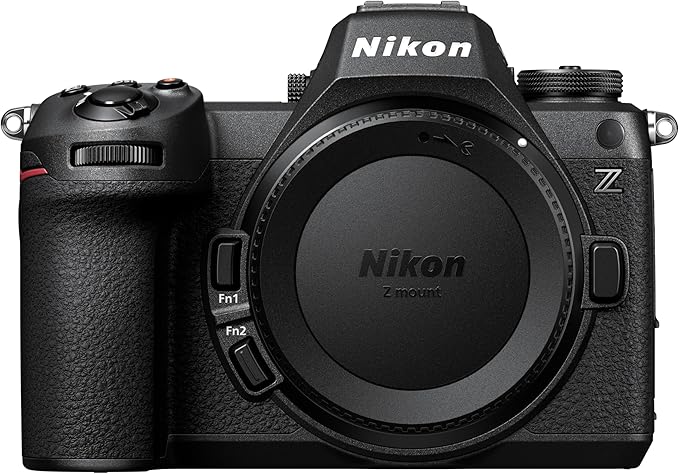
Nikon Z6 lll
Good to have in Iceland