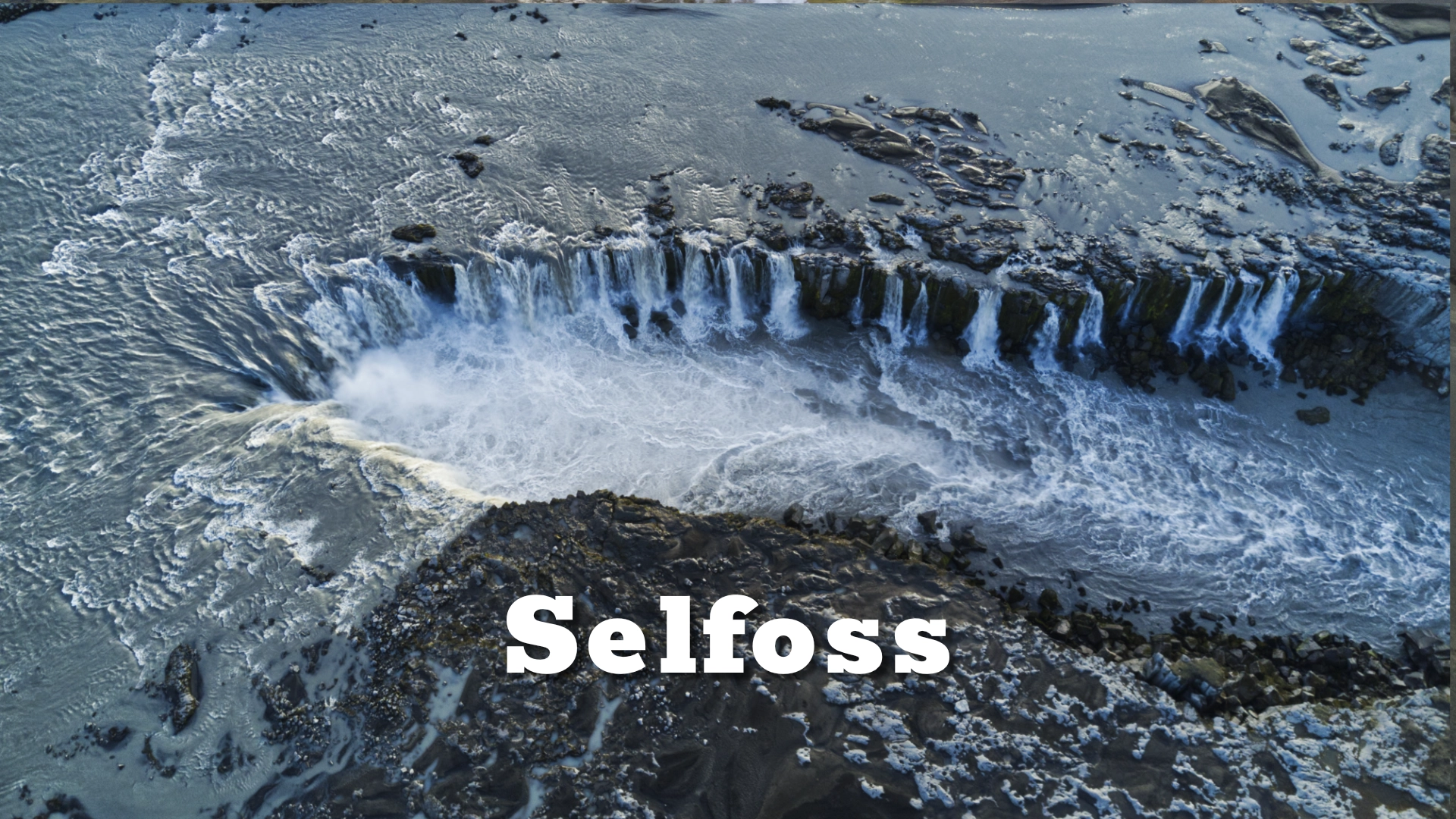
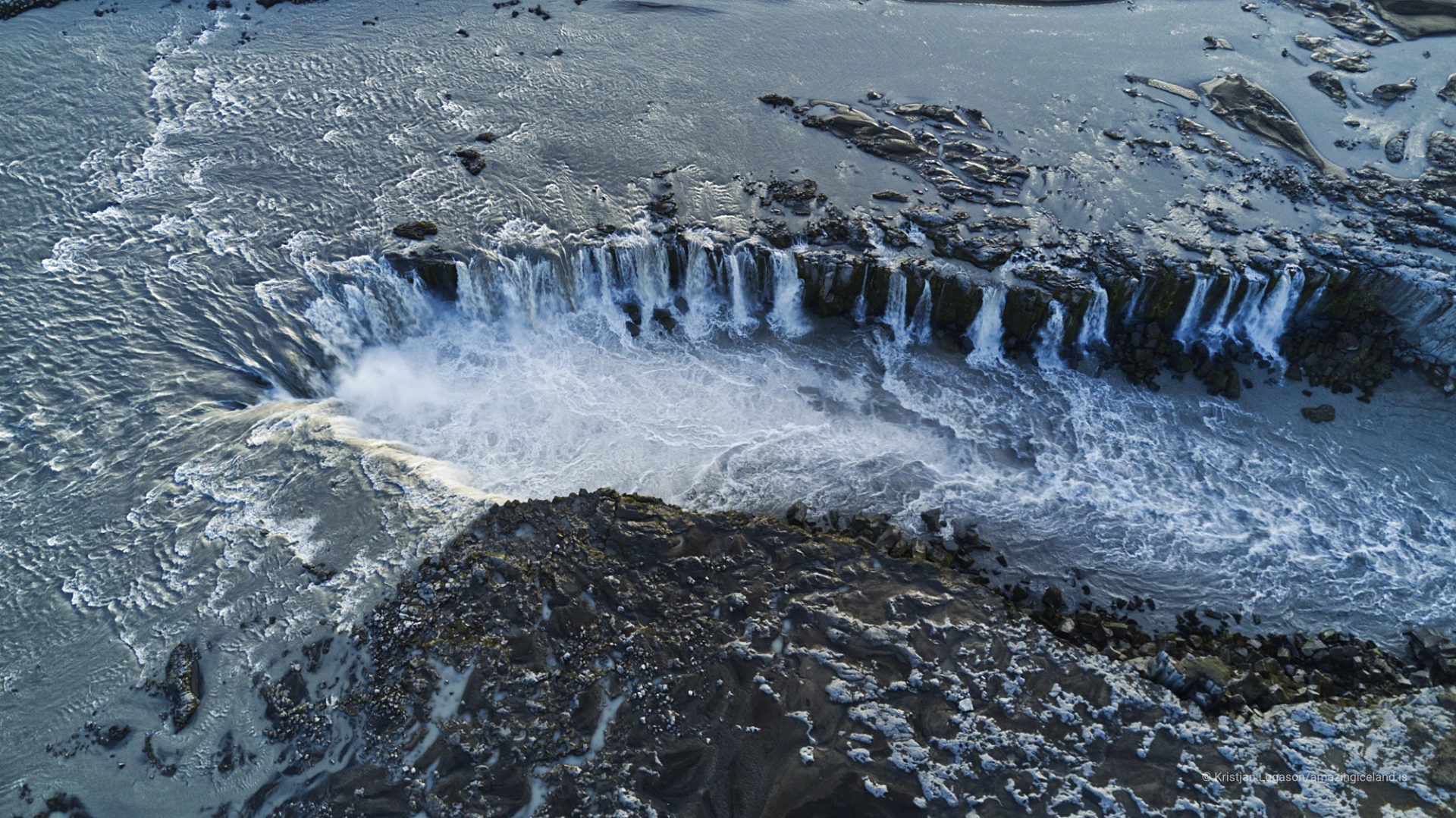
Located on the Jökulsá á Fjöllum river in Northeast Iceland, just upstream from Dettifoss, Selfoss is often overshadowed by its more famous neighbour. Yet in geological and visual terms, Selfoss is no less significant. Its broad, horseshoe-shaped cascade and pronounced basalt columns provide a clear demonstration of how structure, not just volume, governs waterfall character.
The location of Selfoss waterfall in North Iceland
Latitude
65.8156
Longitude
-16.4053
Selfoss waterfall in North Iceland
Geological setting and basalt control
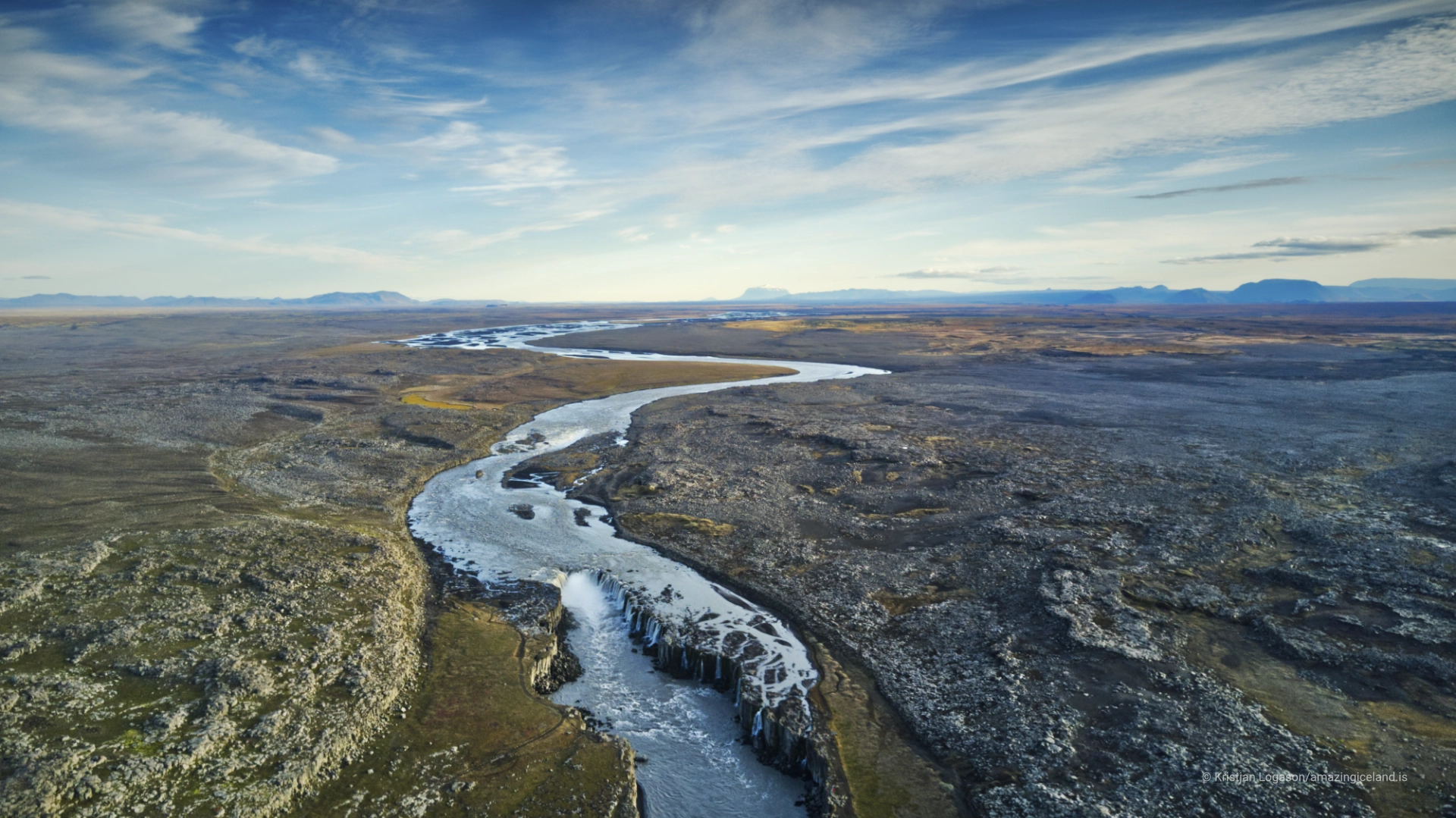
Selfoss lies along the same river corridor as Dettifoss—the Jökulsá á Fjöllum—which drains meltwater from the Vatnajökull ice cap through a sequence of basalt plateaus and canyons. While Dettifoss marks a major erosional step, Selfoss occupies a structurally distinct section of the river where erosion is distributed rather than concentrated.
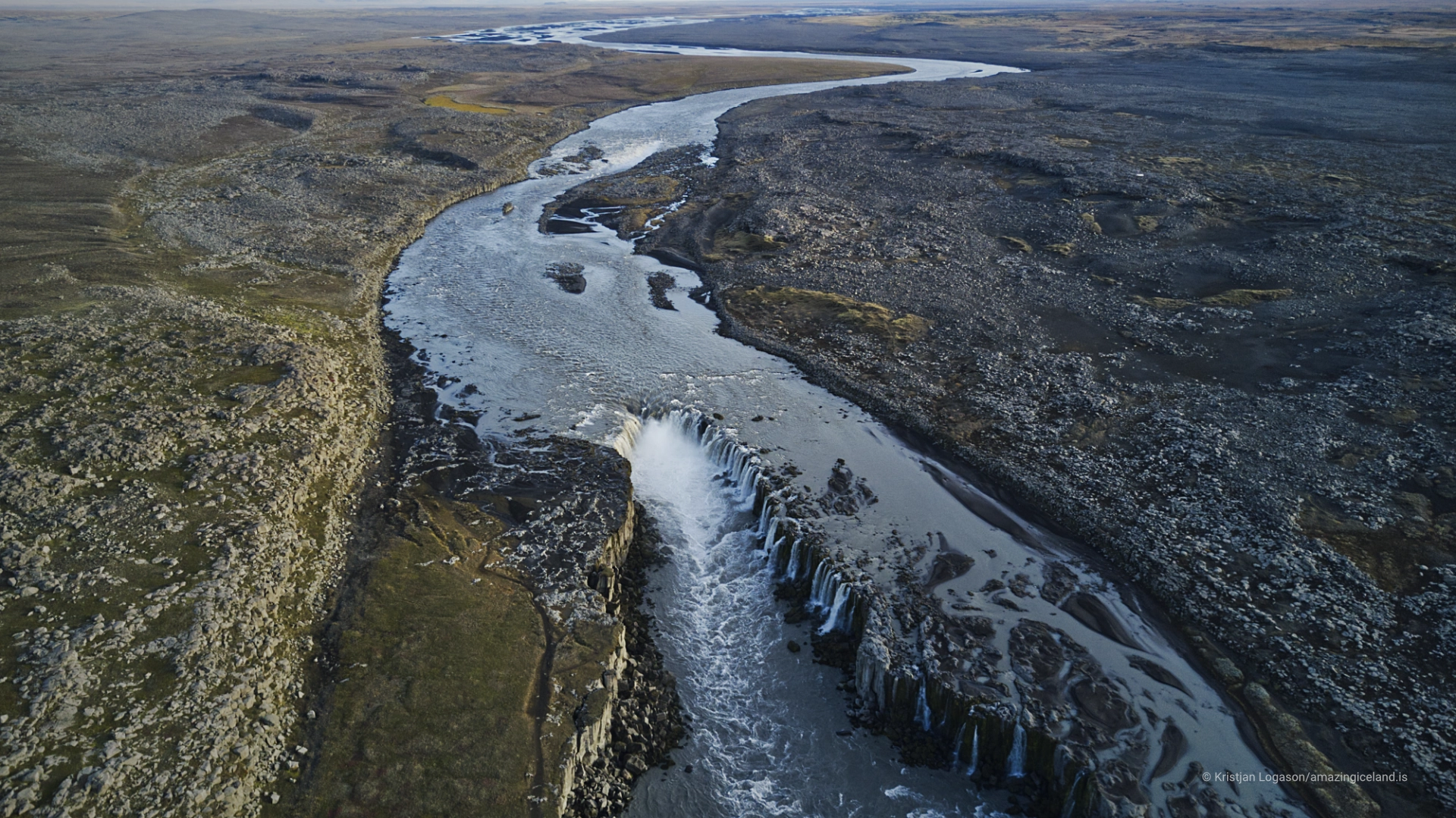
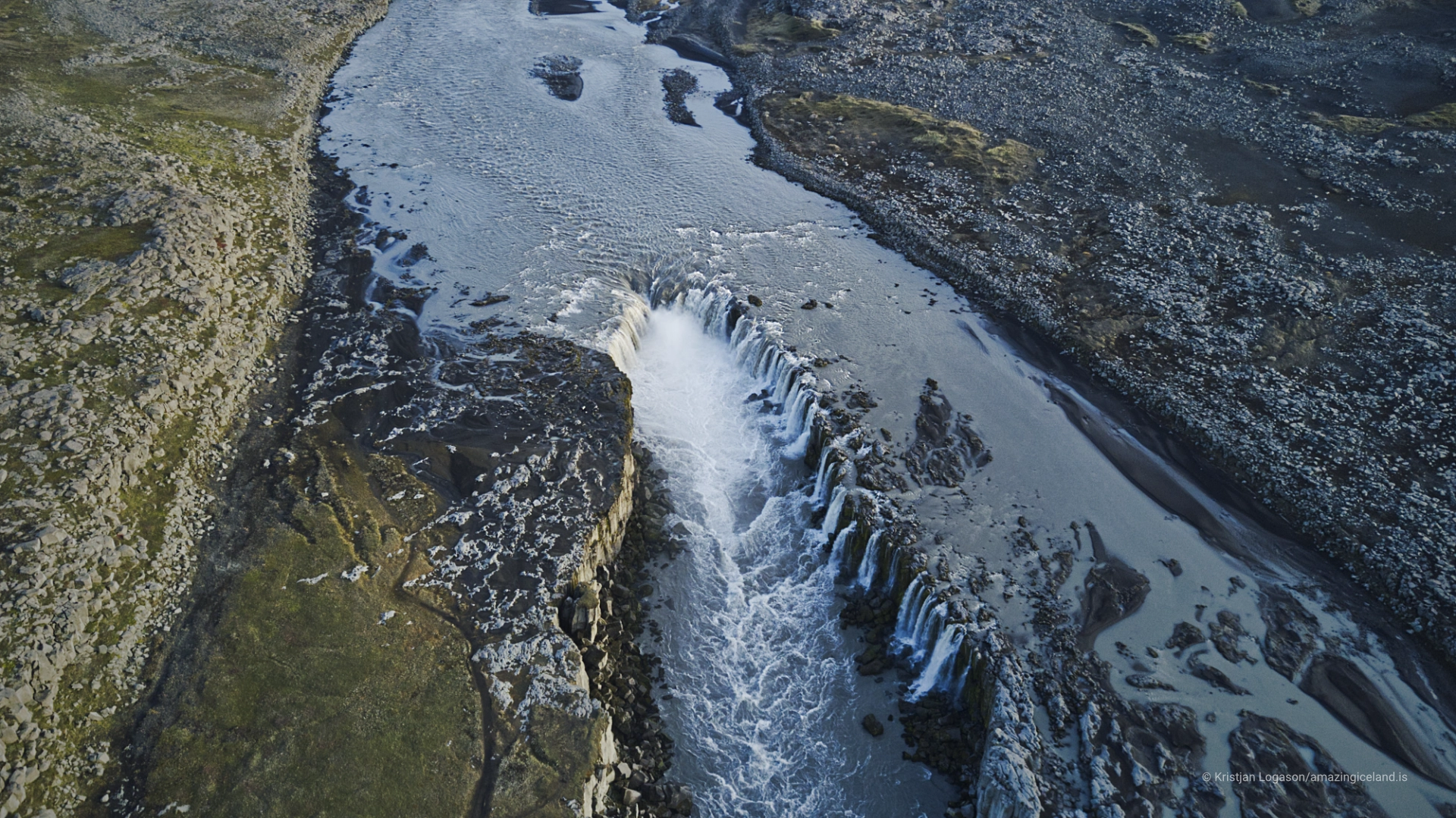
The waterfall is approximately 11 metres high and nearly 100 metres wide, forming a broad arc across jointed basalt bedrock. The underlying lava flows cooled into columnar and blocky jointing patterns, which now segment the river’s lip into repeating vertical elements. These structural divisions guide water flow, producing parallel curtains rather than a single dominant plunge.
From a geomorphological standpoint, Selfoss illustrates structure-controlled knickpoint formation. Rather than retreating rapidly upstream, the waterfall maintains a relatively stable position as erosion proceeds incrementally along joint planes. Blocks fail locally, but the overall geometry remains coherent over long timescales.
This stability contrasts sharply with Dettifoss downstream, where discharge concentration overwhelms structural resistance. Together, the two waterfalls demonstrate how identical water volumes can produce radically different landforms depending on bedrock configuration and channel confinement.
Hydrology, scale, and visual rhythm
Hydrologically, Selfoss carries the full discharge of the Jökulsá á Fjöllum, making it no less powerful in absolute terms than Dettifoss. What differs is how that power is expressed. At Selfoss, the river spreads across a wide lip, reducing flow velocity at any single point and creating a visual emphasis on continuity rather than impact.
The result is a waterfall defined by rhythm and repetition. Individual water segments behave similarly but not identically, producing subtle variation across the width of the falls. Changes in discharge—seasonal melt, rainfall, or upstream ice conditions—alter thickness and spacing but rarely disrupt the underlying pattern.
Sound plays a different role here. Where Dettifoss generates a continuous low-frequency roar, Selfoss produces a more textured acoustic field, composed of overlapping but distinguishable water impacts. This auditory distinction reinforces the sense that Selfoss is expansive rather than overwhelming.
Visually, Selfoss rewards lateral movement. Walking along the riverbank allows the waterfall to be read as a sequence rather than a single event, aligning perception with geological process.
Relationship to Dettifoss and the river system
Selfoss and Dettifoss form a coupled system rather than independent attractions. Selfoss functions as a hydraulic distributor, spreading water evenly before it is abruptly re-concentrated downstream. This spatial proximity—less than one kilometre apart—makes their contrast unusually legible.
From an interpretive perspective, visiting Selfoss first establishes a baseline: river width, discharge, and basalt structure. Dettifoss then escalates these same variables to an extreme. The transition between the two sites is therefore not merely scenic but educational, demonstrating how small changes in channel geometry can trigger disproportionate changes in erosive behavior.
Downstream, the river continues to incise toward Hafragilsfoss, further modifying its character. Selfoss thus occupies a critical midpoint in the river’s narrative—neither origin nor climax, but structural articulation.
Visiting Selfoss—movement, access, and restraint
Selfoss is accessed via the same road network as Dettifoss, most commonly from the east side of the river. A marked walking path leads from the Dettifoss viewpoint upstream to Selfoss, encouraging sequential visitation and reinforcing their conceptual connection.
The terrain near Selfoss is open and exposed, with minimal barriers. Although the waterfall appears calmer than Dettifoss, the river remains powerful, and edges can be undercut or slippery. The temptation to approach the lip should be resisted; safe viewing distances preserve both safety and the site’s visual coherence.
Seasonality shapes access and experience. In summer, high discharge emphasizes width and movement. In winter, partial freezing reveals basalt structure with exceptional clarity, transforming the waterfall into a study of form rather than flow. However, winter conditions also increase hazard, particularly near concealed ice edges.
Selfoss is best experienced deliberately and without haste. Its scale unfolds horizontally, requiring time rather than proximity.
Interpretation and significance
Selfoss challenges common assumptions about waterfall value. It lacks the superlative status of Dettifoss and the cultural symbolism of Goðafoss, yet it offers something rarer: clarity. The relationship between water, rock, and gravity is immediately legible, unmediated by spectacle.
In the broader context of Northeast Iceland, Selfoss reinforces a central theme of the region: process over monument. The landscape here is not arranged around singular icons but around sequences—lava flows, river stages, erosional thresholds—that gain meaning through comparison.
For visitors attuned to geological logic, Selfoss is not secondary. It is essential.
Interesting facts:
- Selfoss is approximately 11 metres high and nearly 100 metres wide, emphasizing breadth over height.
- The waterfall is segmented by basalt column and block jointing, which controls water distribution.
- Selfoss carries the same river and discharge as Dettifoss, despite its calmer appearance.
- The name Selfoss refers to the “shelter waterfall,” or waterfall by the shelter.
- The waterfall lies within Vatnajökull National Park, protected for its geological value.
Image Gallery

The Locomotive Elite
What do Donald Trump and Iceland’s Locomotive Elite have in common?
Far more than you think.
In The Locomotive Elite, you’ll uncover how a tiny clique in Iceland captured extensive control—of banks, courts, media, and even the central bank.
For decades they ruled, first democratically, then through corruption and in the end through crime, enriching themselves and their cronies while dismantling oversight.
The result?
One of the most spectacular financial collapses in modern history.
Photography tips:
- Emphasize width: panoramic or stitched frames suit the site well.
- Move laterally: variation across the falls rewards multiple angles.
- Use long exposures sparingly: structure can be lost if water is over-smoothed.
- Winter highlights geology: ice traces basalt joints with precision.
- Avoid edge compression: include foreground rock to preserve depth.
Good cameras for Iceland
Sony A7R V

Sony A7s lll

Canon R6

Nikon Z6 lll

Destinations nearby
Good to have in Iceland