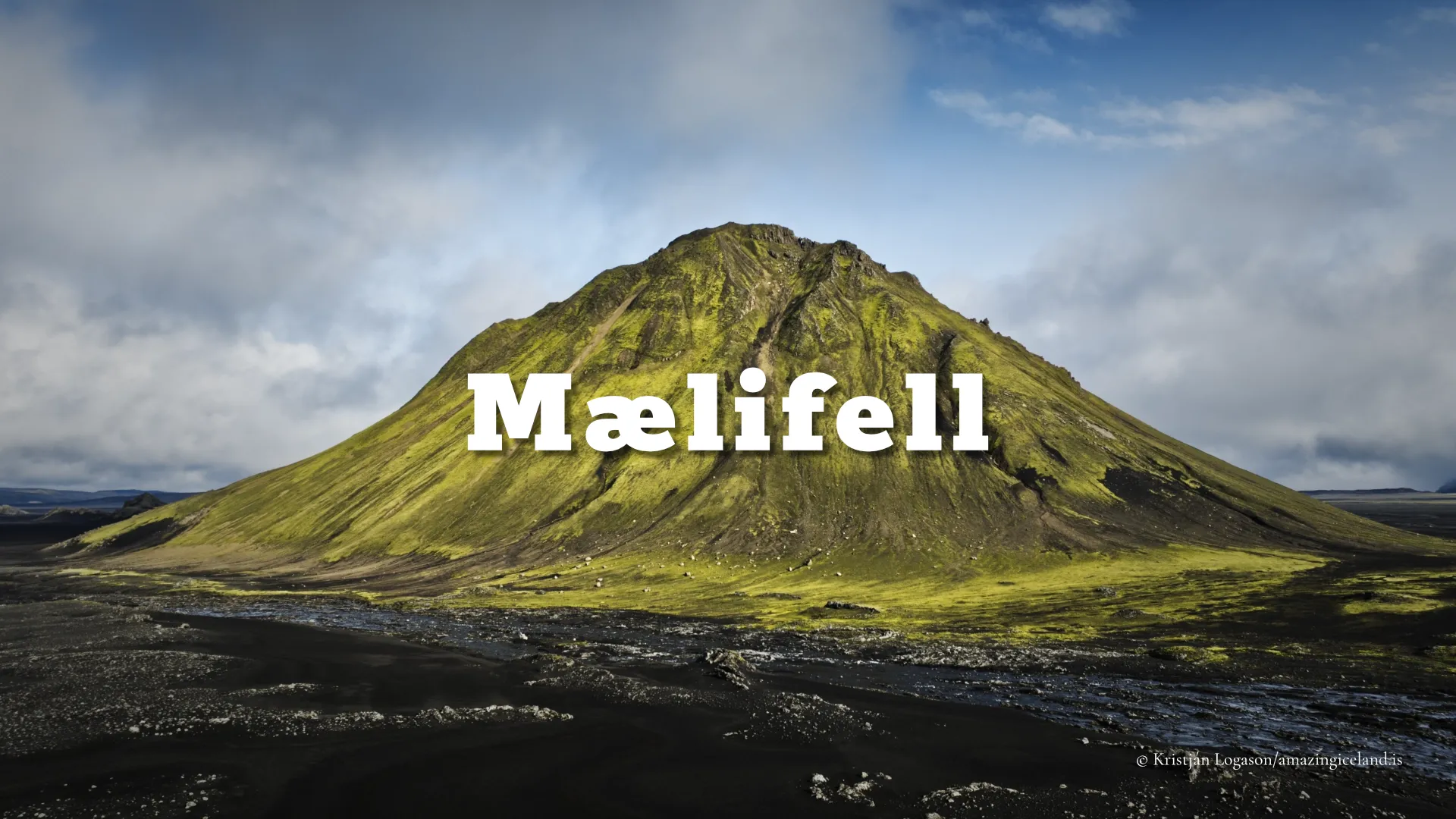
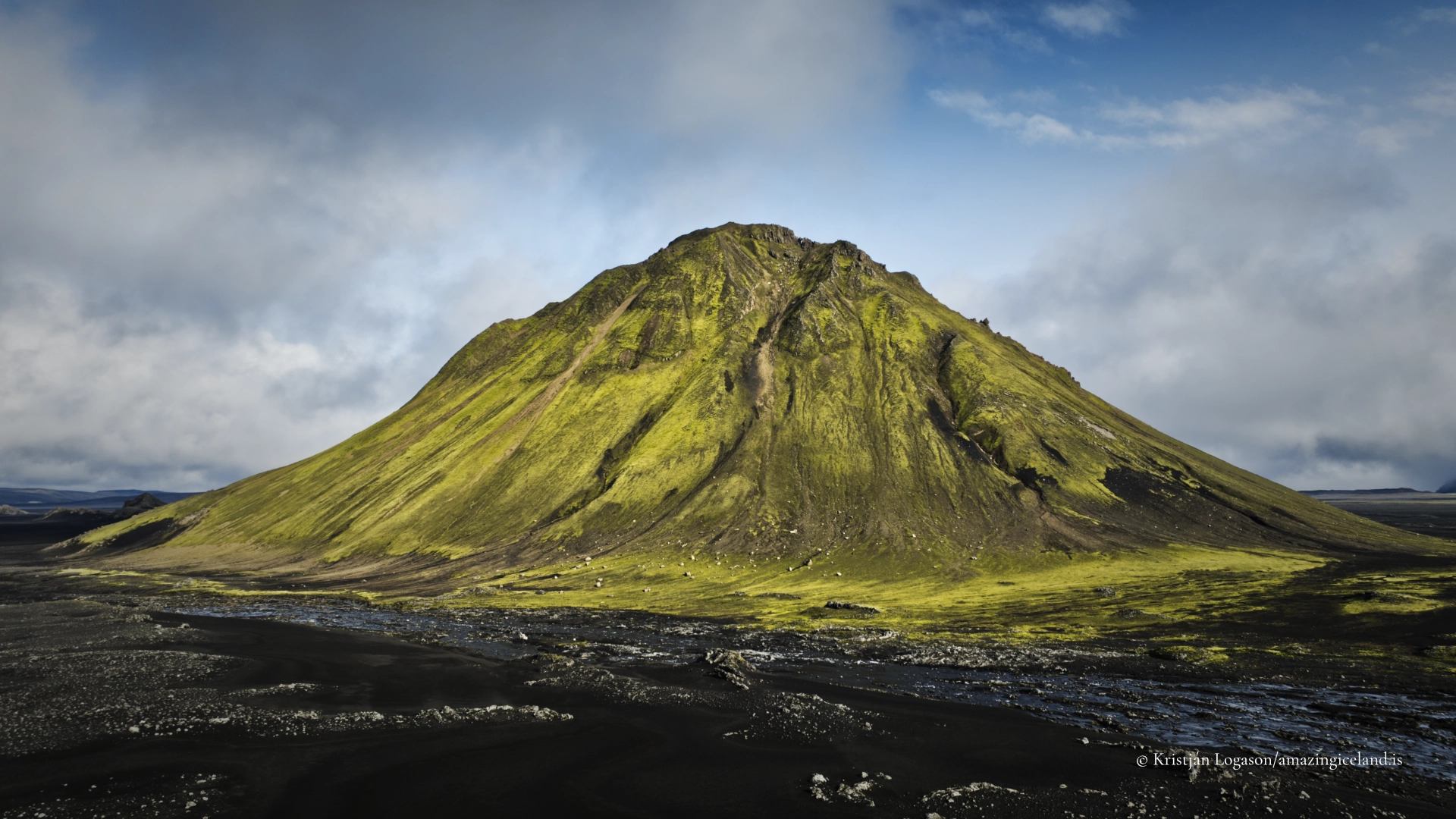
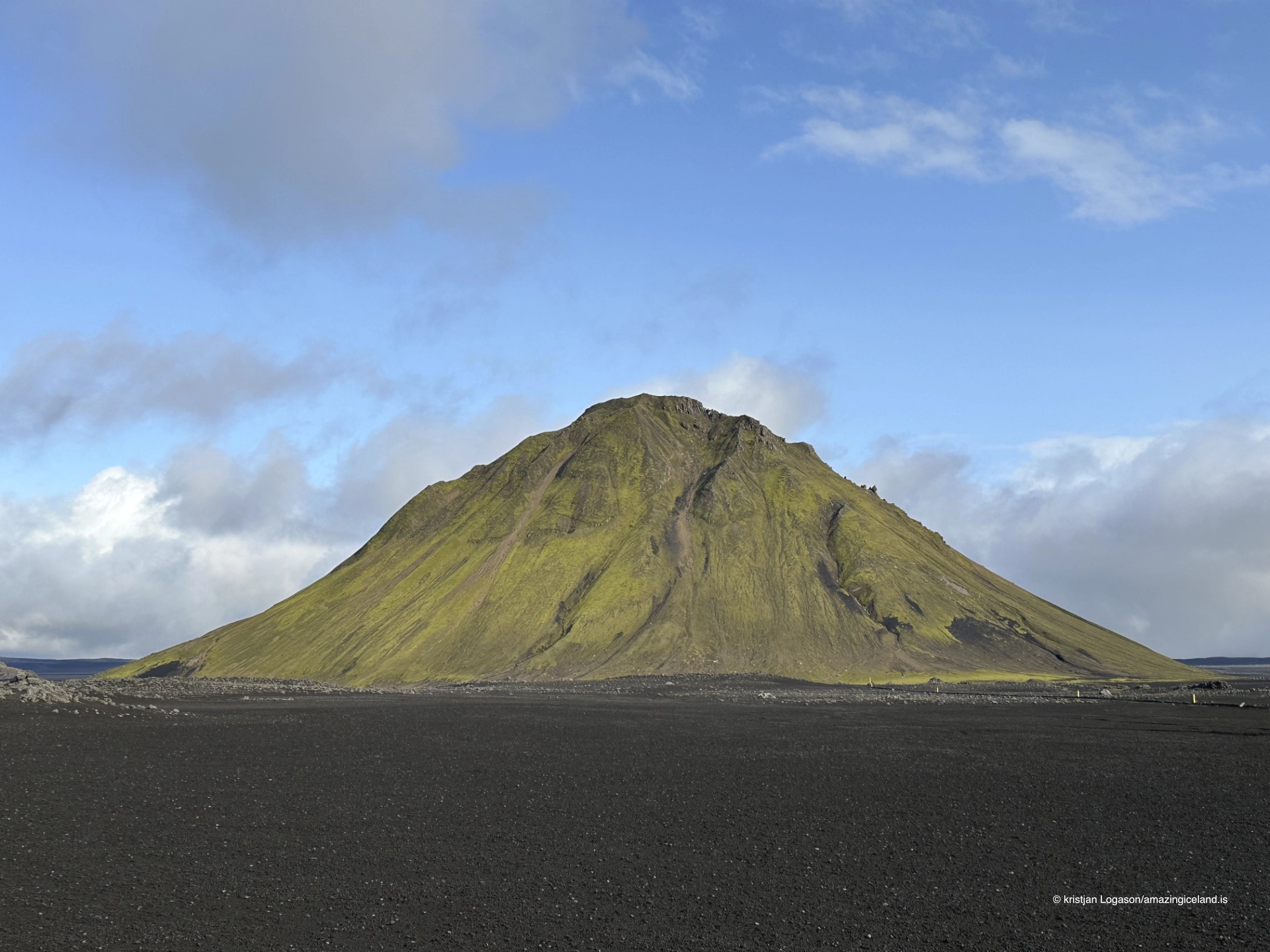
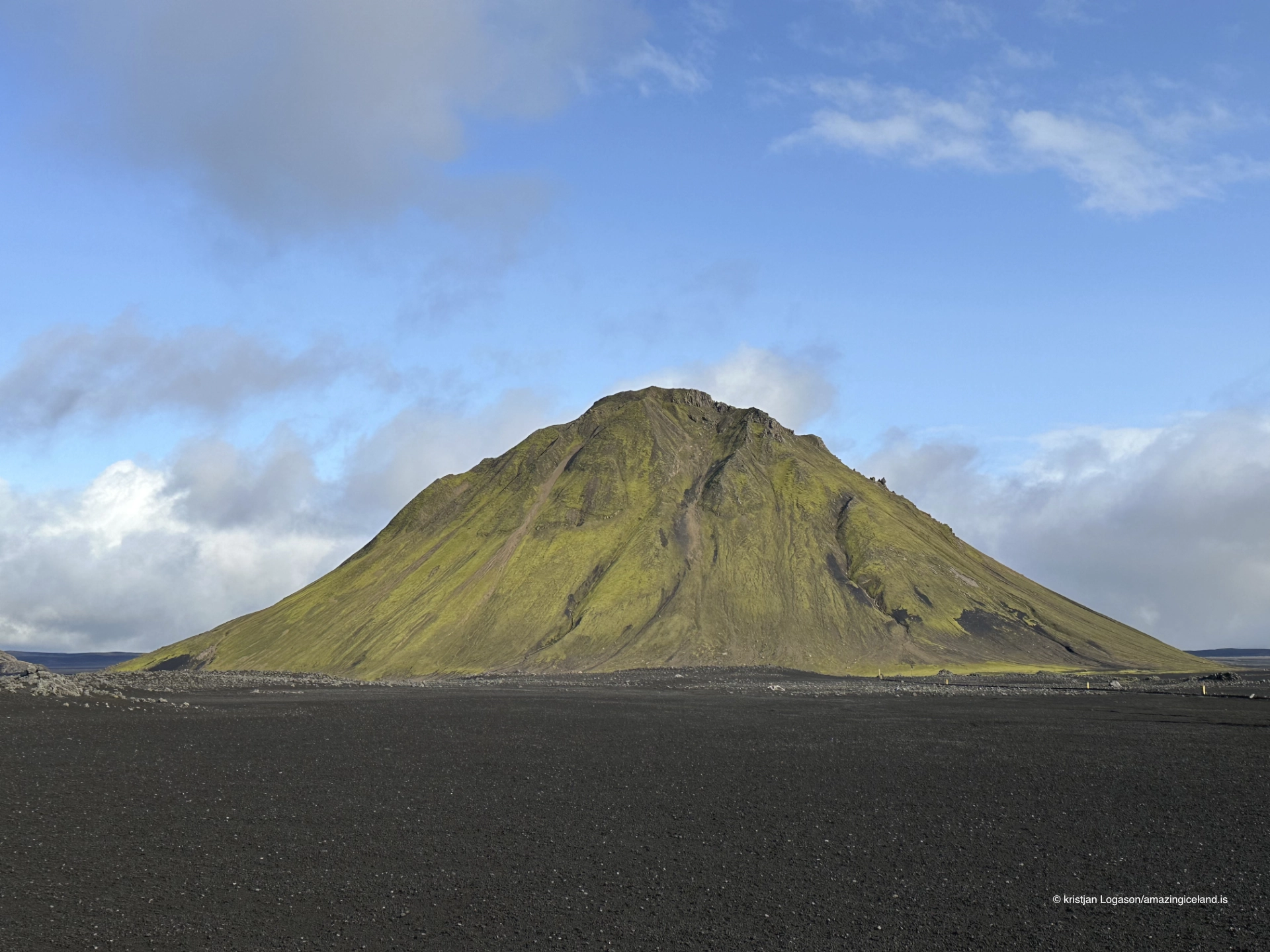
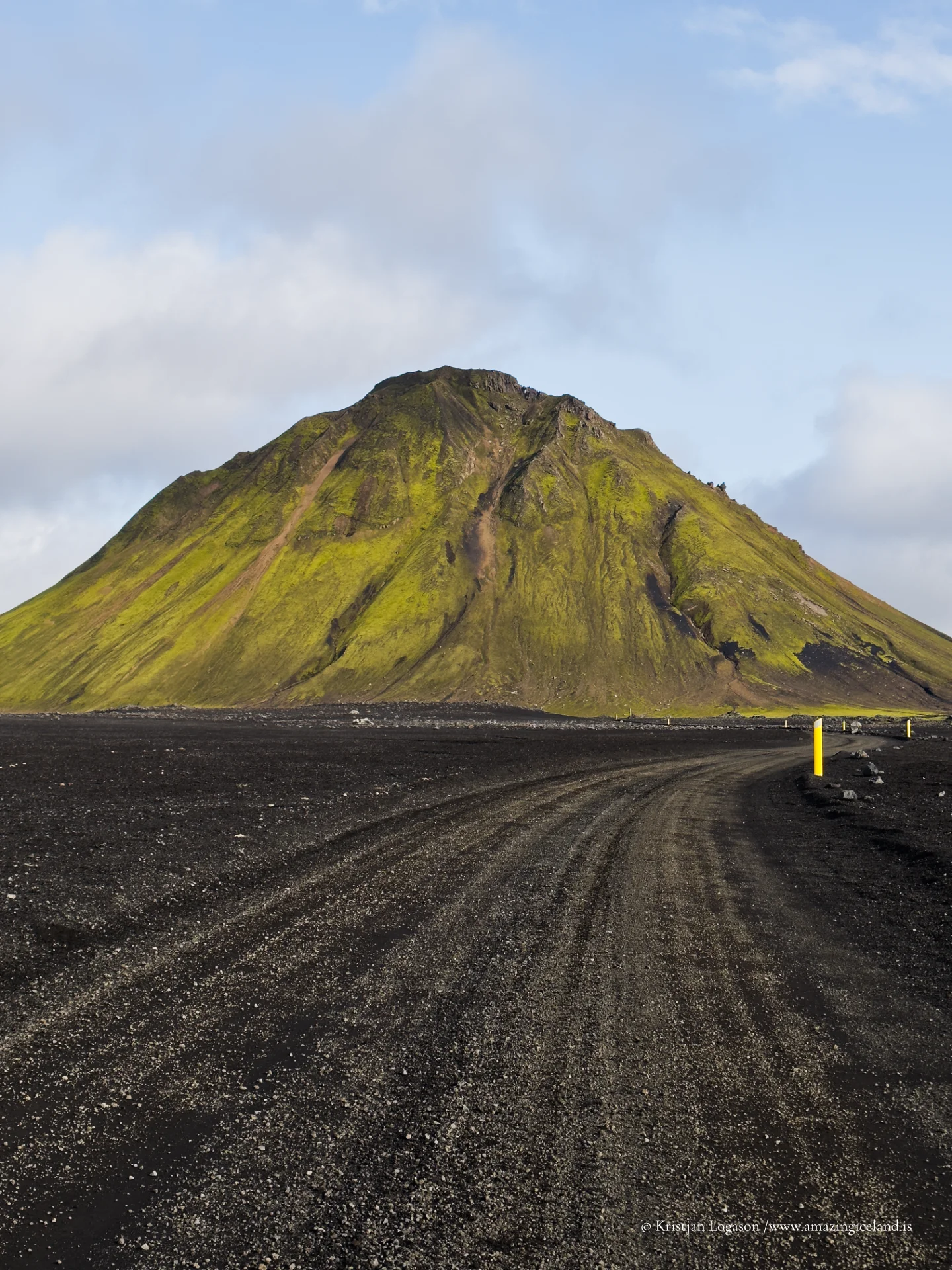
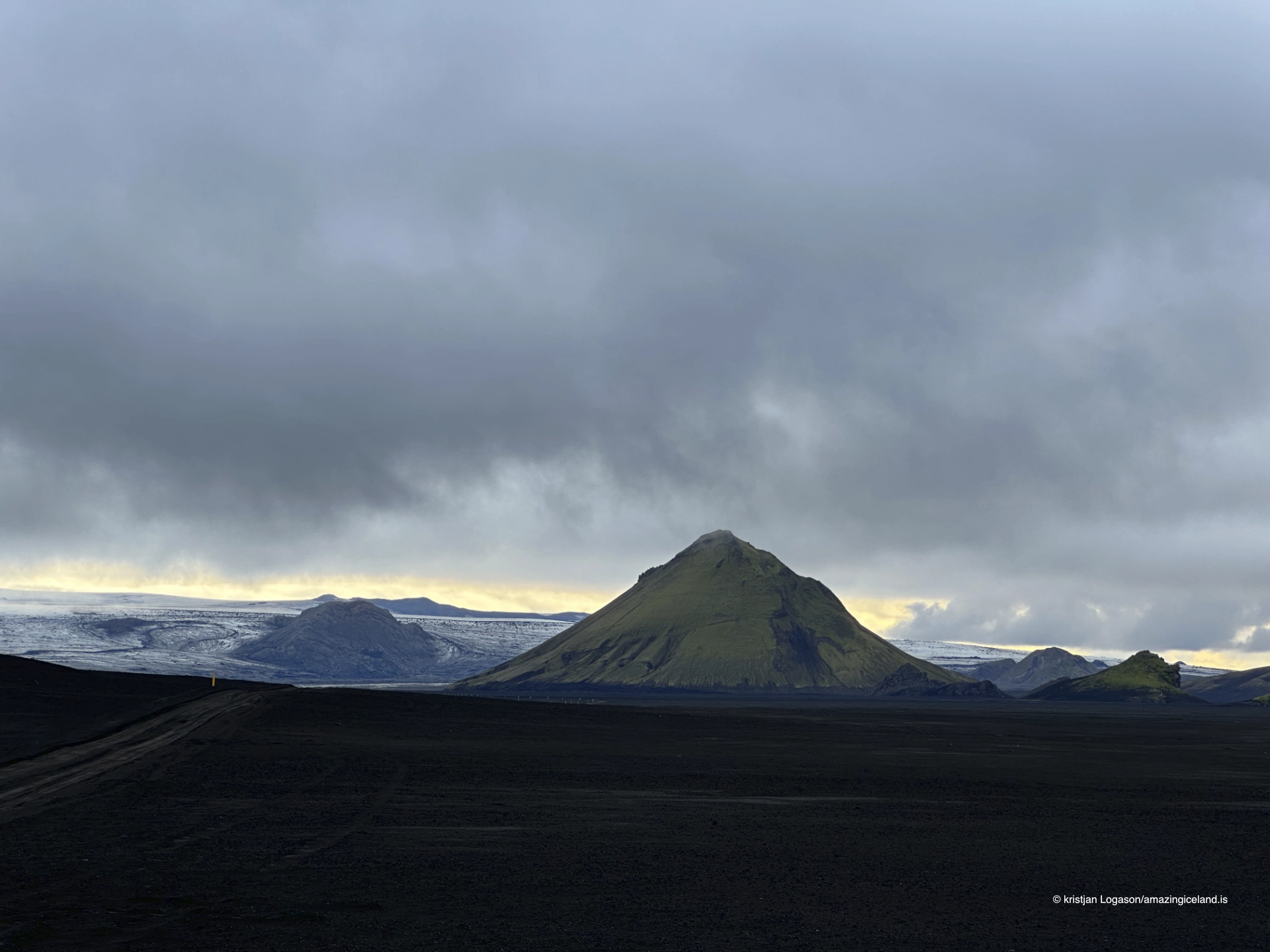
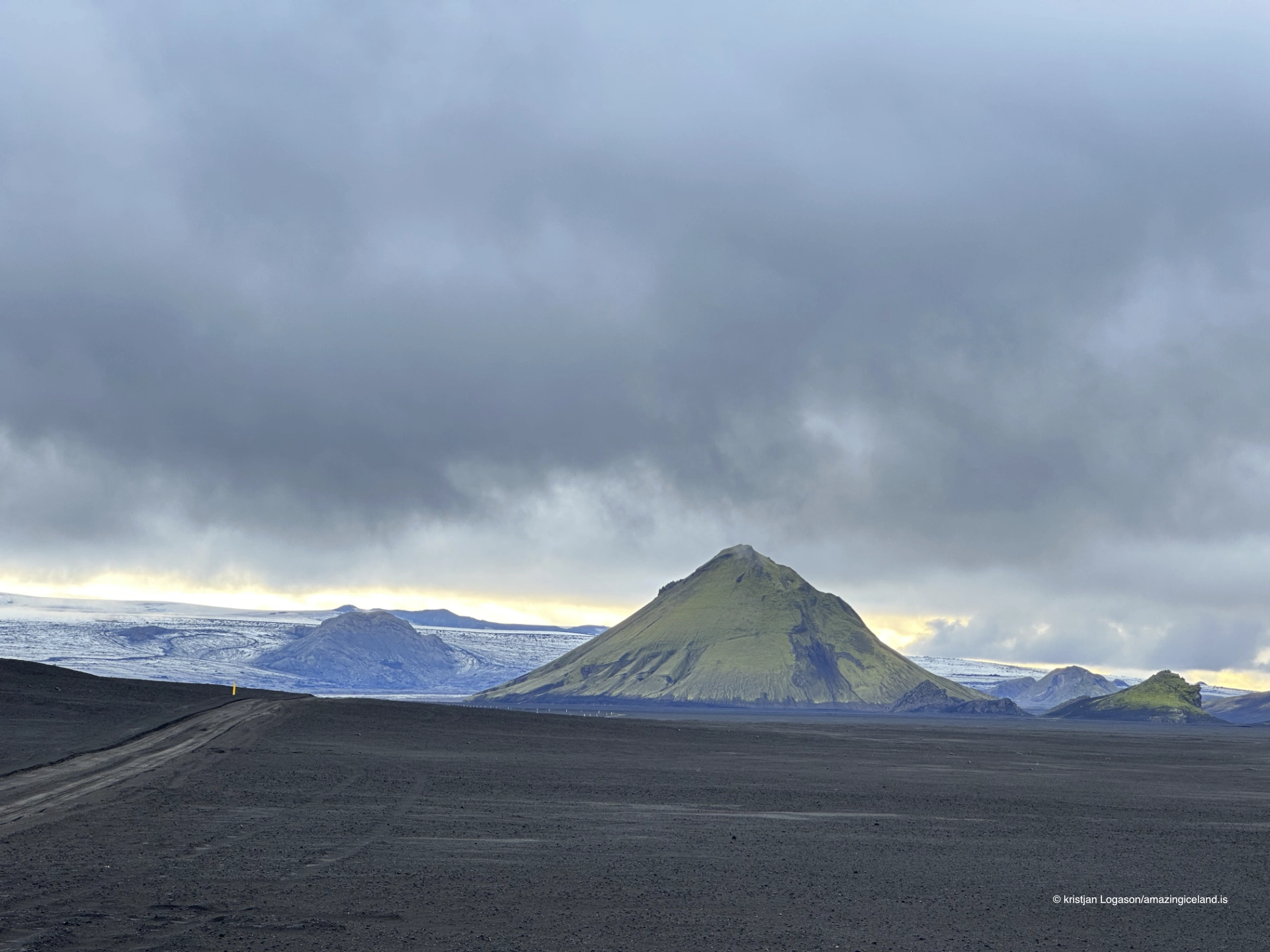
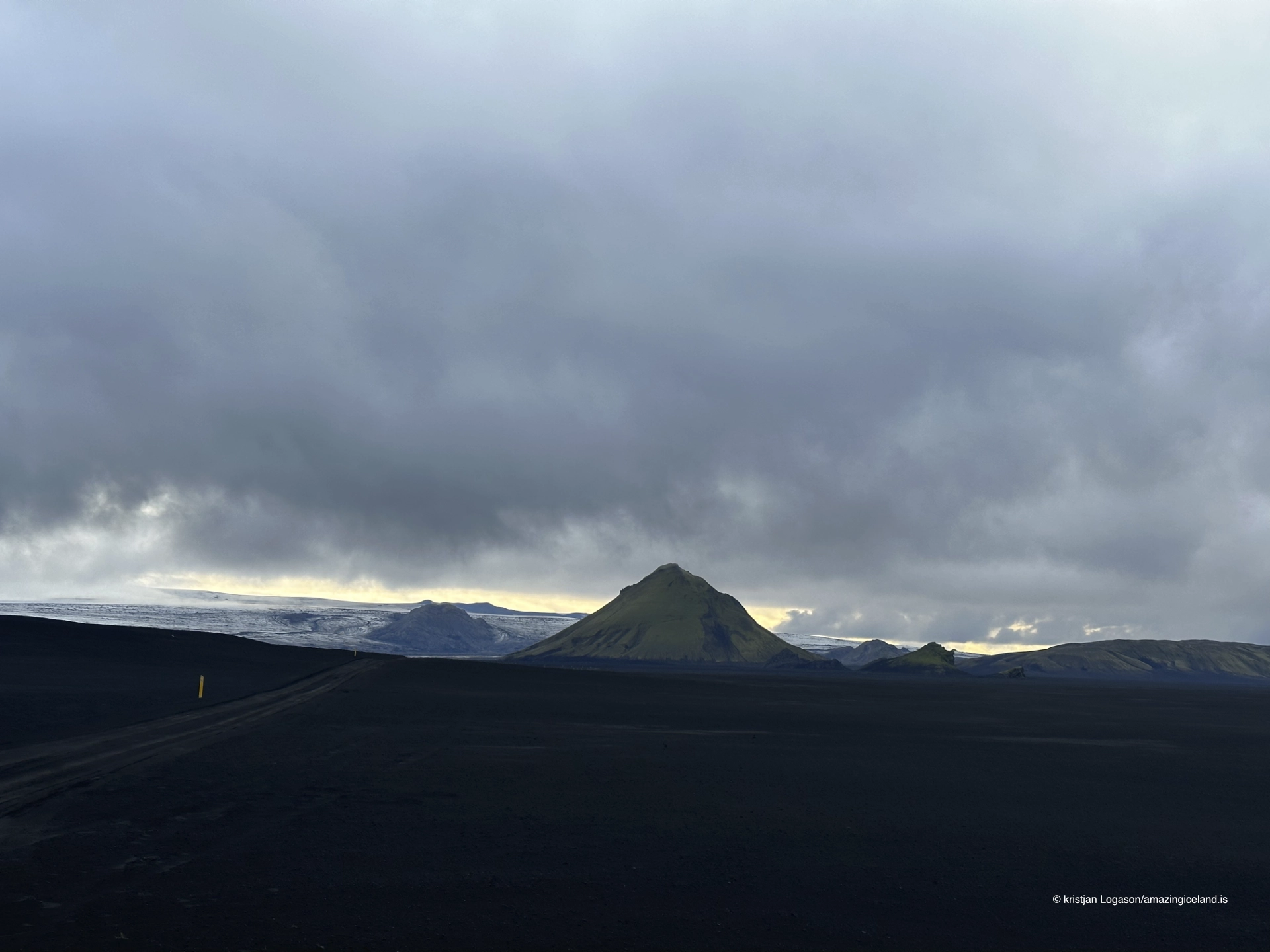
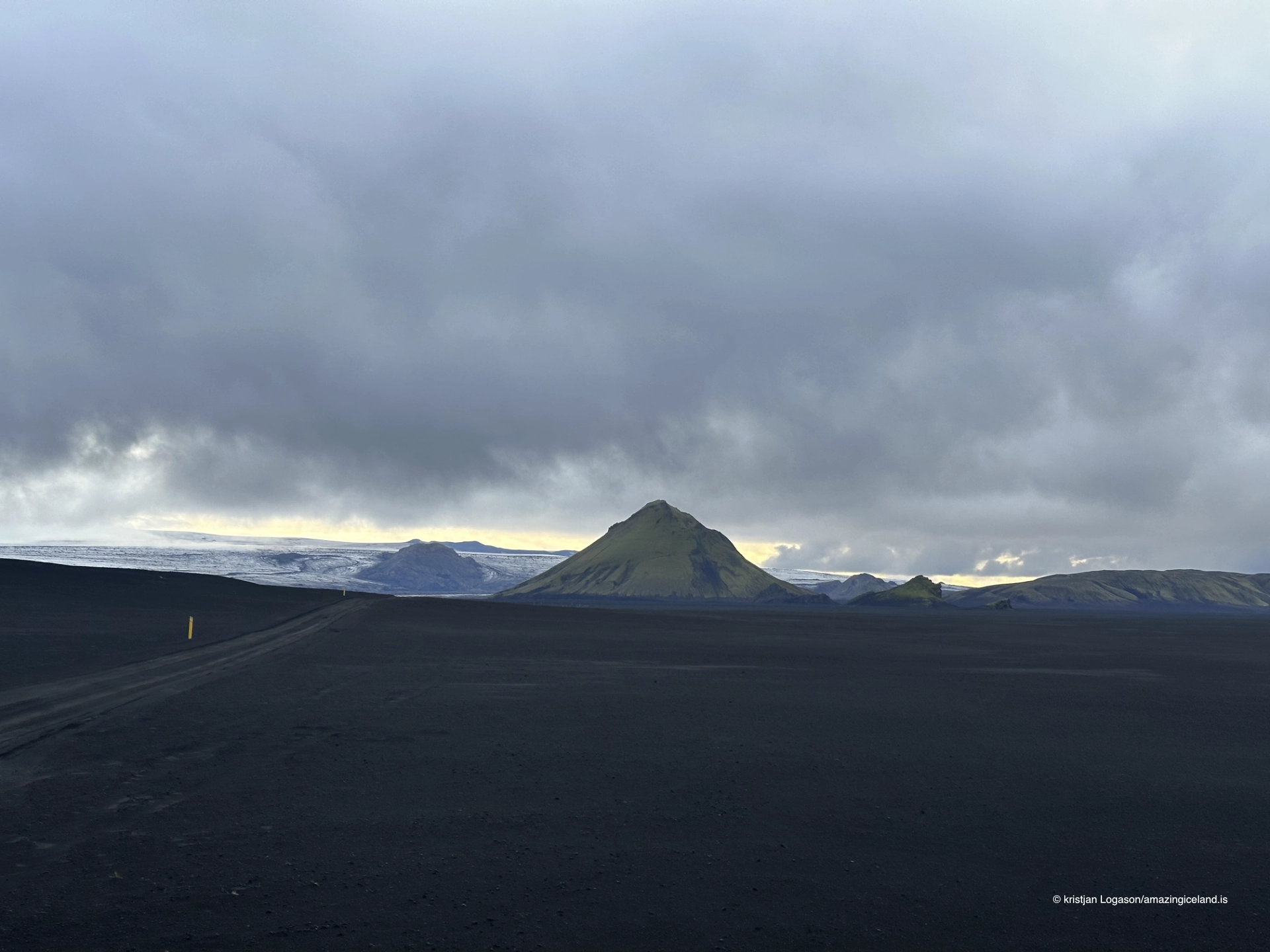
Deep within Iceland’s southern Highlands, Mælifell stands apart—geometrically simple, visually striking, and environmentally uncompromising. Its vivid green slopes contrast sharply with the surrounding black sand plains, revealing a place where volcanic origin, biological colonisation, and isolation intersect. Reaching Mælifell is not incidental; it is an intentional act that places the visitor inside Iceland’s raw interior.
The location of Mt Mælifell volcano on the southern Fjallabak road F210
Latitude
63.8725
Longitude
-18.1736
Mt Mælifell volcano on the southern Fjallabak road F210
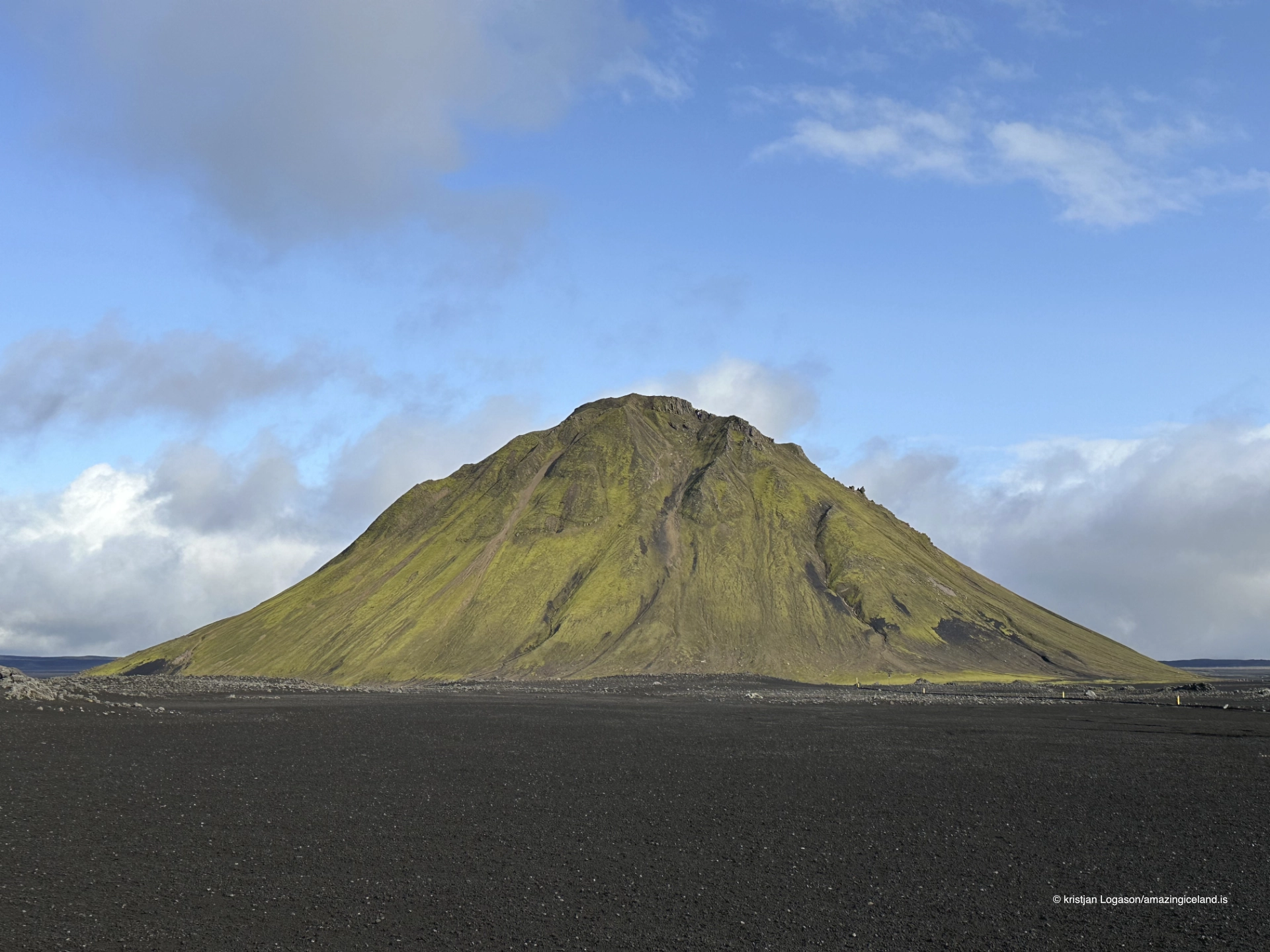
Mælifell is a subglacially formed volcanic cone, located in the southern Highlands between the Mýrdalsjökull and Torfajökull systems. The mountain rises to approximately 764 metres above sea level, presenting a near-perfect cone shape that immediately distinguishes it from the surrounding terrain. Unlike stratovolcanoes formed through prolonged eruptive cycles, Mælifell’s morphology reflects a single or limited eruptive phase, shaped under the influence of ice and later exposed as glaciers retreated.
The most visually defining characteristic of Mælifell is its dense green moss cover, which coats much of the cone. This moss—primarily Racomitrium lanuginosum, common in Iceland’s highland environments—thrives in nutrient-poor volcanic soils but grows extremely slowly. Its presence indicates not fertility, but stability: the absence of frequent disturbance by lava flows, flooding, or human traffic. In academic terms, Mælifell represents a relatively stable volcanic relic within an otherwise highly dynamic geomorphological setting.
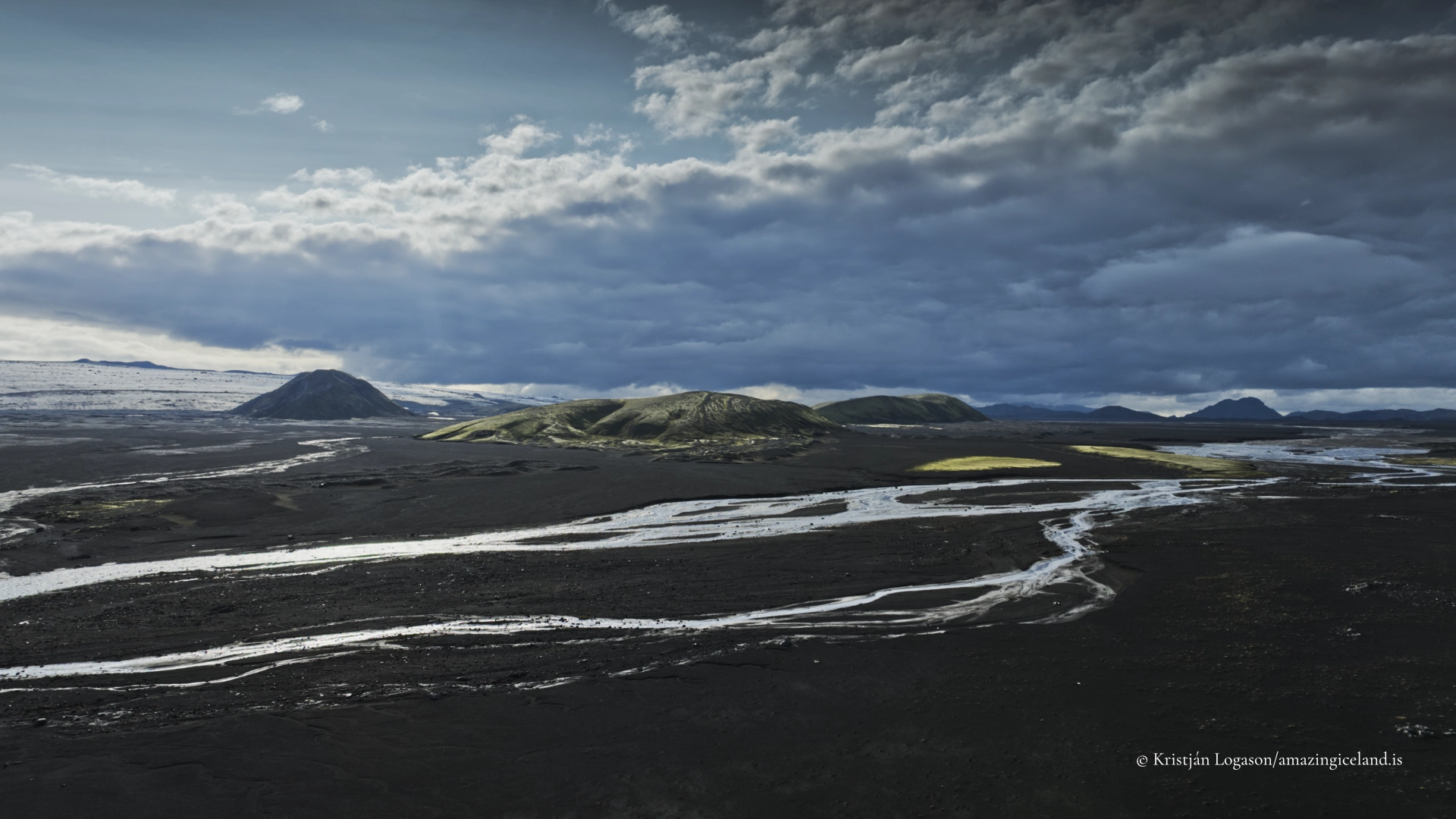
Surrounding the mountain is a vast expanse of black volcanic sand and ash, deposited by past eruptions from nearby volcanic systems, including Katla. This stark substrate absorbs light and heat, intensifying the visual contrast between the moss-covered slopes and the plain below. The effect is not merely aesthetic; it reflects a fundamental ecological gradient—from near-sterile sediment to slow-developing biological cover—compressed into a single, readable scene.
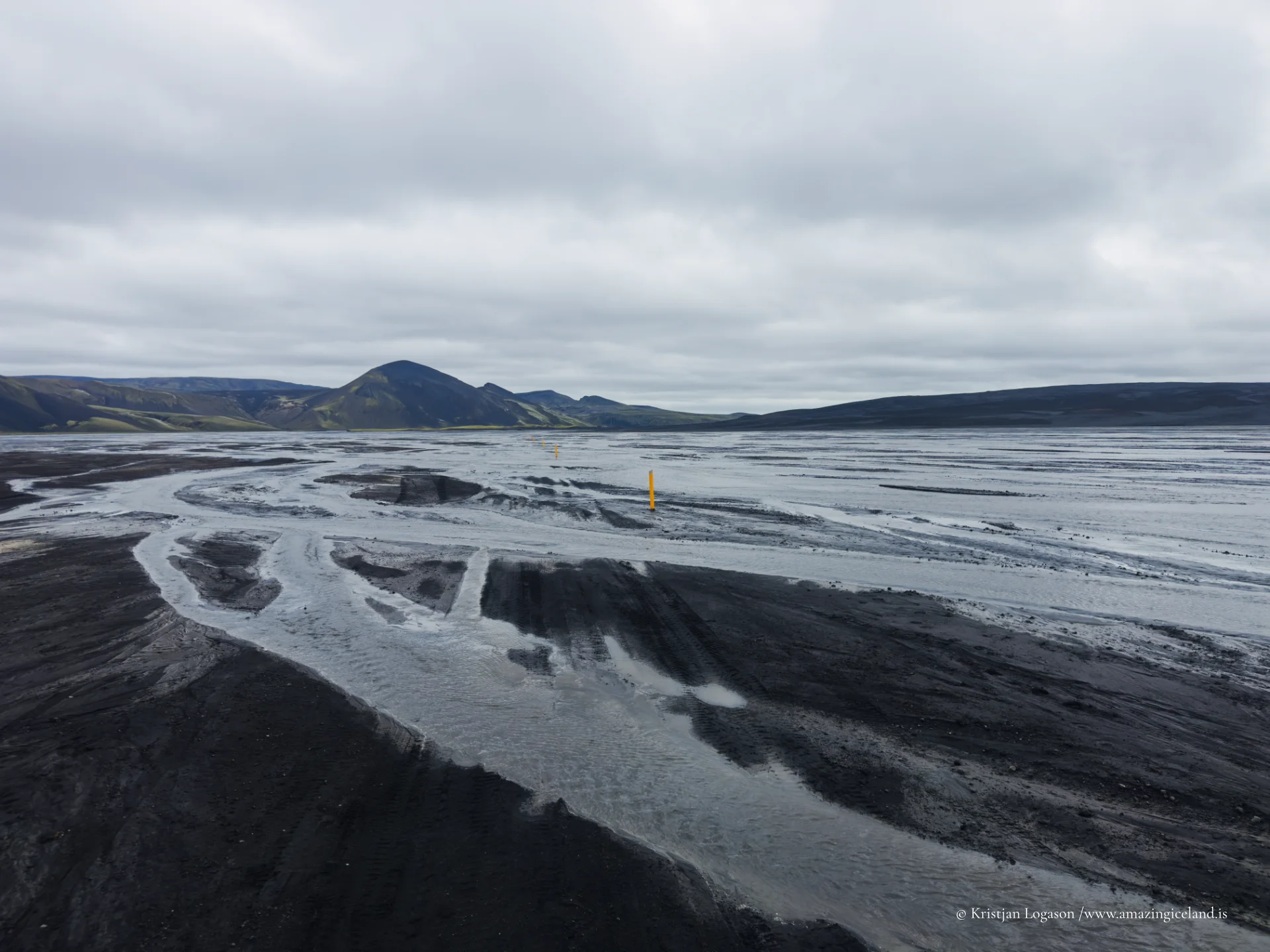
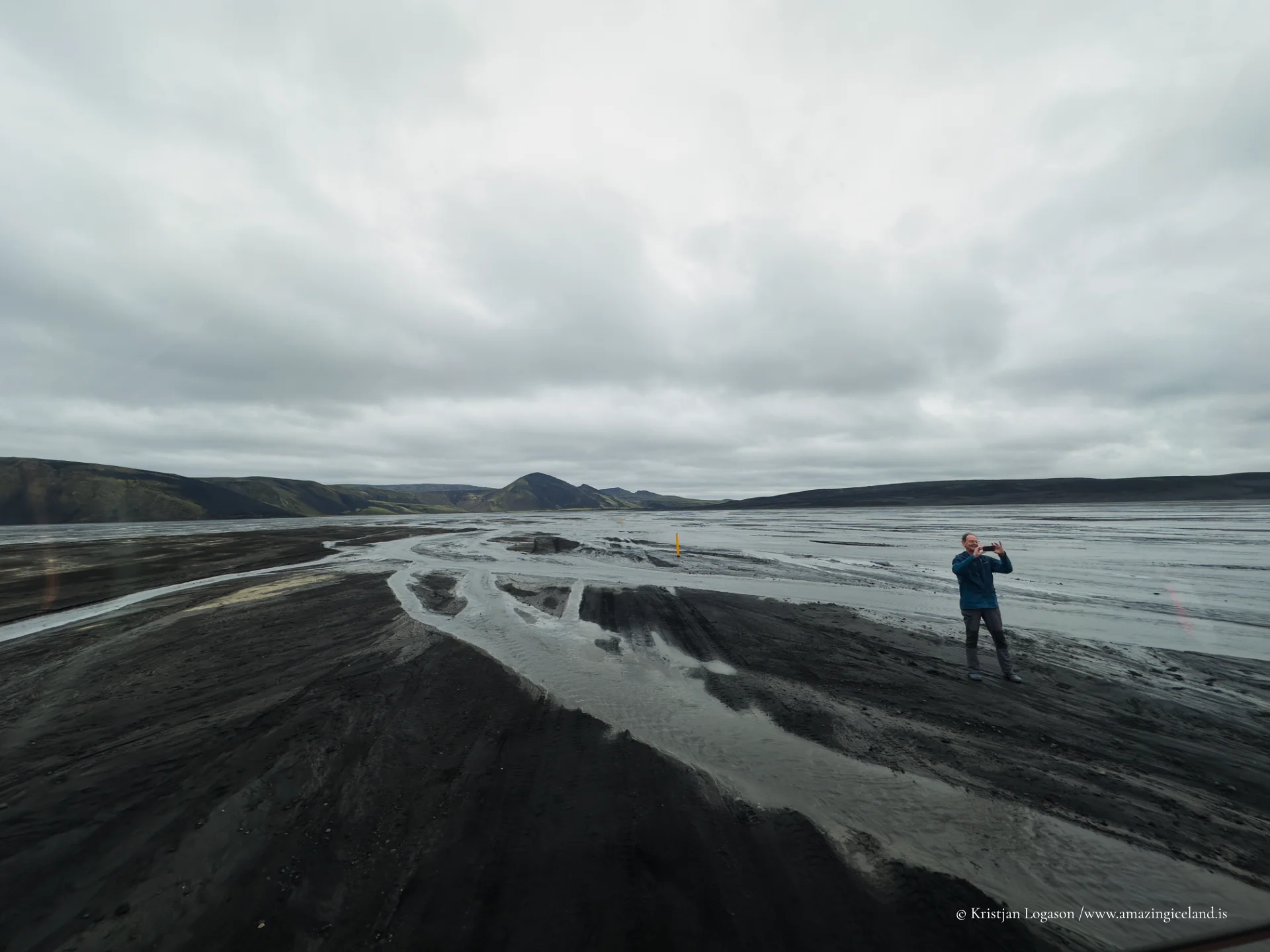
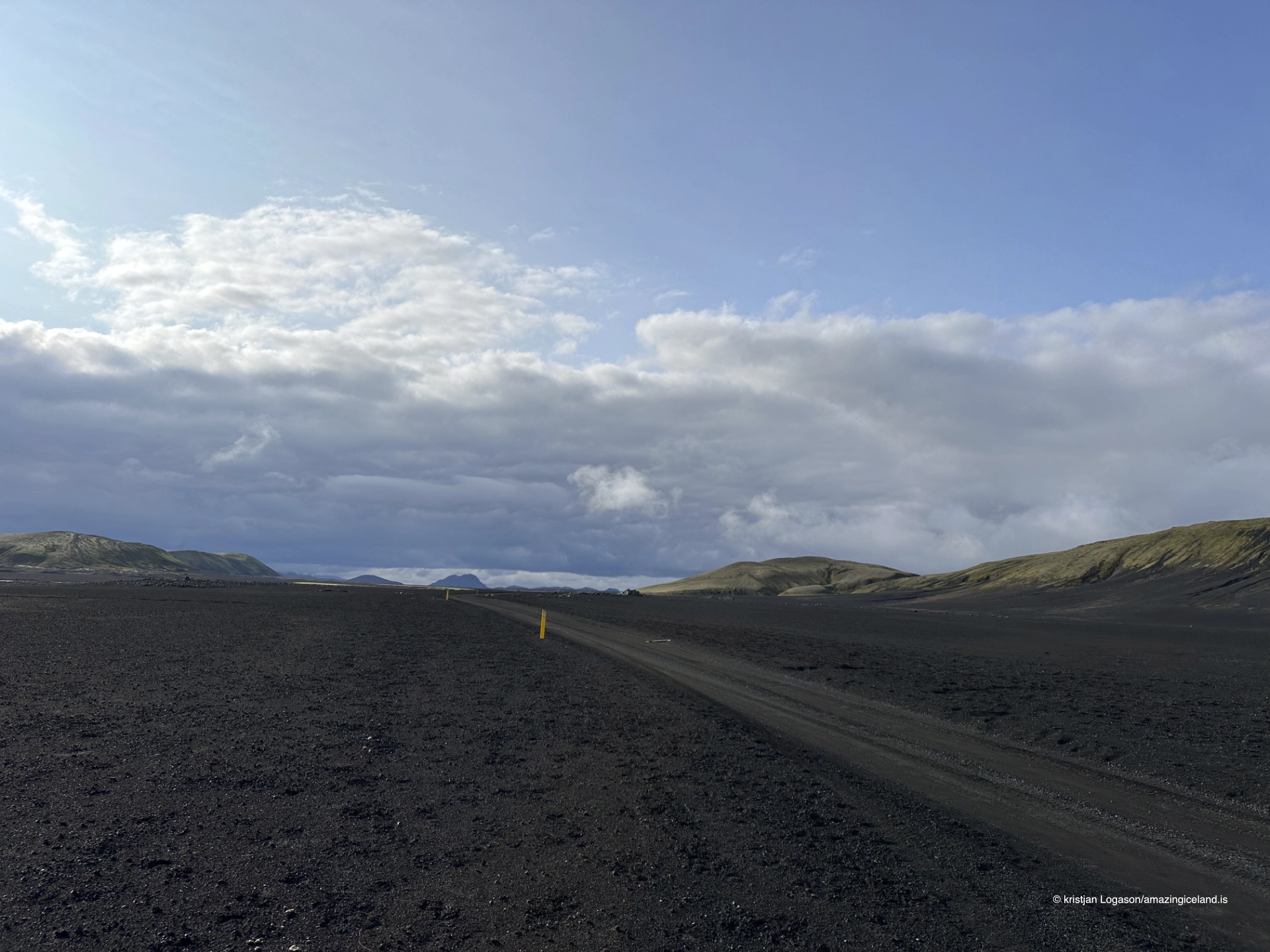
Hydrologically, the area is defined by braided glacial rivers that shift with seasonal melt and rainfall. These rivers make access variable and sometimes hazardous, reinforcing the idea that Mælifell exists on the landscape’s terms, not the visitor’s. There are no constructed viewpoints or barriers here—only distance, exposure, and terrain.
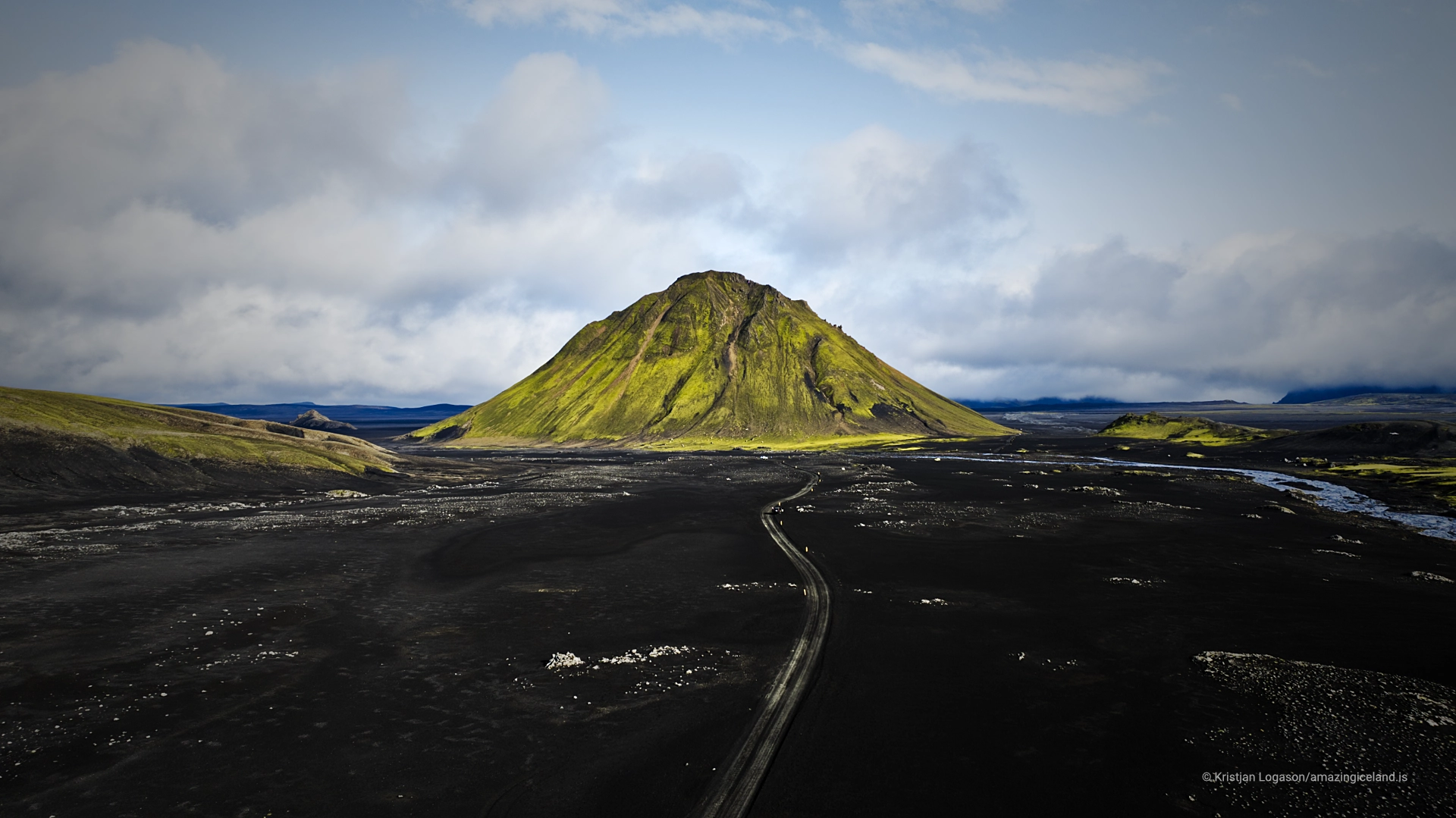
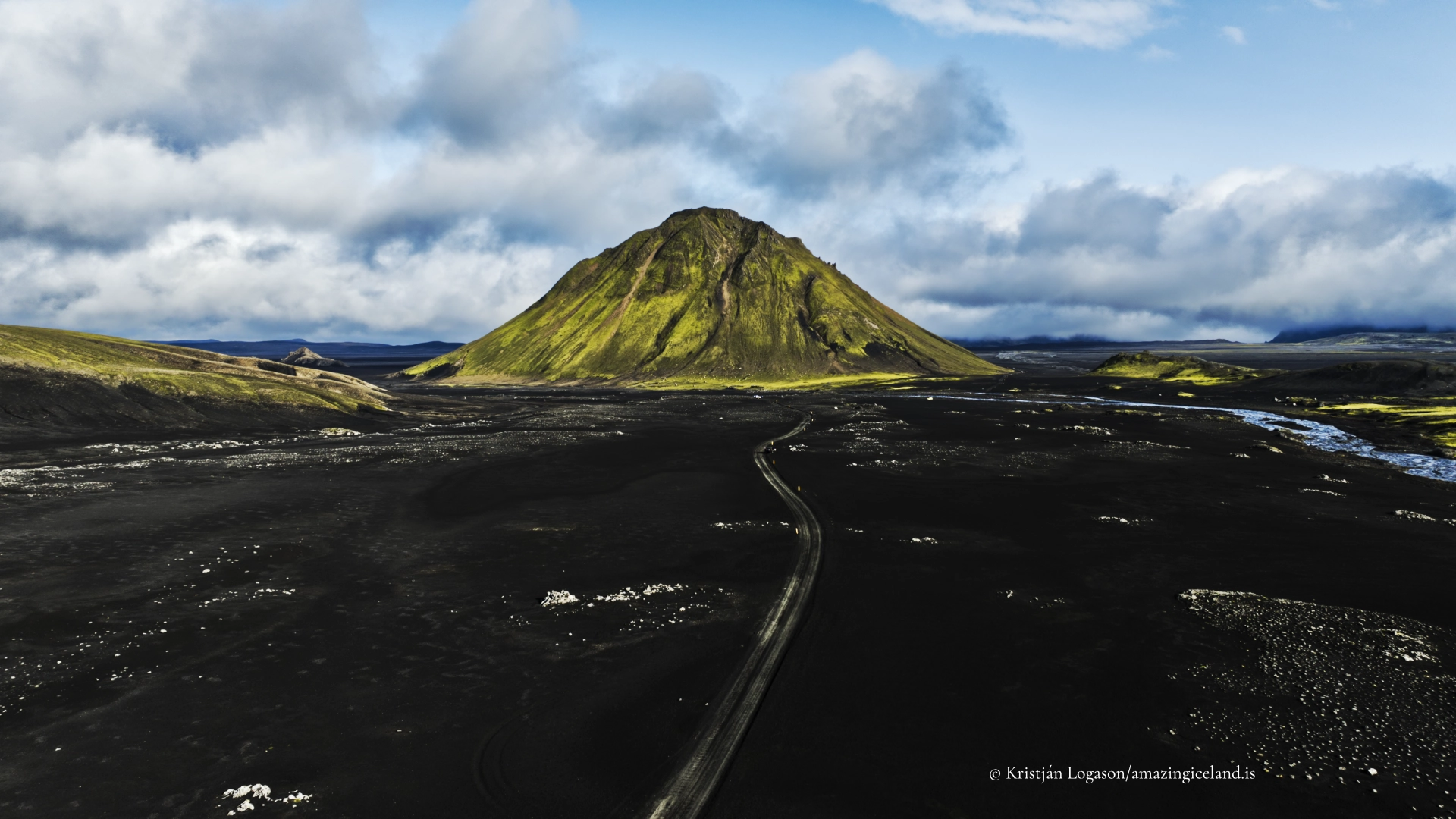
Access to Mælifell is typically via F210 (Fjallabaksleið syðri), one of Iceland’s more demanding highland routes. This is not incidental to the experience. The approach—long stretches of gravel, multiple unbridged river crossings, and changing visibility—functions as a filter, ensuring that presence at Mælifell is deliberate. From a landscape-use perspective, this limitation has helped preserve the mountain’s fragile surface.
Climbing Mælifell itself is strongly discouraged. The moss that gives the mountain its iconic appearance is easily damaged and can take decades to recover from a single footprint. Erosion scars form quickly on steep slopes, particularly where loose volcanic material lies beneath the moss layer. As a result, Mælifell is best understood as a viewed object rather than a summit objective—a shift in mindset that aligns with contemporary conservation ethics in Iceland’s Highlands.
Geologically, Mælifell is part of a broader subglacial volcanic tradition that includes tuyas and hyaloclastite ridges found throughout Iceland. While Mælifell’s exact eruptive history is less prominently documented than some nearby systems, its form suggests eruption beneath ice, where lava interacted with meltwater and fragmented rapidly. This process produces steep-sided, symmetrical landforms once the ice retreats—precisely the geometry that defines Mælifell today.
The mountain’s isolation also contributes to its visual clarity. There are few competing forms nearby, allowing Mælifell to function almost as a reference object within the landscape. For photographers, geologists, and designers alike, this simplicity is powerful: a single form, a limited palette, and an environment that strips away visual noise.
Seasonality governs everything at Mælifell. Access is typically limited to mid-summer, when snow has retreated and rivers are at their most predictable—though never truly stable. Even then, conditions can change rapidly with weather systems moving in from the south. Wind exposure is constant, and cloud cover can transform the scene from stark clarity to total abstraction within minutes.
In clear conditions, Mælifell becomes a lesson in scale and proportion. Vehicles, when visible, are reduced to punctuation marks at the base of the cone, reinforcing the mountain’s dominance. Human presence feels temporary and conditional, a reminder that Iceland’s interior remains governed by natural systems rather than infrastructure.
From a broader interpretive standpoint, Mælifell represents the Highlands in distilled form: volcanic origin, biological restraint, hydrological uncertainty, and access mediated by skill and respect. It is not a destination designed for throughput or convenience, but for intentional observation. The reward is not variety, but coherence.
Mælifell’s popularity in visual media has grown significantly in recent years, yet the site itself remains unchanged—precisely because it resists development. There are no signs, no platforms, no services. What exists is the mountain, the sand, the rivers, and the sky. Understanding Mælifell, therefore, is less about arrival and more about recognising when to stop, where to stand, and what not to disturb.
In that sense, Mælifell is not only a geological feature but a boundary marker—between accessibility and remoteness, between spectacle and restraint. It is Iceland’s Highlands speaking clearly, without translation.
Interesting facts:
- Mælifell is a single volcanic cone, rising approximately 764 m above sea level.
- The mountain is covered in slow-growing moss, highly vulnerable to erosion and foot traffic.
- It is surrounded by black sand plains formed by volcanic ash and glacial outwash.
- Access is typically via F210, requiring a high-clearance 4×4 and river crossings.
- The mountain is often confused with Mælifellshnjúkur, a separate peak in North Iceland.
Image Gallery
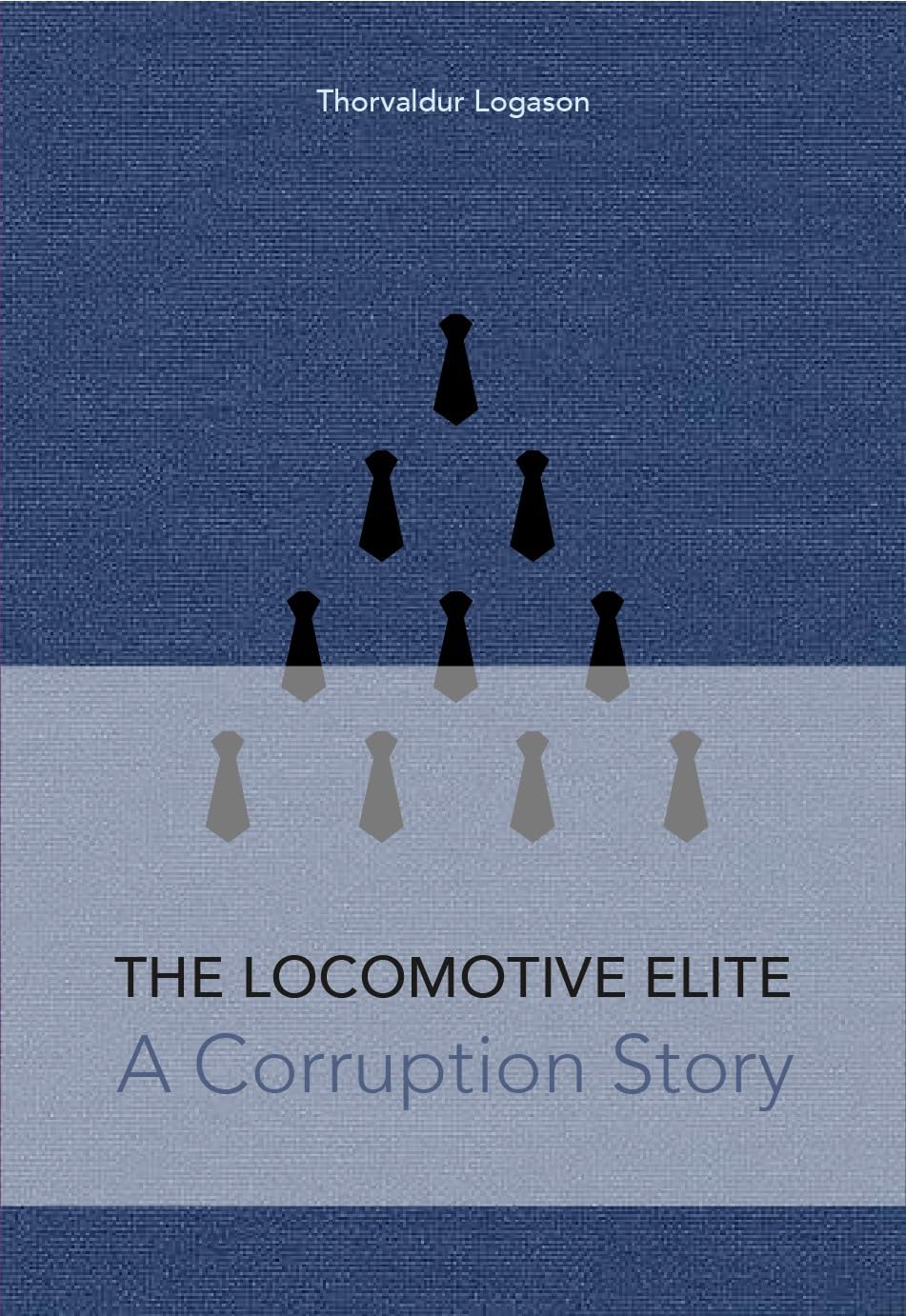
The Locomotive Elite
What do Donald Trump and Iceland’s Locomotive Elite have in common?
Far more than you think.
In The Locomotive Elite, you’ll uncover how a tiny clique in Iceland captured extensive control—of banks, courts, media, and even the central bank.
For decades they ruled, first democratically, then through corruption and in the end through crime, enriching themselves and their cronies while dismantling oversight.
The result?
One of the most spectacular financial collapses in modern history.
Photography tips:
- Distance over proximity: Photograph Mælifell from a respectful distance to preserve moss and composition.
- Use scale deliberately: Include vehicles or river braids sparingly to communicate size.
- Overcast advantage: Soft light enhances the green–black contrast and reduces harsh highlights on sand.
- Aerial discipline: If using drones where permitted, maintain altitude and avoid repeated passes that disturb wildlife or visitors.
- Minimal palettes: Lean into simplicity—green, black, grey, and sky are sufficient.
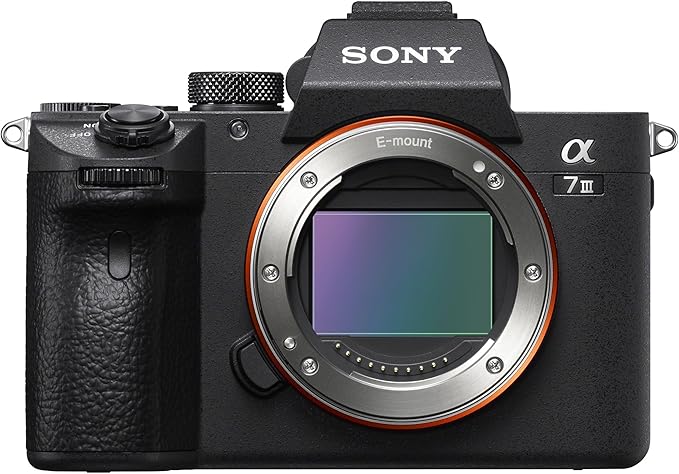
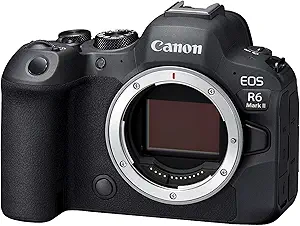
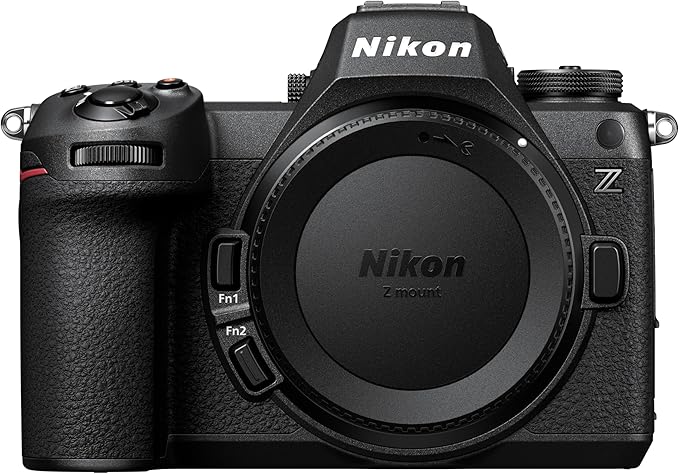
Good cameras for Iceland
Sony A7R V

Sony A7s lll
Canon R6
Nikon Z6 lll
Destinations nearby
Good to have in Iceland