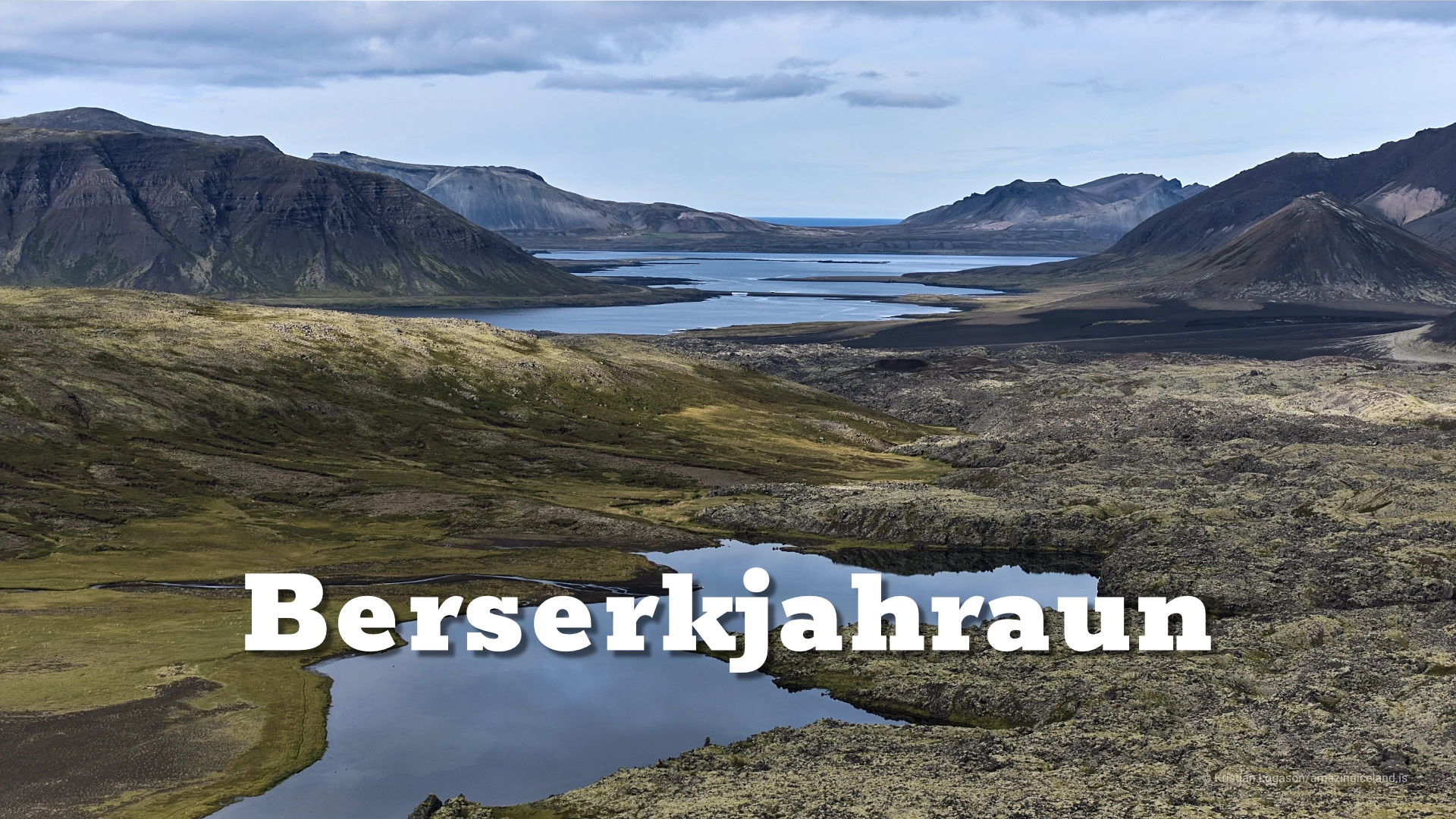
Berserkjahraun lava field in Snæfellsnes Iceland
Berserkjahraun lies in Helgafellssveit on the northern side of the Snæfellsnes Peninsula. The lava field is around **4,000 years old** and was formed by eruptions from **four scoria craters on Bjarnarhafnarfjall**.
Lava spread across the landscape towards Hraunsfjörður and Hraunsvík, leaving behind a rough field of dark broken lava that is still easy to recognise today.
But Berserkjahraun is known for more than geology. Its name comes from _Eyrbyggja saga_, which tells the story of the Swedish berserkers **Halli and Leiknir**, the extraordinary work they carried out in the lava and the betrayal that ended with both men buried beside the road they had built.
Here, the saga is unusually closely tied to the physical landscape. The road, wall and traditional burial place give the story a geographical setting that can still be traced.
The location of Berserkjahraun lava field in Snæfellsnes Iceland
Latitude
64.9629
Longitude
-22.9671
Berserkjahraun lava field in Snæfellsnes Iceland
A 4,000-year-old lava field
Berserkjahraun was formed about 4,000 years ago by eruptions from four scoria craters on the slopes of Bjarnarhafnarfjall. The eruptions took place in relatively short succession, producing lava flows that spread across Helgafellssveit towards Hraunsfjörður and Hraunsvík.
The field extends eastwards in the direction of Stykkishólmur, but not as far as Grundarfjörður. Much of Berserkjahraun consists of rough apalhraun, with broken, jagged surfaces rather than smooth lava.
Different parts of the field show clear changes in colour, texture and vegetation, while the four source craters remain important landmarks above the lava.
Route 558, Berserkjahraunsvegur, passes through the field and makes it possible to experience the lava from close range rather than viewing it only from Route 54.
Halli and Leiknir
According to Eyrbyggja saga, Vermundur brought two Swedish berserkers, Halli and Leiknir, to Iceland. They later entered the service of Vermundur’s brother, Víga-Styr, who lived at Hraun.
Halli fell in love with Styr’s daughter, Ásdís, and asked to marry her. Styr did not refuse outright.
Instead, he set the two brothers a series of demanding tasks. They were to build a road through the difficult lava between the farms, construct a boundary wall across the field and build a sheep enclosure.
If they completed the work, Halli was to be allowed to marry Ásdís.
The bargain gave the brothers a reason to undertake work that would have been exceptionally difficult with the tools available at the time. According to the saga, they nevertheless completed it with remarkable speed.

The road through Berserkjahraun
The most important part of the brothers’ work was the road through the lava, later known as Berserkjagata.
Even a simple route across a field as rough as Berserkjahraun would have required enormous effort. The lava had to be cleared and levelled sufficiently to allow people and animals to pass through it.
The saga also tells of a boundary wall constructed across the lava between properties and a sheep enclosure built as part of the agreement.
Berserkjagata can still be traced today. The road and associated archaeological remains matter because they connect the saga directly with the physical landscape.
This is not simply a story attached to Berserkjahraun centuries later. Features traditionally associated with the episode survive in the same lava field where the saga places the events.
Víga-Styr’s betrayal
Completing the work did not save Halli and Leiknir. While the brothers were labouring in the lava, Víga-Styr prepared a trap.
According to the saga, a sunken bathhouse was heated until the temperature became unbearable. When Halli and Leiknir were invited to bathe, they eventually attempted to escape.
Halli broke out first. Outside, Styr had placed a wet ox hide on the ground. Halli slipped on it, and Styr killed him.
Leiknir then tried to escape and was also killed.
According to the saga, their bodies were carried into Berserkjahraun and buried in a deep hollow close to the road they had built.
The burial place traditionally associated with Halli and Leiknir can still be found in the lava.
That physical connection gives the story particular weight. The saga is not confined to a text; the road, wall and grave are tied to identifiable places within the landscape.
Visiting Berserkjahraun
Berserkjahraun is crossed by Route 558, Berserkjahraunsvegur, a gravel road that loops through the lava and connects back with Route 54.
In normal conditions, the road is suitable for an ordinary car. The land is privately owned, but access through the area is straightforward.
The most interesting features are the lava itself, the four source craters, Berserkjagata and the archaeological remains traditionally linked with the saga.
Much of the lava is rough and awkward to cross on foot, so existing tracks and paths are preferable wherever possible. Archaeological features should be treated as remains rather than as objects to climb on, move or rearrange.
The value of Berserkjahraun lies in reading the landscape as a whole. Geology explains how the lava came to be there, while Eyrbyggja saga explains why people have remembered particular routes, walls and hollows within it for centuries.
Interesting facts:
- Berserkjahraun is approximately 4,000 years old.
- The field was formed by four scoria craters on Bjarnarhafnarfjall.
- Lava flowed towards Hraunsfjörður and Hraunsvík.
- Much of the field consists of rough apalhraun.
- The name Berserkjahraun comes from the story of Halli and Leiknir in Eyrbyggja saga.
- The brothers are said to have built Berserkjagata, a road through the lava.
- They were also ordered to build a boundary wall and sheep enclosure.
- According to the saga, Víga-Styr killed both brothers after they completed the work.
- Their traditional burial place can still be found beside the road.
- Route 558 crosses the lava field.
Image Gallery


Photography tips:
- Include the four craters on Bjarnarhafnarfjall where possible, especially from viewpoints that make their relationship to the lava flows clear.
- Aerial photography is particularly useful because it reveals the structure of the field, differences between lava flows and the line of Route 558 more clearly than ground-level views.
- At ground level, look for changes in texture, moss and colour rather than treating the lava as one uniform black surface.
- Berserkjagata and the traditional grave site are strong photographic subjects because they connect the saga directly to the landscape.
- Low-angle light works particularly well on rough apalhraun, where longer shadows reveal the broken surface.
- Wider lenses are useful for showing the relationship between craters and lava, while longer focal lengths can compress the landscape and isolate individual ridges or sections of the old road.
- Avoid walking unnecessarily across moss-covered lava for a better viewpoint. Existing tracks usually provide enough variation without damaging the surface.
Destinations nearby